

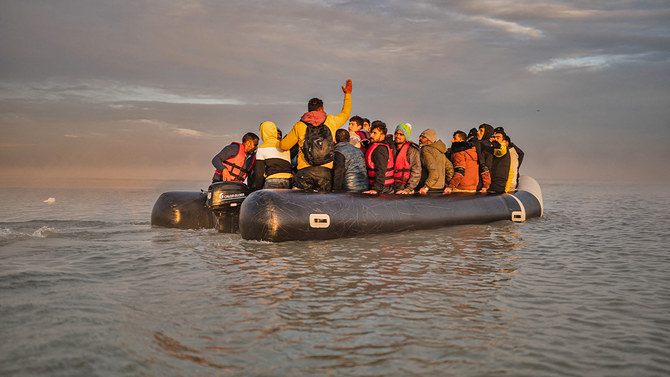
French authorities rescue 61 migrants including Pakistanis in English Channel

Migrants sail after boarding a smuggler's boat on the beach of Gravelines, near Dunkirk, northern France on October 12, 2022, in an attempt to cross the English Channel. (AFP/File)
Short Url
Updated 30 November 2022
Follow

French authorities rescue 61 migrants including Pakistanis in English Channel

  • This was one of the largest emergency operations in recent months 
  • Afghan, Indian, Iranian and Pakistani nationals were aboard the dinghy

BOULOGNE, France: French authorities rescued 61 migrants including small children in the English Channel on Tuesday in one of the largest emergency operations in recent months as calm seas drew a rush of migrants in small boats toward the coast of Britain.

Rescue workers in the port of Boulogne, where the migrants were brought ashore, said about 30 people had to be plucked out of the cold waters as they rushed to climb aboard a French rescue vessel from their rubber dinghy, which had been taking on water.

Officials said the rescue took place about one nautical mile inside British territorial waters.

Afghan, Indian, Iranian and Pakistani nationals were aboard the dinghy, which left the French coast in the small hours of the morning, the refugees said.

At the quayside, the migrants were handed fresh clothing and heat-retaining blankets by emergency workers.

French police earlier on Tuesday had stopped close to 50 migrants from trying to cross the Channel to Britain after mild weather and calm waters led a growing number of people to undertake the dangerous journey in recent days.

Guy Allemand, mayor of the small village of Sangatte near Calais, said some migrants had been forced by police to turn back, but that another 100 had made it to the open waters.

He told Reuters that migrant trafficking networks had recently changed their methods.

“They [traffickers] now arrive with ‘taxi boats’ and the refugees are being asked to run into the water to catch them ... rather than launching their own boats from the beach,” he said.

So far this year more than 40,000 people have crossed the Channel to Britain in small boats, up from 28,526 in 2021. Unusually mild November weather led to a hike in departures.

Earlier this month, Britain and France signed an agreement worth 72.2 million euros ($74.5 million) over the coming year to ramp up joint efforts to prevent illegal migrants making perilous journeys across the Channel.


Olympic town warms up as climate change puts Winter Games on thin ice

Updated 3 sec ago
Follow

Olympic town warms up as climate change puts Winter Games on thin ice

CORTINA D’AMPEZZO: Olympic fans came to Cortina with heavy winter coats and gloves. Those coats were unzipped Sunday and gloves pocketed as snow melted from rooftops — signs of a warming world.
“I definitely thought we’d be wearing all the layers,” said Jay Tucker, who came from Virginia to cheer on Team USA and bought hand warmers and heated socks in preparation. “I don’t even have gloves on.”
The timing of winter, the amount of snowfall and temperatures are all less reliable and less predictable because Earth is warming at a record rate, said Shel Winkley, a Climate Central meteorologist. This poses a growing and significant challenge for organizers of winter sports; The International Olympic Committee said last week it could move up the start date for future Winter Games to January from February because of rising temperatures.
While the beginning of the 2026 Olympic Winter Games in Cortina truly had a wintry feel, as the town was blanketed in heavy snow. The temperature reached about 40 degrees Fahrenheit (4.5 degrees Celsius) Sunday afternoon. It felt hotter in the sun.
This type of February “warmth” for Cortina is made at least three times more likely due to climate change, Winkley said. In the 70 years since Cortina first held the Winter Games, February temperatures there have climbed 6.4 degrees Fahrenheit (3.6 degrees Celsius), he added.
Coping with varying climates across host cities
For the Milan Cortina Games, there’s an added layer of complexity. It’s the most spread-out Winter Games in history, so Olympic venues are in localities with very different weather conditions. Bormio and Livigno, for example, are less than an hour apart by car, but they are separated by a high mountain pass that can divide the two places climatically.
The organizing committee is working closely with four regional and provincial public weather agencies. It has positioned weather sensors at strategic points for the competitions, including close to the ski jumping ramps, along the Alpine skiing tracks and at the biathlon shooting range.
Where automatic stations cannot collect everything of interest, the committee has observers — “scientists of the snow”— from the agencies ready to collect data, according to Matteo Pasotti, a weather specialist for the organizing committee.
The hope? Clear skies, light winds and low temperatures on race days to ensure good visibility and preserve the snow layer.
The reality: “It’s actually pretty warm out. We expected it to be a lot colder,” said Karli Poliziani, an American who lives in Milan. Poliziani was in Cortina with her father, who considered going out Sunday in just a sweatshirt.
And forecasts indicate that more days with above-average temperatures lie ahead for the Olympic competitions, Pasotti said.
Weather can affect competition
Weather plays a critical role in the smooth running and safety of winter sports competitions, according to Filippo Bazzanella, head of sport services and planning for the organizing committee. High temperatures can impact the snow layer on Alpine skiing courses and visibility is essential. Humidity and high temperatures can affect the quality of the ice at indoor arenas and sliding centers, too.
Visibility and wind are the two factors most likely to cause changes to the competition schedule, Bazzanella added. Wind can be a safety issue or a fairness one, such as in the biathlon where slight variations can disrupt the athletes’ precise shooting.
American alpine skier Jackie Wiles said many races this year have been challenging because of the weather.
“I feel like we’re pretty good about keeping our heads in the game because a lot of people are going to get taken out by that immediately,” she said at a team press conference last week. “Having that mindset of: it’s going to be what it’s going to be, and we still have to go out there and fight like hell regardless.”