

Pakistan among nations contributing highest footfall at Abu Dhabi airports in Q3 2022

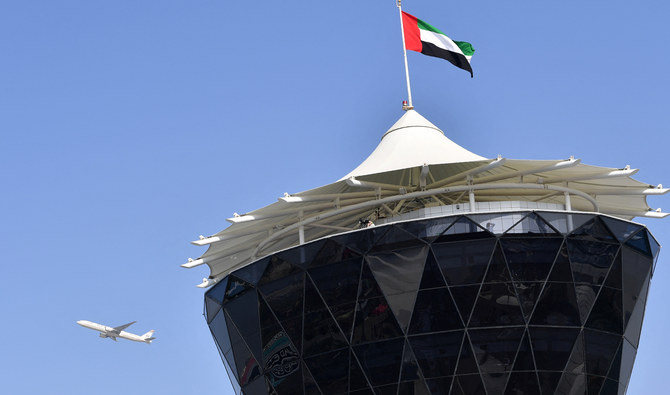
An Etihad Airways plane flies over the main control tower at the Yas Marina circuit ahead of the start of the Abu Dhabi Formula One Grand Prix on November 27, 2016. (Photo courtesy: AFP/File)
Short Url
Updated 29 November 2022
Follow

Pakistan among nations contributing highest footfall at Abu Dhabi airports in Q3 2022

  • Abu Dhabi Airports releases new passenger traffic report showing 250 percent rise compared to Q3 2021
  • Top five countries for passenger footfall increase during Q3 were India, UK, Pakistan, Saudi Arabia, Egypt

ISLAMABAD: Abu Dhabi Airports, the operator of the five airports in the Emirate of Abu Dhabi, on Monday released its passenger traffic results’ report for the third quarter of 2022, showing a total footfall of 4.7 million passengers — a 250 percent rise from 1.3 million passengers in Q3 2021.

The report, the findings of which were published by the UAE’s state news agency, revealed passenger traffic figures across Abu Dhabi International, Al Ain International, Al Bateen Executive, Delma Island and Sir Bani Yas Island between July 1 and September 30, 2022.

“The top five countries in terms of the passenger footfall increase during Q3 were from India (933,640), the United Kingdom (291,576), Pakistan (265,793), Saudi Arabia (217,656) and Egypt (197,193),” WAM reported.

Abu Dhabi’s five airports reported 10,982,114 passengers by September 30, 2022, which is the equivalent of passenger traffic in 2020 and 2021 combined, the report said, saying Abu Dhabi Airports expected to close 2022 with an excess of 15 million passengers.

“These figures are a demonstration of how the aviation industry has recovered remarkably,” Jamal Salem Al Dhaheri, MD and Chief Executive Officer at Abu Dhabi Airports, said.

“New airlines and air routes continue to be attracted to Abu Dhabi, while new and improved services have played a prominent role in accommodating the expected surging demand head-on. For Abu Dhabi Airports, 2022 has been a year of sustained momentum, maintaining a level of excellence that we will carry forward to Q4.”

Third-quarter statistics confirm that 49,046 Air Traffic Movements (ATMs) were recorded across the five airports, a 35 percent increase from 36,367 ATMs in Q3 2021 “in a clear demonstration of network and passenger growth.”

These flights were conducted between more than 100 passenger destinations on 23 airlines.

The busiest destinations served during Q3 included London Heathrow (232,002), Mumbai International (155,294), Delhi International (130,723), Cairo International (118,885) and Kochi International Airport (101,828).


Pakistan’s OGDC ramps up unconventional gas plans

Updated 4 sec ago
Follow

Pakistan’s OGDC ramps up unconventional gas plans

  • Pakistan has long been viewed as having potential in tight and shale gas but commercial output has yet to be proved
  • OGDC says has tripled tight-gas study area to 4,500 square km after new seismic, reservoir analysis indicates potential

ISLAMABAD: Pakistan’s state-run Oil & Gas Development Company is planning a major expansion of unconventional gas developments from early next year, aiming to boost production and reduce reliance on imported liquefied natural gas.

Pakistan has long been viewed as having potential in both tight and shale gas, which are trapped in rock and can only be released with specialized drilling, but commercial output has yet to be proved.

Managing Director Ahmed Lak told Reuters that OGDC had tripled its tight-gas study area to 4,500 square kilometers (1,737 square miles) after new seismic and reservoir analysis indicated larger potential. Phase two of a technical evaluation will finish by end-January, followed by full development plans.

The renewed push comes after US President Donald Trump said Pakistan held “massive” oil reserves in July, a statement analysts said lacked credible geological evidence, but which prompted Islamabad to underscore that it is pursuing its own efforts to unlock unconventional resources.

“We started with 85 wells, but the footprint has expanded massively,” Lak said, adding that OGDC’s next five-year plan would look “drastically different.”

Early results point to a “significant” resource across parts of Sindh and Balochistan, where multiple reservoirs show tight-gas characteristics, he said.

SHALE PILOT RAMPS UP

OGDC is also fast-tracking its shale program, shifting from a single test well to a five- to six-well plan in 2026–27, with expected flows of 3–4 million standard cubic feet per day (mmcfd) per well.

If successful, the development could scale to hundreds or even more than 1,000 wells, Lak said.

He said shale alone could eventually add 600 mmcfd to 1 billion standard cubic feet per day of incremental supply, though partners would be needed if the pilot proves viable.

The company is open to partners “on a reciprocal basis,” potentially exchanging acreage abroad for participation in Pakistan, he said.

A 2015 US Energy Information Administration study estimated Pakistan had 9.1 billion barrels of technically recoverable shale oil, the largest such resource outside China and the United States.

A 2022 assessment found parts of the Indus Basin geologically comparable to North American shale plays, though analysts say commercial viability still hinges on better geomechanical data, expanded fracking capacity and water availability.

OGDC plans to begin drilling a deep-water offshore well in the Indus Basin, known as the Deepal prospect, in the fourth quarter of 2026, Lak said. In October, Turkiye’s TPAO with PPL and its consortium partners, including OGDC, were awarded a block for offshore exploration.

A combination of weak gas demand, rising solar uptake and a rigid LNG import schedule has created a surplus of gas that forced OGDC to curb output and pushed Pakistan to divert cargoes from Italy’s ENI and seek revised terms with Qatar.