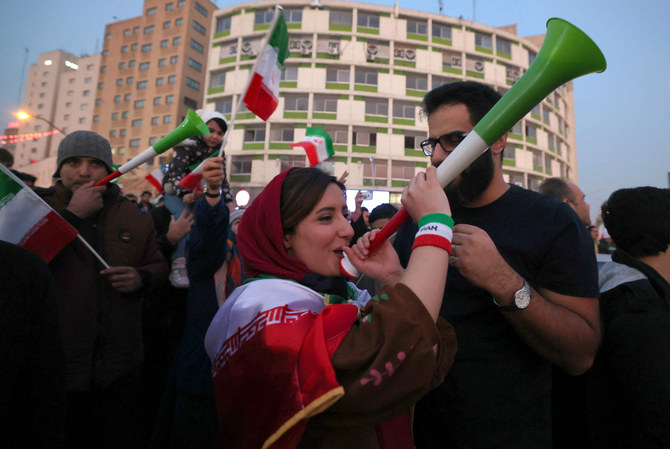
TEHRAN: Iran has released more than 700 prisoners after the national team’s World Cup football victory over Wales, the judiciary’s Mizan Online website said Monday.
It announced that “709 detainees were freed from different prisons in the country” following the 2-0 victory on Friday.
Among those are “some arrested during the recent events,” Mizan Online said, making indirect reference to demonstrations which have shaken Iran for more than two months.
It gave no further detail.
The ongoing protests were triggered by the September 16 death in custody of Mahsa Amini, 22, after her arrest by morality police for an alleged breach of Iran’s strict dress rules for women.
Other Iranian media separately reported that prominent Iranian actor Hengameh Ghaziani had been released on bail after her arrest for having supported the protests.
Two of the most prominent figures detained over the demonstrations — former international footballer Voria Ghafouri and dissident Hossein Ronaghi — were also let out on bail, reports said.
State news agency IRNA reported on Monday that former state television host Mahmoud Shahriari, 63, had been released after two months in prison for “encouraging riots.”
Iran on Friday scored twice deep into stoppage time to stun Wales and breathe new life into its World Cup campaign ahead of a politically charged showdown Tuesday against the United States.
Iran lost its first World Cup match to England, 6-2.
Iran’s judiciary says more than 2,000 people have been charged since the start of the protests.
United Nations High Commissioner for Human Rights Volker Turk last week said around 14,000 people have been arrested.

Iran frees hundreds after World Cup win over Wales
https://arab.news/wj7rb
Iran frees hundreds after World Cup win over Wales
- 709 detainees were freed from different prisons in the country
- Prominent Iranian actor Hengameh Ghaziani had also been released on bail
UN chief condemns Israeli law blocking electricity, water for UNRWA facilities
- The agency provides education, health and aid to millions of Palestinians in Gaza, the West Bank, Jordan, Lebanon and Syria
United Nations Secretary General Antonio Guterres condemned on Wednesday a move by Israel to ban electricity or water to facilities owned by the UN Palestinian refugee agency, a UN spokesperson said.
The spokesperson said the move would “further impede” the agency’s ability to operate and carry out activities.
“The Convention on the Privileges and Immunities of the United Nations remains applicable to UNRWA (United Nations Relief and Works Agency for Palestine Refugees in the Near East), its property and assets, and to its officials and other personnel. Property used by UNRWA is inviolable,” Stephane Dujarric, spokesman for the secretary-general, said while adding that UNRWA is an “integral” part of the world body.
UNRWA Commissioner General Phillipe Lazzarini also condemned the move, saying that it was part of an ongoing “ systematic campaign to discredit UNRWA and thereby obstruct” the role it plays in providing assistance to Palestinian refugees.
In 2024, the Israeli parliament passed a law banning the agency from operating in the country and prohibiting officials from having contact with the agency.
As a result, UNRWA operates in East Jerusalem, which the UN considers territory occupied by Israel. Israel considers all Jerusalem to be part of the country.
The agency provides education, health and aid to millions of Palestinians in Gaza, the West Bank, Jordan, Lebanon and Syria. It has long had tense relations with Israel but ties have deteriorated sharply since the start of the war in Gaza and Israel has called repeatedly for UNRWA to be disbanded, with its responsibilities transferred to other UN agencies.
The prohibition of basic utilities to the UN agency came as Israel also suspended of dozens of international non-governmental organizations working in Gaza due to a failure to meet new rules to vet those groups.
In a joint statement, Canada, Denmark, Finland, France, Iceland, Japan, Norway, Sweden, Switzerland and the United Kingdom said on Tuesday such a move would have a severe impact on the access of essential services, including health care. They said one in three health care facilities in Gaza would close if international NGO operations stopped.