

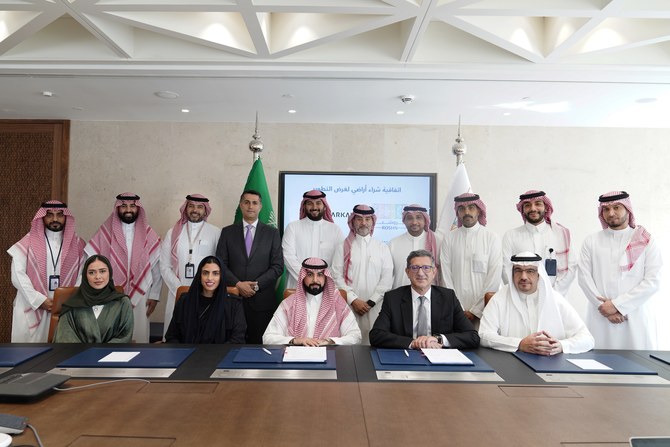
Dar Al Arkan bags contract to develop ROSHN’s residential units in SEDRA

Dar Al Arkan has won a contract to develop residential units in SEDRA, an integrated community project being developed in northern Riyadh
Short Url
Updated 27 November 2022
Follow

Dar Al Arkan bags contract to develop ROSHN’s residential units in SEDRA

RIYADH: Saudi developer Dar Al Arkan has won a contract to develop residential units in SEDRA, an integrated community project being developed in northern Riyadh by national developer ROSHN, a Public Investment Fund-backed company.

This brings two of the leading property developers in Saudi Arabia together as both look to combine their expertise to bring more variety to ROSHN’s housing offering at SEDRA. 

“We will deliver beautiful and well-appointed villas in the community that will further raise the bar for luxury residences in Saudi Arabia,” said Yousef Al Shelash, chairman of Dar Al Arkan.

Being developed in eight phases, SEDRA is set to add 30,000 residential units to Riyadh’s housing stock once completed in three years. The project is being constructed over 20 million square meters of neighborhoods. 

A flagship development of ROSHN, SEDRA recently won the ‘Residential Project of the Year’ award at the Construction Week Middle East 2022 Awards held in Dubai. 

The project will offer a diverse mix of residences built around a ‘work, live and play’ model, the company said in a press release, adding that it will foster a sustainable community.

ROSHN said it seeks to bring a new concept of integrated, human-centric, livable communities to the Kingdom.  SEDRA’s facades are influenced by the ‘Salmani’ style of architecture, it said. The company said the project will have a blend of tradition and modernity, while it will have natural features including a wadi and an acacia forest. 

“Bringing the ROSHN concept to life requires novel ways of thinking, new partnerships with the top entities in their fields, and innovative solutions to address the challenges of the future. As a development sector enabler, ROSHN leverages its partnerships to ensure we bring the highest quality homes to markets, across the Kingdom,” said ROSHN Group CEO, David Grover. 

Dar Al Arkan Properties is fast growing its portfolio across the Kingdom and expanding its international footprint. It boasts a track record of delivering 15,000 residential units and over 50,000 square meters of commercial space. 

ROSHN's ethos is to develop communities that look both to Saudi heritage and the evolving aspirations of the Saudi people. The master developer operates across a broad range of asset classes and land uses, including residential, retail, commercial, hospitality, and public and civic facilities.


Kuwait PMI climbs to 54.5; Egypt falls to 48.9 in February: S&P Global 

Updated 7 sec ago
Follow

Kuwait PMI climbs to 54.5; Egypt falls to 48.9 in February: S&P Global 

RIYADH: Kuwait’s non-oil private sector continued to expand in February, supported by growth in output and new orders, while business conditions in Egypt weakened, an economy tracker showed. 

According to the latest Purchasing Managers’ Index surveys released by S&P Global, Kuwait’s PMI rose to 54.5 in February from 53 in January, extending the current run of improving business conditions to a year and a half. 

The expansion in Kuwait’s non-oil sector aligns with a broader trend across the Gulf Cooperation Council region, where countries are pursuing diversification strategies to reduce reliance on crude revenues. 

The surveys were conducted before regional tensions escalated following US and Israeli strikes on Iran and Tehran’s retaliatory attacks across the Gulf, which have since disrupted markets and energy trade. 

Commenting on the February survey, Andrew Harker, economics director at S&P Global Market Intelligence, said: “Growth momentum strengthened in Kuwait’s non-oil private sector in February as companies were again successful in securing new business.”  

According to the report, key factors supporting expansions in new orders and business activity included the provision of good-quality products at competitive prices and successful marketing efforts. 

The rate of job creation was modest in February and unchanged from January. 

Firms continued hiring staff for advertising and project-related work, resulting in a twelfth consecutive monthly increase in employment. 

“The main issue facing firms at present is being able to grow workforce numbers quickly enough to keep up with workloads,” said Harker. 

He added: “With backlogs rising at a fresh record pace for three months in a row now, fulfilling customer requirements in a timely manner is becoming more difficult, although companies did expand their purchasing activity at a near-record pace in February to help make sure the necessary materials are available going forward.”

Overall input cost inflation hit a nine-month high in February, with both purchase prices and staff costs rising at faster rates compared to January. 

The report added that some companies increased their selling prices in response to higher input costs. 

Regarding the outlook, companies expressed optimism, with sentiment reaching a 26-month high in February, driven by product variety, competitive pricing and good-quality customer service. 

Egypt’s non-oil sector contracts 

Egypt’s non-oil private sector contracted in February, driven by rising costs and softer demand, according to S&P Global. 

The country’s PMI fell to 48.9 in February from 49.8 in January. 

Although the reading remained below the 50 neutral threshold, it was still above its long-run average of 48.3, the report said. 

Output declined for the first time in four months in February, and all five sub-components of the PMI indicated weaker business conditions compared to January. 

“The February PMI data pointed to a slowdown in the Egyptian non-oil private sector as activity curtailed and new order volumes weakened,” said David Owen, senior economist at S&P Global Market Intelligence.

That said, he added that the dip followed an unusually strong run in business performance, and that the latest figures are consistent with annual GDP growth of approximately 4.5 percent. 

Egyptian non-oil companies also reported a decline in order book volumes during the month. 

Sales fell across manufacturing, wholesale and retail, and services, while construction was the only monitored sector where new orders improved. 

Employment fell for the third consecutive month in February, though at a slower rate, as companies continued active job cuttings and hiring freezes. 

The report revealed that cost pressures accelerated across the month, driven by rising ⁠global commodity prices, particularly oil and metals. 

Selling prices, however, were up only fractionally, with just a small proportion of firms choosing to pass cost increases onto their customers.

“Egyptian non-oil companies were notably exposed to the uplift in global commodity prices, with firms emphasising the impact of higher prices for oil and metals, resulting in the sharpest increase in business costs for nine months and hitting margins at a time when firms are reluctant to raise their selling prices,” said Owen. 

He concluded: “Firms will therefore be keen to see commodity markets settle, especially as recent periods of high input cost inflation have typically constrained business output.”