

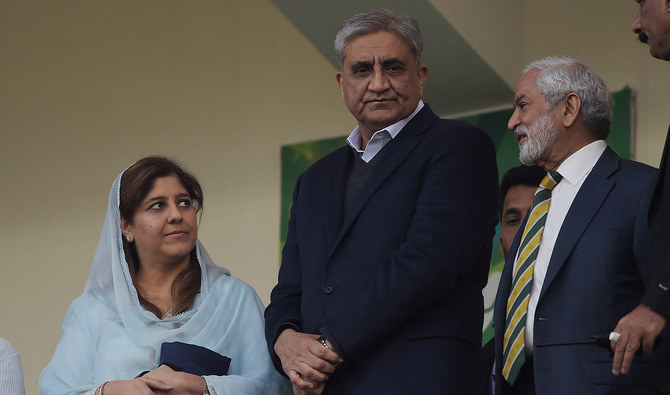

ISLAMABAD: The Pakistani military on Sunday rebutted a “sinister” campaign against the outgoing army chief, General Qamar Javed Bajwa, based on incorrect figures about his family’s wealth, saying the stats were “exaggerated on the basis of assumptions.”
The statement comes days after Fact Focus, an independent investigative journalism website, published wealth and tax details of members of Bajwa’s immediate and extended family, saying they had become “billionaires over the last six months” by establishing international businesses, shifting capital abroad, and buying foreign properties.
The report, citing the family’s tax and wealth statements, said the current market value of known assets and businesses owned by the family within Pakistan and abroad during the last six years amounted to “more than Rs12.7 billion.”
The Inter-Services Public Relations (ISPR), the Pakistani military’s media wing, said on Sunday the figures shared on social media relating to the assets owned by the army chief and his family were “misleading.”
“A specific group has quite cleverly and dishonestly attributed the assets of the father of General Bajwa’s daughter-in-law and his [former’s] family to the army chief and family,” the ISPR said in a statement.
“A completely false impression is being given that these assets were made by the in-laws of Army Chief General Bajwa’s [son] during his six-year tenure [as army chief]. It is totally against the facts, a blatant lie and based on malice.”
Pakistan’s finance czar, Ishaq Dar, this week said authorities had traced a few people in the Pakistani cities of Lahore and Rawalpindi, who had been involved in the “illegal and unwarranted leakage” of tax information of General Bajwa’s family members.
In the absence of a court order, Dar said, the leakage of an individual’s tax details was a “violation of law,” which was why he had earlier ordered an investigation into the matter.
The ISPR said all assets of the army chief and his family were formally declared with country’s revenue watchdog, the Federal Board of Revenue (FBR), and General Bajwa and his family members regularly filed their wealth statements.
“Like every citizen, the army chief and his family are accountable to the tax authorities with regard to their assets,” it added.
Fact Focus, which has previously published investigative reports on the “misappropriation of funds” by prominent Pakistani politicians and generals, released its recent report at a crucial time when General Bajwa, who has been the country’s army chief since 2016, is due to retire on November 29, following the final day of his second three-year term.
The army chief is arguably the most powerful man in the country. The military has for decades ruled Pakistan either through coups or as the invisible guiding hand in politics.
In 2020, a retired general who at the time chaired the government body overseeing billions of dollars of investment from China, faced scrutiny over his family’s finances after an investigative report in Fact Focus claimed they had acquired a vast empire as he rose through the ranks. Gen Asim Bajwa, who is not related to the current army chief, denied the allegations.
The military defense spending appears each year as a single-line figure in Pakistan’s annual budget and is not open to public scrutiny, like the budgets of other government departments.


