

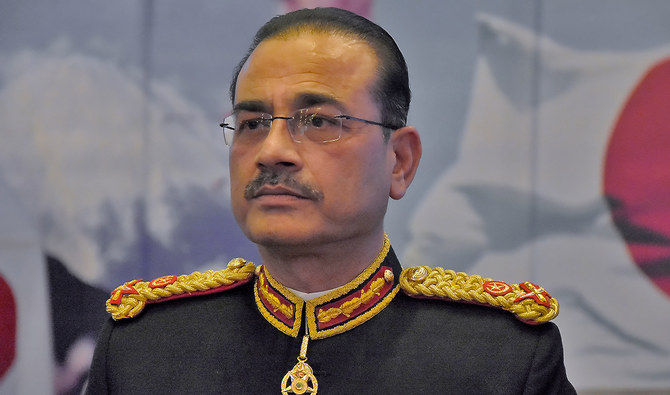

ISLAMABAD: President Arif Alvi endorsed the appointment of Pakistan’s new army chief on Thursday after Prime Minister Shehbaz Sharif picked Lt. Gen. Asim Munir to replace outgoing General Qamar Javed Bajwa as top commander of the country’s all-powerful army.
The president’s decision to sign off on the summary sent by the Prime Minister’s Office earlier on Thursday put to rest speculation and uncertainty surrounding the high-profile appointment that has caused months of political instability in Pakistan.
The army chief is arguably the most influential person in Pakistan, with the military having ruled the country for about half of its 75-year history since independence from Britain and enjoying extensive powers even under civilian administrations.
Munir, currently serving as quartermaster general in the Pakistan army, will likely take charge of the world’s sixth-largest army by troop numbers in a formal handover on Tuesday, when Bajwa formally retires.
Lt. Gen. Sahir Shamshad Mirza has been appointed chairman of the joint chiefs of staff committee.
“The president has immediately promoted Lt. Gen. Syed Asim Munir to the rank of General and appointed him as Chief of Army Staff,” the Presidency said in an official statement, adding the new army chief’s appointment would come into effect from November 29.

The statement said Mirza’s appointment had also been approved by the president and would come into force from November 27.
Speaking to journalists in Islamabad, defense minister Khawaja Muhammad Asif said it was “a good omen that a phase which had created anxiety in the country for the last six months has settled down amicably.”
He added it was time “all people, especially politicians, brought their behavior within the ambit and boundaries of the constitution.”
Earlier in the day, information minister Marriyum Aurangzeb announced in a Twitter post the prime minister had decided to “appoint Lt. Gen. Sahir Shamshad Mirza as the Chairman of the Joint Chiefs of Staff and Lt. Gen. Syed Asim Munir as the Chief of the Army Staff using his constitutional authority.”
“A summary of this has been sent to the President of Pakistan,” she added.
According to Article 48 of the Pakistani constitution, the president is bound to follow the advice of the prime minister. However, the president also has the right to return the summary to the premier for reconsideration within 15 days of its issuance.
As the government announced the new chief, some experts expressed concerns Alvi might not immediately ratify the summary and try to drag the process. The fears were raised in the backdrop of ex-prime minister Imran Khan, a chief rival of Sharif, saying in an interview on Wednesday the president, a close aide and member of Khan’s PTI party, was in contact with him and would consult him on the appointment of the top slots in the military.
“It will also be a test for President Alvi whether he will follow political advice or constitutional and legal advice,” Asif had said in the afternoon. “As the supreme commander of the armed forces, it is his duty to protect the country from political conflicts.”
Munir was the senior most general on the list of nominations sent to the prime minister by the military for consideration for the army chief’s slot. He is from the 17th course of the Officers Training School in Mangla and was commissioned in the 23rd Battalion of the Frontier Force Regiment.
He was promoted to the rank of Lt. Gen. in September 2018 and was subsequently appointed as the head of Pakistan’s all-powerful ISI spy agency.



