

Pakistan PM condemns World Cup ‘propaganda’ against Qatar, expresses solidarity

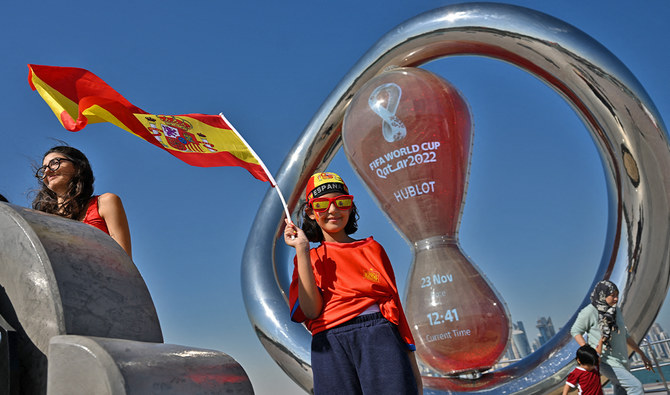
A child holds Spain's national flag in front of the countdown clock of the Qatar 2022 World Cup football tournament in Doha on November 23, 2022. (AFP)
Short Url
Updated 24 November 2022
Follow

Pakistan PM condemns World Cup ‘propaganda’ against Qatar, expresses solidarity

  • Qatar has faced criticism over alleged mistreatment of migrant workers since winning the right to host the tournament in 2010
  • PM Shehbaz Sharif says the world should commend the arrangements made by the Arab country to host the mega sporting event

ISLAMABAD: Prime Minister Shehbaz Sharif on Wednesday condemned “a barrage of propaganda” against Qatar which is currently hosting the first football World Cup that has ever been held in the Middle East, saying that his own country stood in solidarity with the Arab state.

Qatar won the right to host the tournament in 2010. Subsequently, it faced criticism over its treatment of migrant workers and faced questions about its human rights record.

The ruler of the Arab state, Sheikh Tamim bin Hamad Al-Thani, pointed out during the opening ceremony that the event had brought together people of different beliefs while praising everyone for setting aside their differences to celebrate diversity.

Yet, American actor Morgan Freeman also faced anger from his fans in the United States and Europe for participating in the World Cup inauguration ceremony which, according to some critics, symbolized his support to “an oppressive regime.”

“Unfortunate that Qatar is being subjected to a barrage of propaganda as host of FIFA World Cup,” said the Pakistani prime minister in a Twitter post. “It should rather be commended for wonderful arrangements for mega event & being a promoter of global peace & development. Pakistan stands in solidarity with HH Emir & [people] of Qatar.”

Besides extending moral support to Qatar, Pakistan also sent a military contingent to help the authorities in Doha make security arrangements for the tournament.

The South Asian country has also sent tens of thousands of flags belonging to various soccer playing nations along with a bunch of footballs that are used in World Cup matches.

FIFA President Gianni Infantino blamed Qatar’s critics in Western countries for “hypocrisy” ahead of the tournament, saying they had no moral authority to point fingers at other nations.

“I’m European,” he said. “For what we Europeans have been doing around the world in the last 3,000 years, we should be apologizing for the next 3,000 years before starting to give moral lessons to people.”


Pakistan’s Afghan salvo risks turning ‘open war’ into long crisis

Updated 3 sec ago
Follow

Pakistan’s Afghan salvo risks turning ‘open war’ into long crisis

  • Nuclear-armed Pakistan has a formidable military of 660,000 active personnel, backed by a fleet of 465 combat aircraft
  • But the Taliban have the option to lean on insurgent groups like the TTP and the BLA to move beyond border skirmishes

KARACHI: Weeks after the Taliban’s lightning offensive in 2021 wrested control of Afghanistan from a US-led military coalition, Pakistan’s then intelligence chief flew into the capital Kabul for talks, where the serving lieutenant general told a reporter: “Don’t worry, everything will be okay.”

Five years on, Islamabad — long seen as a patron of the Taliban — is locked in its heaviest fighting with the group, which Pakistan’s Defense Minister Khawaja Muhammad Asif described on Friday (February 27) as an “open war.”

The turmoil means that a wide swathe of Asia — from the Gulf to the Himalayas — is now in flux, with the United States building up a military deployment against Afghanistan’s neighbor Iran even as relations between Pakistan and arch rival India remain on edge after four days of fighting last May.

At the heart of the conflict with Afghanistan is Pakistan’s accusation that the Afghan Taliban provides support to militant groups, including the Tehreek-e-Taliban Pakistan (TTP), that have wreaked havoc across inside the South Asian country.

The Afghan Taliban, which has previously fought alongside the TTP, denies the charge, insisting that Pakistan’s security situation is its internal problem.

The disagreement is a reflection of starkly incompatible positions taken by both sides, as Pakistan expected compliance after decades of support to the Taliban, which did not see itself beholden to Islamabad, analysts said.

“We all know that the government in Pakistan supported the Taliban, the Afghan Taliban for many years, in the 90s and the 2000s, and provided havens to them during the period where the US and NATO were in Afghanistan.

So there’s a very close relationship between the Taliban and Pakistan,” said Jennifer Brick Murtazashvili, a political scientist at the University of Pittsburgh and an Afghanistan expert.

“It’s really surprising and shocking to many of us to see how quickly this relationship deteriorated,” she said.

Although tensions have simmered along their rugged 2,600-km (1,615-mile) frontier for months, following clashes last October, Friday’s fighting is notable because of Pakistan’s use of warplanes to hit Taliban military installations instead of confining the attacks to the militants it allegedly harbors.

These include targets deep inside the country in Kabul, as well as the southern city of Kandahar, the seat of Taliban supreme leader Hibatullah Akhundzada, according to Pakistan military spokesman Lt. Gen. Ahmed Sharif Chaudhry.

The clashes are unlikely to end there.

“I think in the immediate aftermath, I think hostilities will subside. There will be, I hope there will be a ceasefire through mediation. But I do not see these tensions subsiding in the foreseeable future,” said Abdul Basit,  an expert on militancy and violent extremism at Singapore’s S. Rajaratnam School of International Studies.

Nuclear-armed Pakistan has a formidable military of 660,000 active personnel, backed by a fleet of 465 combat aircraft, several thousand armored fighting vehicles and artillery pieces.

Across the border, the Afghan Taliban has only around 172,000 active military personnel, a smattering of armored vehicles and no real air force.

But the battle-hardened group, which took on a phalanx of Western military powers in 2001 and outlasted them, has the option to lean on insurgents like the TTP and the Baloch Liberation Army (BLA), moving beyond border skirmishes.

Based in Pakistan’s largest and poorest province of Balochistan that borders both Iran and Afghanistan, the BLA has been at the center of a decades-long insurgency, which in recent years has staged large coordinated attacks.

Pakistan has long accused India of backing the insurgents, a charge repeatedly denied by New Delhi, which has retained a robust military deployment along the border since last May.

Although a raft of countries with influence — including China, Russia, Turkiye and Qatar — have indicated an openness to help mediate the conflict, all such efforts have been met with limited success so far.