

Months of political ‘anxiety’ to end with Pakistan army chief's appointment – defence minister

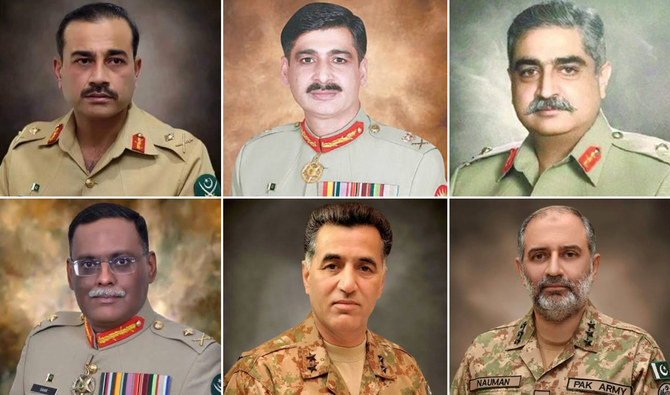
The collage of photos shows six senior generals who are being considered for Pakistan army chief's post. (Photo courtesy: ISPR)
Short Url
Updated 23 November 2022
Follow

Months of political ‘anxiety’ to end with Pakistan army chief's appointment – defence minister

  • Khawaja Asif says PM traveling to Turkey on Friday evening and would make his selection before departing
  • Hopes President Dr Arif Alvi, a close Imran Khan ally, would cooperate with the PM on the appointment

ISLAMABAD: Federal Minister for Defense Khawaja Asif said on Wednesday a “sense of anxiety” created by months of political turmoil and anti-government protests would be eliminated when a new army chief was announced later this week.

Prime Minister Shehbaz Sharif is poised to appoint a new army chief as Pakistan is in the grips of an intense political crisis, with the party of ex-PM Imran Khan leading a protest march to the capital that started from the eastern city of Lahore on Oct. 28.

The country was plunged into fresh turmoil earlier this month when Khan, who is calling on Sharif to immediately resign and call fresh elections, survived an assassination attempt during firing at his protest march.

Khan is sitting out the protests while he recovers but is expected to again join the march on Islamabad on Nov. 26, according to his Pakistan Tehreek-e-Insaf party. Even before launching his protest march last month, Khan has been holding anti-government rallies across Pakistan since his ouster in a parliamentary vote on no-confidence in April.

“I don't want to speculate but the sense of anxiety that has been there for the last few months, not even weeks but months, when this issue [of the appointment] is settled in a day or two … because of this the sense of anxiety will be eliminated,” Asif told reporters when asked if the march might be called off after the new chief’s appointment.

He added that PM Sharif was traveling to Turkey on Friday evening and would make his selection before that.

The current chief, General Qamar Javed Bajwa, has been the head of the army since 2016 and received an extension in service in 2019. He will retire on November 29.

Amid widespread speculation in Pakistani media and public over who would be appointed the new army chief, the Prime Minister’s Office on Wednesday received from the ministry of defense the names of the top contenders for the post, as the government moves to vet nominations for arguably the most powerful office in the country.

Prime Minister Shehbaz Sharif will pick a chief from among the six names suggested by the army, and will subsequently advice the president to appoint him as army chief. As per the rules, the president has to approve the PM’s advise on the appointment on the same day.

When asked by reporters if President Dr Arif Alvi, a close Khan ally, would cooperate with the PM on the appointment, Asif said:

“The duties of the president or the prime minister, they should take decisions in the best interest of the nation … there should be no political consideration in this.”

Asif said that the government would take its coalition partners as the federal cabinet into confidence before announcing the name of the new army chief.

Among the main contenders for the army chief’s post are Lieutenants-Generals Asim Munir, the army’s quartermaster general, Azhar Abbas, the chief of general staff, Nauman Mahmood, president of the National Defense University, and Faiz Hameed, the former chief of Pakistan’s premier Inter-Services Intelligence agency and currently the commander of the army’s Bahawalpur Corps.

The appointment of a new army chief will have a crucial bearing on the future of the South Asian nation’s burgeoning democracy and set the tone for relations with India, Afghanistan, China, and the United States.



Pakistan, UK launch £10 million higher education partnership

Updated 5 sec ago
Follow

Pakistan, UK launch £10 million higher education partnership

  • Pak-UK Education Gateway second phase expands climate research, scholarships, university exchanges
  • First phase was launched in 2018 and delivered 165 partnerships, 2,000 joint studies and £5 million in grants

ISLAMABAD: Pakistan’s Higher Education Commission (HEC) and the British Council have launched the £10 million second phase of the Pak-UK Education Gateway, the HEC said on Monday, a joint initiative aimed at deepening collaboration between universities in both countries on research, mobility and higher-education reform.

The program, funded equally by the HEC and the British Council, builds on a partnership launched in 2018 and seeks to strengthen institutional ties between Pakistani and British universities, focusing on shared challenges including climate change, skills development and economic growth.

Education cooperation has become an increasingly important pillar of broader Pakistan-UK relations, as both countries look to expand academic mobility, research collaboration and international recognition of qualifications at a time when higher-education systems face pressure to respond to climate risks, labor-market shifts and funding constraints.

“This £10 million partnership is set to deepen collaboration between UK and Pakistani universities on critical issues like Climate Change and Mobility. A true system-to-system commitment,” the HEC said in an X post. 

According to the British Council and HEC, the first phase of the Pak-UK Education Gateway supported 165 institutional partnerships, generated around 2,000 joint research papers and awarded £5 million in research grants. Officials say the second phase aims to build on that foundation as part of a longer-term effort to internationalize Pakistan’s higher-education sector.

“Education is the building block of growth and prosperity. Our work on education in Pakistan supports people throughout their lives: from helping reform education policy at the school level, to our strong partnership in higher education,” British High Commissioner Jane Marriott said in a statement.

“This next phase builds on our already strong relationship, and will unlock opportunities to help both our higher education sectors thrive.”

Opportunities under the second phase include increased funding for scholarships, joint research grants and faculty exchanges, alongside a Start-Up Challenge Fund to support Pakistan-UK university collaborations pursuing commercial opportunities and access to new markets.

The program will also focus on leadership and governance reforms within Pakistan’s higher-education system, including quality assurance, improved campus accessibility for people with disabilities, and greater participation of women in senior leadership roles. It further aims to expand opportunities for Pakistani students to study UK-accredited courses without leaving their home cities, alongside a commitment to mutual recognition of qualifications.

Pakistan’s Minister for Federal Education and Professional Training Khalid Maqbool Siddiqui said the initiative had already delivered concrete results since its launch in 2018, calling education “the bridge that connects people, cultures, and futures.”

Acting HEC Chairperson Nadeem Mahbub described the Gateway as a system-to-system partnership rather than a stand-alone program, noting that it had benefited institutions and students in both countries.