


LONDON: The United Kingdom’s top court will give its ruling on Wednesday on whether the Scottish government can hold a second referendum on independence next year without approval from the British parliament, potentially paving the way for a new vote.
In 2014, Scots rejected ending the more-than 300-year-old union with England by 55 percent to 45 percent, but independence campaigners have argued the vote two years later for Britain to leave the European Union, which the majority of Scottish voters opposed, has materially changed the circumstances.
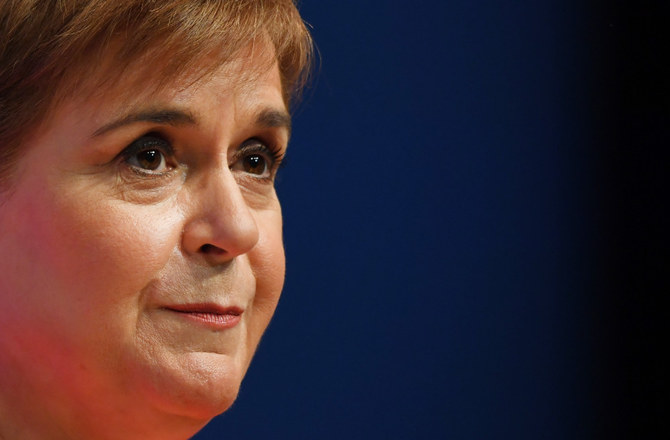
Scottish First Minister Nicola Sturgeon, leader of the pro-independence Scottish National Party (SNP), announced earlier this year that she intended to hold an advisory independence vote on Oct. 19, 2023, but that it had to be lawful and internationally recognized.
However, the British government in London has said it would not grant permission for another plebiscite, saying it should be a once-in-a-generation event. Polls suggest voters remain evenly split over whether or not they support independence and a vote would be too close to call.
Under the 1998 Scotland Act, which created the Scottish parliament and devolved some powers from Westminster, all matters relating to the Union of the Kingdoms of Scotland and England are reserved to the UK parliament.
The Supreme Court will decide firstly whether it should consider the issue at all, given that no referendum bill has been introduced yet into Scotland’s devolved parliament.
If it concludes it has jurisdiction, it will then decide whether an advisory referendum is a reserved matter.
In two days of hearings in October, the Scottish government argued that while politically significant, the vote on independence would be merely advisory and not legally binding.
However, the Conservative-led British government said the court should not even engage with an abstract legal question.
Most legal experts expect the court to support the view that no referendum can be held without the British government’s approval. Sturgeon has said that if that is the outcome, then her party would seek to make the next UK-wide election, expected in 2024, a ‘de facto’ vote on independence.
Scottish politics has been diverging from other parts of the United Kingdom for some time. The SNP has been the largest party in the Scottish parliament since 2007, partly driven by the demand for another referendum.
However, the party has been under pressure over its record on health and education. Scotland has the highest drug deaths in Europe and two thirds of the population is either obese or overweight, while a think tank report last year said its education system is the weakest in the United Kingdom.
“The independence movement is stuck, blocked constitutionally and legally, and it is stuck on 50 percent of the vote,” Michael Keating, a professor of politics at the University of Aberdeen.
“The unionists are also stuck on 50 percent of the vote and have run out of arguments for the union. They have not been able to articulate a clear case for the union and why Scotland should remain part of it.”


