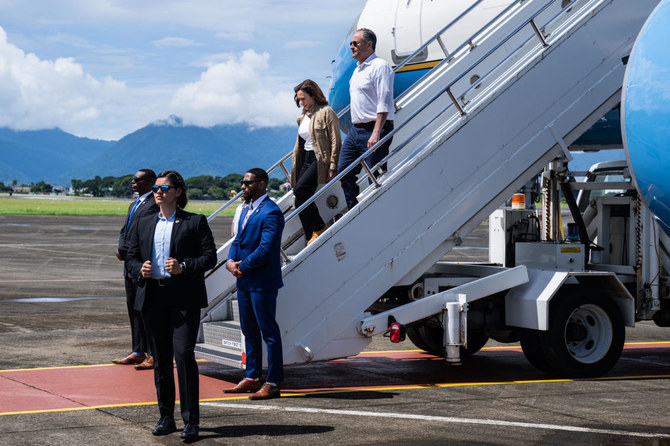
PUERTO PRINCESA, Philippines: US Vice President Kamala Harris on Tuesday visited a Philippine island near waters claimed by China to show support for the longtime US ally and counter Beijing’s growing influence in the region.
Harris is the highest-ranking US official ever to visit the western island of Palawan, the closest Philippine landmass to the Spratly archipelago in the hotly contested South China Sea.
Beijing claims sovereignty over almost the entire sea and has ignored an international court ruling that its claims have no legal basis.
The Philippines, Vietnam, Malaysia and Brunei have overlapping claims to parts of it.
Harris met with fisherfolk in a coastal village and members of the Philippine Coast Guard.
In a speech, Harris said “international rules and norms” must be upheld and the UN-backed tribunal decision rejecting China’s claims over the South China Sea respected.
“The United States — and the broader international community — have a profound stake in the future of this region,” she said, on board a Philippine Coast Guard vessel.
“As an ally, the United States stands with the Philippines in the face of intimidation and coercion in the South China Sea.”
Harris’s trip to Palawan comes a day after she held talks with Philippine President Ferdinand Marcos in Manila.
She reaffirmed the United States’ “unwavering” commitment to defending the Philippines if its vessels or aircraft were attacked in the South China Sea.
Washington has a decades-old security alliance with the Philippines that includes a mutual defense treaty and a 2014 pact, known by the acronym EDCA, which allows for the US military to store defense equipment and supplies on five Philippine bases.
It also allows US troops to rotate through those military bases.
EDCA stalled under former president Rodrigo Duterte, but the United States and the Philippines have expressed support for accelerating its implementation as China becomes increasingly assertive.
As regional tensions rise, fueled by China’s recent wargames around Taiwan, Washington is seeking to repair ties with Manila, whose cooperation would be critical in the event of a conflict.
Relations between the two countries fractured under the mercurial Duterte, who favored China over his country’s former colonial master.
Marcos has sought to strike more of a balance between his superpower neighbors, insisting he will not let China trample on Manila’s maritime rights.
Harris’s visit conveyed a “stronger sense of commitment” to the Philippines’ position on maritime claims, but also underscored the need for EDCA’s continued implementation, said Jay Batongbacal, director of the University of the Philippines’s Institute for Maritime Affairs and Law of the Sea.
“The US cannot adequately carry out its obligations if it is forced to stay several thousand kilometers away in Japan or Guam,” he said.
Of all the claimants to the South China Sea, Beijing has in recent years pressed its stance most aggressively.
Hundreds of Chinese coast guard and maritime militia vessels prowl the waters, swarming reefs, harassing and attacking fishing and other boats, and interfering in oil and gas exploration as well as scientific research.
Chinese state outlet Global Times on Tuesday accused Harris of “fanning the flames of the South China Sea issue.”
“The Philippines has the right to receive any foreign visitor. What we want to emphasize is that any bilateral exchanges should not be at the expense of the interests of any third country as well as regional peace and stability,” it said in an editorial.
On the eve of Harris’s visit to Palawan, a senior Philippine navy official accused the Chinese coast guard of “forcefully” seizing parts of a rocket that landed in the Spratlys.
Beijing — which has built militarised artificial islands in the archipelago — insisted the handover took place after “friendly consultation.”
Tensions between Manila and Beijing flared last year after hundreds of Chinese vessels were detected at Whitsun Reef in the Spratlys.
Last November, Chinese coast guard ships fired water cannon at Philippine boats delivering supplies to marines at Second Thomas Shoal in the same archipelago.


![]()

US VP Harris visits Philippine island near China-claimed waters
Short Url
https://arab.news/j6zfp
US VP Harris visits Philippine island near China-claimed waters
- Harris met with fisherfolk in a coastal village and members of the Philippine Coast Guard
- Washington has a decades-old security alliance with the Philippines that includes a mutual defense treaty and a 2014 pact


Latest updates





© 2026 SAUDI RESEARCH & PUBLISHING COMPANY, All Rights Reserved And subject to Terms of Use Agreement.