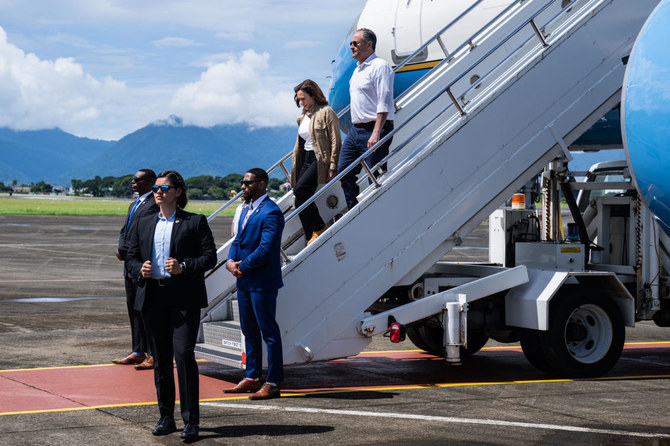
US VP Harris visits Philippine island near China-claimed waters

US Vice President Kamala Harris arrive at Puerto Princesa International Airport. (AFP)
Short Url
Updated 22 November 2022
Follow

US VP Harris visits Philippine island near China-claimed waters

  • Harris met with fisherfolk in a coastal village and members of the Philippine Coast Guard
  • Washington has a decades-old security alliance with the Philippines that includes a mutual defense treaty and a 2014 pact

PUERTO PRINCESA, Philippines: US Vice President Kamala Harris on Tuesday visited a Philippine island near waters claimed by China to show support for the longtime US ally and counter Beijing’s growing influence in the region.
Harris is the highest-ranking US official ever to visit the western island of Palawan, the closest Philippine landmass to the Spratly archipelago in the hotly contested South China Sea.
Beijing claims sovereignty over almost the entire sea and has ignored an international court ruling that its claims have no legal basis.
The Philippines, Vietnam, Malaysia and Brunei have overlapping claims to parts of it.
Harris met with fisherfolk in a coastal village and members of the Philippine Coast Guard.
In a speech, Harris said “international rules and norms” must be upheld and the UN-backed tribunal decision rejecting China’s claims over the South China Sea respected.
“The United States — and the broader international community — have a profound stake in the future of this region,” she said, on board a Philippine Coast Guard vessel.
“As an ally, the United States stands with the Philippines in the face of intimidation and coercion in the South China Sea.”
Harris’s trip to Palawan comes a day after she held talks with Philippine President Ferdinand Marcos in Manila.
She reaffirmed the United States’ “unwavering” commitment to defending the Philippines if its vessels or aircraft were attacked in the South China Sea.
Washington has a decades-old security alliance with the Philippines that includes a mutual defense treaty and a 2014 pact, known by the acronym EDCA, which allows for the US military to store defense equipment and supplies on five Philippine bases.
It also allows US troops to rotate through those military bases.
EDCA stalled under former president Rodrigo Duterte, but the United States and the Philippines have expressed support for accelerating its implementation as China becomes increasingly assertive.
As regional tensions rise, fueled by China’s recent wargames around Taiwan, Washington is seeking to repair ties with Manila, whose cooperation would be critical in the event of a conflict.
Relations between the two countries fractured under the mercurial Duterte, who favored China over his country’s former colonial master.
Marcos has sought to strike more of a balance between his superpower neighbors, insisting he will not let China trample on Manila’s maritime rights.
Harris’s visit conveyed a “stronger sense of commitment” to the Philippines’ position on maritime claims, but also underscored the need for EDCA’s continued implementation, said Jay Batongbacal, director of the University of the Philippines’s Institute for Maritime Affairs and Law of the Sea.
“The US cannot adequately carry out its obligations if it is forced to stay several thousand kilometers away in Japan or Guam,” he said.
Of all the claimants to the South China Sea, Beijing has in recent years pressed its stance most aggressively.
Hundreds of Chinese coast guard and maritime militia vessels prowl the waters, swarming reefs, harassing and attacking fishing and other boats, and interfering in oil and gas exploration as well as scientific research.
Chinese state outlet Global Times on Tuesday accused Harris of “fanning the flames of the South China Sea issue.”
“The Philippines has the right to receive any foreign visitor. What we want to emphasize is that any bilateral exchanges should not be at the expense of the interests of any third country as well as regional peace and stability,” it said in an editorial.
On the eve of Harris’s visit to Palawan, a senior Philippine navy official accused the Chinese coast guard of “forcefully” seizing parts of a rocket that landed in the Spratlys.
Beijing — which has built militarised artificial islands in the archipelago — insisted the handover took place after “friendly consultation.”
Tensions between Manila and Beijing flared last year after hundreds of Chinese vessels were detected at Whitsun Reef in the Spratlys.
Last November, Chinese coast guard ships fired water cannon at Philippine boats delivering supplies to marines at Second Thomas Shoal in the same archipelago.


Israel is risking global security, warns Somali Information Minister

Updated 6 min 21 sec ago
Follow

Israel is risking global security, warns Somali Information Minister

  • Tel Aviv’s actions boost terror groups, Daud Aweis Jama tells Arab News in exclusive interview
  • He accuses Tel Aviv of wanting to relocate Palestinians from Gaza to region

RIYADH: Israel’s recognition of Somaliland and its presence in the region risks inflaming the situation there, allowing terrorist groups to undermine regional security and stability, according to Somali Information, Culture and Tourism Minister Daud Aweis Jama.

In a special interview with Arab News, Jama insisted that Israel’s unprecedented Dec. 26 move to recognize Somaliland as a sovereign state represents a major setback for Mogadishu’s fight against terrorist organizations like Al-Shabab and Daesh.

“The presence of Israel will be used by the terrorist groups to expand their operations in the region. (They will) have a pretext to spread their ideologies in the region,” he said.

Somaliland's President Abdirahman Abdullahi Mohamed speaking during a press conference with Israel's Foreign Minister Gideon Saar at the Presidential Palace in Hargeisa. (Somaliland Presidential Office/AFP)

“That is another factor that is also risking global security and regional stability, because we have been in the last stage of overcoming the challenges of the terrorist groups Al-Shabab and ISIS,” he added, using another term for Daesh.

Jama added: “We have been putting all our resources and all our time into making sure that we finalize the final stages of the fight against Al-Shabab. So, if something else interrupts us, that means that we are not going to focus fully on the operations against Al-Shabab. And that means we are giving more opportunities to Al-Shabab or other organizations.”

The consequences of this hit to Somalia’s ability to fight terror will not be restricted to the country’s borders, according to Jama, but will spread across the region and beyond.

“This might invite other, external terrorist groups to the region, because they will take advantage of this crisis and will make sure that they take over all the areas that have been defeated before,” the minister said.

Mogadishu residents wave Somali and Palestinian flags at a rally denouncing Israel’’s recognition of Somaliland. (AFP)

“We believe this has come at a time that is going to affect our security as a Somali government, the security of the Horn of Africa, the security of the Gulf of Aden, the security of the Red Sea, the security of the Middle East and global stability. This is a very important location that holds the trade of the world.”

The minister underlined that Israel’s recognition and larger presence in the region are leading to more challenges, “putting more fuel on the ongoing challenges that exist in the region, especially in Somalia.” He added: “And at this time, it is not only limited to Somalia, but it’s going to be a challenge that is going to spread like a fire all over the region and all over the world.”

Jama told Arab News that Israel has other strategic motives for its recognition of Somaliland — including the forced resettlement of Palestinians from Gaza.

A woman walks past stalls selling household items at the Waheen Market in Hargeisa. (AFP)

“According to reliable sources that our intelligence gathered, one of the conditions that Israel put forward (for recognizing Somaliland) was to have a place that they can settle the people from Gaza,” he said.

“We find that it is a violation also of the people of Palestine, because we believe that the people of Palestine have the right to self-determination. The two-state solution that has been the call of the international community has to be adhered to and implemented.”

Israel’s coalition government, the most right-wing ‌and religiously conservative in its history, includes far-right politicians who advocate the ‍annexation of both Gaza and the West ‍Bank and encouraging Palestinians to leave their homeland.

A man holds a flag of Somaliland in front of the Hargeisa War Memorial monument. (AFP)

Somalia’s UN Ambassador Abukar Dahir Osman said ‍Security Council members Algeria, Guyana, Sierra Leone and Somalia “unequivocally reject any steps aimed at advancing this objective, including any attempt by Israel to relocate the Palestinian population from Gaza to the northwestern region of Somalia.”

Israel last month became the first country to recognize Somaliland as an independent nation. In the three-plus decades since its self-declaration of independence in 1991, no state had recognized the northwestern territory as being separate from Somalia.

Mogadishu immediately rejected the Israeli move, alongside countries all over the world.

Soldiers of the Somalia National Army (SNA) secure a village that ws allegedly destroyed by retreating insurgents during a visit by senior officers at Awdheegle. (AFP/File)

Saudi Arabia affirmed its rejection of any attempts to impose parallel entities that conflict with the unity of Somalia. It also affirmed its support for the legitimate institutions of the Somali state and its keenness to preserve the stability of Somalia and its people.

A group of foreign ministers from Arab and Islamic countries, alongside the Organization of Islamic Cooperation, also firmly rejected Israel’s announcement. In a joint statement, the ministers warned that the move carries “serious repercussions for peace and security in the Horn of Africa and the Red Sea region” and undermines international peace and security.

The 22-member Arab League rejected “any measures arising from this illegitimate recognition aimed at facilitating forced displacement of the Palestinian people or exploiting northern Somali ports to establish military bases,” the organization’s UN Ambassador Maged Abdelfattah Abdelaziz told the UN Security Council.

Arab News senior reporter Lama Alhamawi conducted an exclusive interview with Somalia’s information minister on Wednesday. (AN photo)

In the most recent development in Israel-Somaliland relations, less than two weeks after Tel Aviv’s recognition, Israeli Foreign Minister Gideon Saar visited the region on Tuesday to publicly formalize diplomatic relations.

“It was a blatant violation of Somalia’s sovereignty that Israel recognized a region within the Somali Federal Republic as an independent state,” Jama underlined. “That was a total violation of international laws. It was a violation of the territorial integrity and sovereignty of Somalia.

Mogadishu residents attend a rally denouncing Israel’’s recognition of Somaliland. (AFP)

“From the beginning, our path was to follow diplomatic efforts. And we kind of started with a successful UN Security Council meeting that supported Somalia’s territorial integrity and sovereignty. (This was) followed by other international actors like the Arab League, the Organization of Islamic Cooperation, the African Union and regional bodies like the East African Community and IGAD.

“Also, the Peace and Security Council of the African Union has reiterated the importance of supporting Somali sovereignty and territorial integrity.”