

Saudi culinary talents’ recipe for success

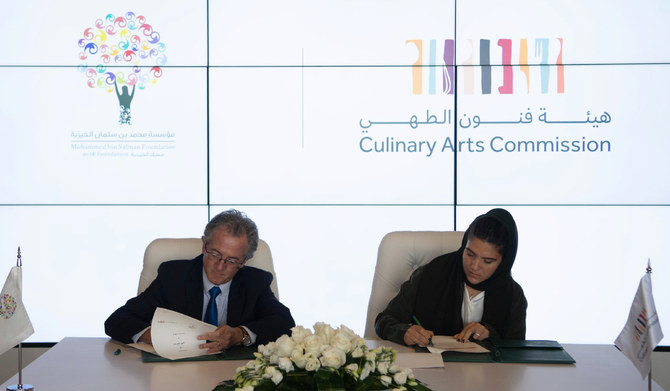
From the right, Mayada Badr, CEO of Culinary Arts Commissions, next to David Henry, CEO of Prince Mohammed bin Salman Nonprofit City while signing the MoU. (Photo/Twitter)
Short Url
Updated 21 November 2022
Follow

Saudi culinary talents’ recipe for success

  • The memorandum of understanding covers four tracks: Education and training, entrepreneurship, consulting, and events and festivals

JEDDAH: Representatives of the Saudi Culinary Arts Commission and the Prince Mohammed bin Salman Nonprofit City in Riyadh have signed an agreement to develop and encourage local culinary talents both in the Kingdom and internationally.

The commission was represented at the signing by CEO Mayada Badr and the city by CEO David Henry.

In a post on its official Twitter account, the commission said that the agreement “will advance Saudi Arabia’s culinary sector in pursuit of our shared goals.”

The memorandum of understanding covers four tracks: Education and training, entrepreneurship, consulting, and events and festivals.

HIGHLIGHT

The memorandum of understanding covers four tracks: Education and training, entrepreneurship, consulting, and events and festivals. The MoU comes in the context of the commission’s keenness to strengthen partnerships with government, private and nonprofit sector organizations to develop the culinary sector in the Kingdom.

The education and training track will support the educational and training process by establishing programs and initiatives to develop culinary arts in the city.

It will also support the development and operation of educational and training initiatives by setting up projects in Prince Mohammed bin Salman Nonprofit City, including the Academy of Culinary Arts, as well as internal and external scholarship programs.

As part of the entrepreneurship track, Prince Mohammed bin Salman Nonprofit City will help culinary entrepreneurs, startups and businesses through a series of programs in its creative center.

Under the consultations track, the commission will provide guidance and recommendations to support the development of the culinary sector, and will coordinate with the city charitable foundation and its subsidiaries to offer advice and recommendations.

The fourth track will develop the city as a venue for culinary events, including farmers’ markets and food festivals.

The MoU comes in the context of the commission’s keenness to strengthen partnerships with government, private and nonprofit sector organizations to develop the culinary sector in the Kingdom.


Al Akaria signs SR1.2bn agreement lease with Amsa Hospitality 

Updated 25 February 2026
Follow

Al Akaria signs SR1.2bn agreement lease with Amsa Hospitality 

  • Project, located in Riyadh Diplomatic Quarters, spans approximately 40,000 sq. meters and includes 240 modern residential units, comprising 176 apartments and 64 villas and townhouses
  • CEO of Amsa Hospitality Muin Serhan: We have a certain commitment to deliver to the community and to the project in particular

RIYADH: The Saudi Real Estate Co., also known as Al Akaria, recently announced the signing of a lease agreement for the Amsa Vue Residential Compound in Riyadh with Amsa Hospitality, with the total value of the project estimated at around SR1.2 billion ($320 million). 

Spread across 20 years, the cost reflects the long-term nature of the investment and its focus on value, sustainability, and operational quality.

The project, located in Riyadh Diplomatic Quarters, spans approximately 40,000 sq. meters and includes 240 modern residential units, comprising 176 apartments and 64 villas and townhouses.

Acting CEO of Al Akaria Khalid Al-Sehaibany stated that the project embodies the company’s approach to developing residential communities that focus on an integrated experience built on quality planning and comprehensive facilities, elevating the standard of living in Riyadh.

CEO of Amsa Hospitality Muin Serhan told Arab News that the core philosophy behind the project is to create a space that focuses both on individuals and community values. 

Serhan pointed out that this strategy is central to a broader ambition to redefine hospitality in Saudi Arabia by embedding the hallmark of Arabian hospitality into the brand’s identity.

“We have a certain commitment to deliver to the community and to the project in particular. Year on year, we're adding value to the landlord and the owners of the assets,” he said. 

He outlined a clear vision for the company’s legacy, aiming to set a new standard for hospitality management in the region. The goal, he said, is to be the go-to partner for developers and asset owners seeking to integrate hospitality elements into their projects.

Serhan confirmed that this vision is currently being brought to life through close collaboration with contractors and designers. 

He emphasized that the process is a “moving journey,” where the designer, the brand, and the location converge to create a product that truly reflects the local narrative.
