Finance minister orders probe into leak of wealth details of relatives of Pakistan army chief

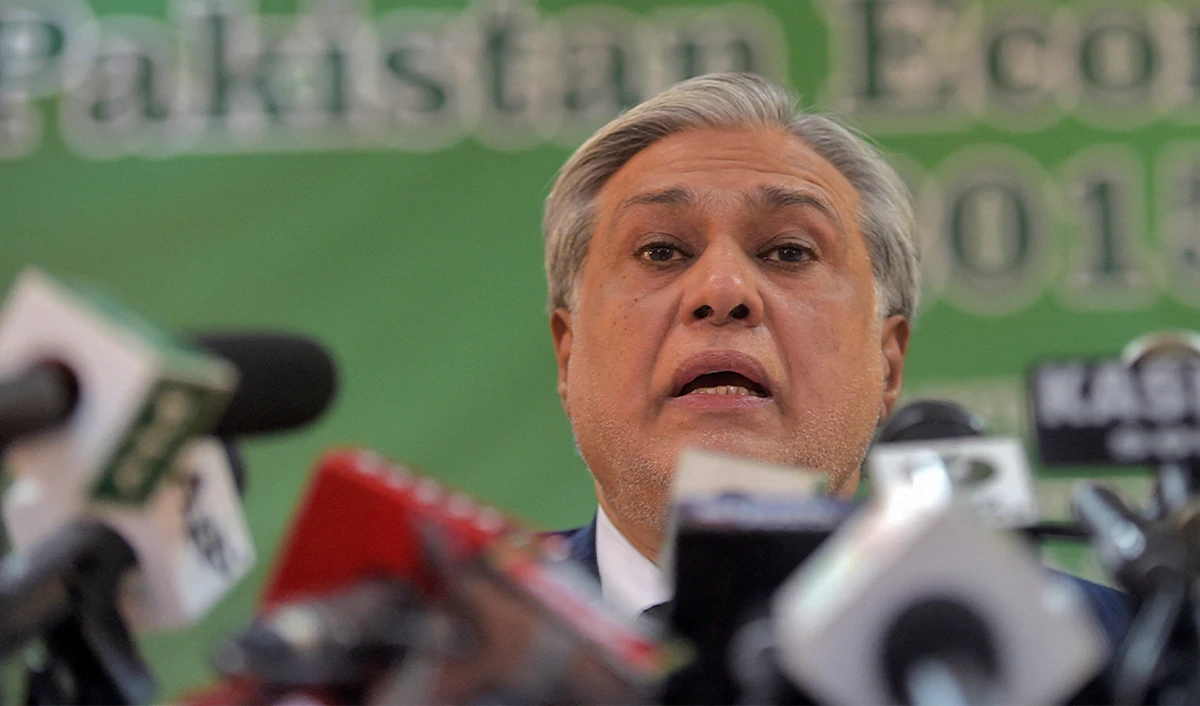
Pakistan's finance minister Ishaq Dar during a press conference in Islamabad on June 2, 2016. (AFP/File)
Short Url
Updated 21 November 2022
Follow

Finance minister orders probe into leak of wealth details of relatives of Pakistan army chief

  • Fact Focus last week published wealth and tax details of General Bajwa’s immediate and extended family members
  • Report said they became "billionaires" by setting up businesses and properties and shifting capital abroad

ISLAMABAD: Federal Minister for Finance and Revenue, Ishaq Dar, on Monday ordered an investigation into what he called the "illegal and unwarranted leakage" of tax information of the family members of Pakistan army chief General Qamar Javed Bajwa.

Dar was referring to a report by Fact Focus, an independent investigative journalism website, which last week published wealth and tax details of members of General Bajwa’s immediate and extended family, saying they had become "billionaires over the last six months" by establishing international businesses, shifting capital abroad, and buying foreign properties.

The report, citing the family’s tax and wealth statements, said the current market value of known assets and businesses owned by the family within Pakistan and abroad during the last six years amounted to “more than Rs12.7 billion.”

"This is clearly violative of the complete confidentiality of tax information that the Law provides," the finance division said in a statement attributed to Dar, saying he had taken "serious notice" of the leak.

"The finance minister has directed the SAPM [special assistant to the prime minister] on Revenue Mr. Tariq Mehmood Pasha to personally lead an immediate investigation into the violation of tax law and breach of FBR data, affix responsibility and submit a report within twenty four hours."


Fact Focus, which has previously published investigative reports on the “misappropriation of funds” by prominent Pakistani politicians and generals, released its recent report at a crucial time when General Bajwa, who has been the country’s army chief since 2016, is due to retire on November 29, following the final day of his second three-year term.

The army chief is arguably the most powerful man in the country. The military has for decades ruled Pakistan either through coups or as the invisible guiding hand in politics.

In 2020, a retired general who at the time chaired the government body overseeing billions of dollars of investment from China, faced scrutiny over his family's finances after an investigative report in Fact Focus claimed they had acquired a vast empire as he rose through the ranks. Gen Asim Bajwa, who is not related to the current army chief, denied the allegations.

The military defence spending appears each year as a single-line figure in the annual budget and is not open to public scrutiny like the budgets of other government departments.

Pakistan, global crypto exchange discuss modernizing digital payments, creating job prospects 

Updated 05 December 2025
Follow

Pakistan, global crypto exchange discuss modernizing digital payments, creating job prospects 

  • Pakistani officials, Binance team discuss coordination between Islamabad, local banks and global exchanges
  • Pakistan has attempted to tap into growing crypto market to curb illicit transactions, improve oversight

ISLAMABAD: Pakistan’s finance officials and the team of a global cryptocurrency exchange on Friday held discussions aimed at modernizing the country’s digital payments system and building local talent pipelines to meet rising demand for blockchain and Web3 skills, the finance ministry said.

The development took place during a high-level meeting between Finance Minister Muhammad Aurangzeb, Pakistan Virtual Assets Regulatory Authority (PVARA) Chairman Bilal bin Saqib, domestic bank presidents and a Binance team led by Global CEO Richard Teng. The meeting was held to advance work on Pakistan’s National Digital Asset Framework, a regulatory setup to govern Pakistan’s digital assets.

Pakistan has been moving to regulate its fast-growing crypto and digital assets market by bringing virtual asset service providers (VASPs) under a formal licensing regime. Officials say the push is aimed at curbing illicit transactions, improving oversight, and encouraging innovation in blockchain-based financial services.

“Participants reviewed opportunities to modernize Pakistan’s digital payments landscape, noting that blockchain-based systems could significantly reduce costs from the country’s $38 billion annual remittance flows,” the finance ministry said in a statement. 

“Discussions also emphasized building local talent pipelines to meet rising global demand for blockchain and Web3 skills, creating high-value employment prospects for Pakistani youth.”

Blockchain is a type of digital database that is shared, transparent and tamper-resistant. Instead of being stored on one computer, the data is kept on a distributed network of computers, making it very hard to alter or hack.

Web3 refers to the next generation of the Internet built using blockchain, focusing on giving users more control over their data, identity and digital assets rather than big tech companies controlling it.

Participants of the meeting also discussed sovereign debt tokenization, which is the process of converting a country’s debt such as government bonds, into digital tokens on a blockchain, the ministry said. 

Aurangzeb called for close coordination between the government, domestic banks and global exchanges to modernize Pakistan’s payment landscape.

Participants of the meeting also discussed considering a “time-bound amnesty” to encourage users to move assets onto regulated platforms, stressing the need for stronger verifications and a risk-mitigation system.

Pakistan has attempted in recent months to tap into the country’s growing crypto market, crack down on money laundering and terror financing, and promote responsible innovation — a move analysts say could bring an estimated $25 billion in virtual assets into the tax net.

In September, Islamabad invited international crypto exchanges and other VASPs to apply for licenses to operate in the country, a step aimed at formalizing and regulating its fast-growing digital market.