

Pakistan reopens border with Afghanistan more than a week after soldier’s killing

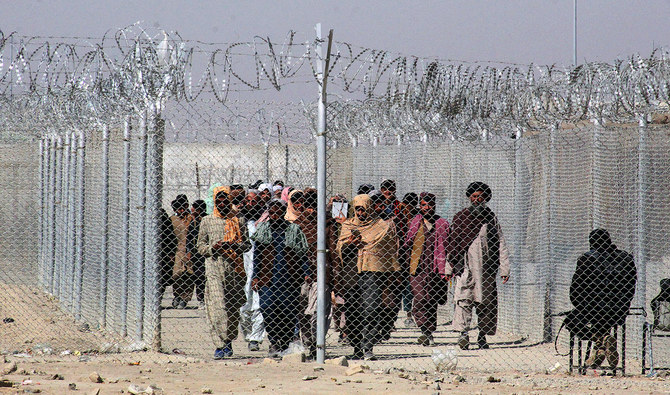
Pakistan's and Afghan's nationals walk along a fenced corridor as they enter Pakistan through the Pakistan-Afghanistan border crossing point in Chaman on February 27, 2022. (Photo courtesy: AFP)
Short Url
Updated 21 November 2022
Follow

Pakistan reopens border with Afghanistan more than a week after soldier’s killing

  • The Chaman border crossing was closed after a Pakistani border guard was killed in a shooting on Nov 13
  • The decision to reopen the border comes after Taliban officials assured Pakistan of arresting the suspects

QUETTA: Pakistan has reopened its border with Afghanistan in the southwestern Balochistan province, officials said on Monday, more than a week after it was closed because of the killing of a Pakistani soldier.

The soldier of Pakistan’s Frontier Corps paramilitary force died in a shooting from the Afghan side on November 13, leading Pakistani authorities to indefinitely close the Chaman border crossing, the most important border point for trade between the two countries after Torkham in Pakistans’ mountainous northwest.

The decision to reopen the border crossing, which connects with Spin Boldak district in Afghanistan’s Kandahar province, was made after multiple meetings of Pakistan’s border liaison committee, comprising officials of Pakistan Army and district administration as well as tribal elders, with Taliban border officials.

“During various rounds of talks, the Afghan government expressed grief over the killing of Pakistani border guard and assured of averting these attacks in future,” Chaman Deputy Commissioner Abdul Hameed Zehri said at a press conference.

“After this, Pakistan’s border liaison committee has decided to reopen the border for all trade and pedestrian movement through Pak-Afghan Friendship Gate.”

Zehri said no one would be allowed to disturb friendly relations between Pakistan and Afghanistan.

Hundreds of Afghans cross into Pakistan every day for trade, medical treatment, work or to meet relatives, who have taken refuge in various Pakistani cities. Most Pakistanis go to the other side of the border for business transactions.

The unruly frontier between Pakistan and Afghanistan has seen similar shooting incidents in the past at Chaman, Torkham and other border crossings.

The Afghan government said the attack was an attempt by a “third party” to disturb peaceful relations between the two countries.

“The Taliban government has a clear policy toward all neighboring countries and has been working with all neighbors in a very conducive manner,” Hajji Zaid, a spokesman for the Kandahar governor, told Arab News.

“We will not allow any third party within or outside Afghanistan to disturb our relations with any neighboring country, particularly Pakistan.”

He said Taliban officials had assured the Pakistani government that all efforts were being made to arrest the suspect, who had killed the Pakistani border guard.

The Chaman border crossing remained close for eight consecutive days, causing heavy losses to traders and stranding thousands of people on both sides.

Traders and business community on Monday welcomed Pakistan’s decision to reopen the border crossing.


Pakistan, Iran leaders highlight mutual support after both engaged in short wars this year

Updated 59 min 49 sec ago
Follow

Pakistan, Iran leaders highlight mutual support after both engaged in short wars this year

  • Prime Minister Sharif met Iranian President Pezeshkian in Ashgabat on the sidelines of an international forum
  • Pakistani PM also had an informal interaction with President Putin, discussed regional issue with President Erdogan

ISLAMABAD: Prime Minister Shehbaz Sharif and Iranian President Masoud Pezeshkian on Friday praised the support their countries offered one another during episodes of external aggression this year, according to the state media, as they met on the sidelines of an international peace forum in Turkmenistan.

Pakistan fought a four-day war with India in May, when New Delhi fired missiles at its cities and Islamabad responded with retaliatory strikes. Nearly a month after the conflict, Iran waged its own war with Israel after Tel Aviv carried out attacks inside Iranian territory, prompting Tehran to launch a series of missile and drone barrages in response.

The meeting in Turkmenistan came as Pakistan and Iran seek to steady ties after a period of strained security relations, while also attempting to expand economic cooperation and strengthen border management. The two leaders reviewed regional developments, including Pakistan’s concerns over militant attacks it says originate from Afghanistan, and ongoing diplomatic efforts related to Gaza.

“Both leaders appreciated the strong support that their countries had provided to each other when they had faced external aggression earlier this year,” the state-owned Associated Press of Pakistan (APP) said.

Sharif highlighted the outcome of the 22nd Pakistan–Iran Joint Economic Commission held this year and urged closer coordination to increase bilateral trade, operationalize border markets, reinforce border security and revive transport links, including the Islamabad-Tehran-Istanbul rail network.

Pezeshkian, according to the report, said Iran wished to further strengthen ties and thanked Sharif for a “useful and timely exchange of views.”

Sharif also pressed for “meaningful action” from the Afghan Taliban administration to address Pakistan’s security concerns, APP added.

Separately, the Pakistani prime minister met other global leaders attending the forum marking the International Year of Peace and Trust 2025 and Turkmenistan’s Neutrality Day.

He held informal interactions with Russian President Vladimir Putin and discussed regional issues with Turkish President Tayyip Erdogan, Tajik President Emomali Rahmon and Kyrgyz President Sadyr Zhaparov.