

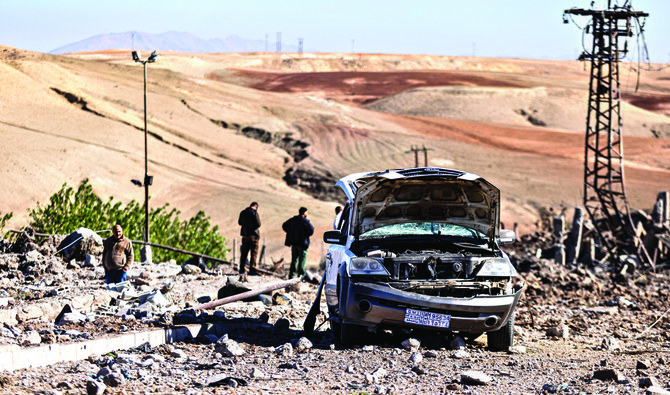

ANKARA: Turkiye on Sunday launched simultaneous drone strikes on bases in northern Iraq and Syria allegedly being used by militants of the outlawed Kurdistan Workers’ Party, or PKK.
The night-time operation, dubbed Claw-Sword, came a week after the deadly terror attack in Istanbul’s Istiklal Street that killed six Turkish citizens and injured more than 80 others.
Ankara believes the PKK and its Syrian Kurdish affiliates were responsible for the attack, but the PKK has denied any involvement.
“The hour of reckoning has come,” Turkiye’s defense ministry tweeted, citing the country’s right to self-defense under Article 51 of the UN charter.
Presidential spokesperson Ibrahim Kalin also tweeted a photo of the Turkish flag, saying: “Payback time for Istiklal.”
The defense ministry confirmed that the strikes were carried out in Qandil, Asos and Hakurk in Iraq, and Kobani, Tal Rifat, Cizire and Derik in Syria, and said that shelters, tunnels and ammunition depots had been destroyed.
Levent Kemal, a Middle East expert, said that the raids will be limited in time, but wide-ranging in scope.
“This is an operation to devastate predefined targets near Turkiye’s borders with Iraq and Syria,” he told Arab News.
“It is crystal-clear that Turkish decision-makers decided to launch this operation after last week’s terror attack in Istanbul, but we cannot claim that this attack directly triggered Sunday operation because these targets were defined following lengthy examinations on the ground.”
Kemal said that the length of the operation is difficult to predict because the number of the targets is still unknown.
In the past six years, Turkiye has launched three major cross-border operations in Syria against Syrian Kurdish YPG militia, as well as raids in northern Iraq.
Turkish President Recep Tayyip Erdogan has long threatened another operation in northwestern Syria following Russian troop withdrawals from the area to bolster its forces in Ukraine.
Turkiye’s plan is to establish a 30 km security zone along its southern border.
However, Washington’s longtime alliance with the YPG in its fight against Daesh in Syria has resulted in disagreements between the two NATO allies.
Oytun Orhan, coordinator of Syria studies at the Orsam think tank in Ankara, said that the operation on Sunday should be seen as a preparation for a ground operation, especially given the public anger following the Istiklal attack.
“It is a strong message against the PKK and its offshoots in northern Iraq and Syria. The situation on the ground will surely not change overnight, and YPG’s aerial control will continue,” he told Arab News.
Orhan believes that Ankara also intended to send a message by carrying out simultaneous operations in Iraq and Syria.
“It is a warning to the US and the international community to say that Ankara considers the Kurdish Democratic Union Party (PYD) and its military wing, the People’s Protection Units (YPG), in Syria as linked with the PKK. Therefore, Turkiye designs its counterterrorism plans in a holistic way and does not make distinctions among terror groups,” he said.
Turkish airstrikes targeted Kobani, a strategic Kurdish-majority Syrian town near the Turkish border, as well as northern Iraq’s Sinjar town, which has a large Yazidi population. Sinjar district served as a key crossing point into Syria and a PKK entry point into Iraq.
Turkiye has previously targeted areas in and around Sinjar, with operations against the PKK and its local Iranian-backed allies.
“The US has always shown sensibilities for the situation of Kobani and Sinjar. Therefore, such targets are also meant to warn the US over the disagreements on terror groups and to show determination about Turkiye’s firm stance in the fight against the PKK wherever its members are based,” Orhan said.
Experts say that Turkiye is still pursuing its aim of establishing a 30 km security zone.
“This latest operation is a blatant sign that Turkiye intends to establish that zone. But for it to happen, there is a need to conduct a ground operation,” Orhan said.
He believes neither the US nor Russia could have raised strong objections to Sunday’s operation, especially after Turkiye became an open target of a terror attack last week.
“But if Turkiye follows up these aerial strikes with a ground operation, things may change regarding its engagements with Russia and US because a ground operation will be accompanied with bigger military risks, including the risk of clashes with American soldiers on the ground,” he said.


