Climate change ‘main threat’ for World Heritage sites

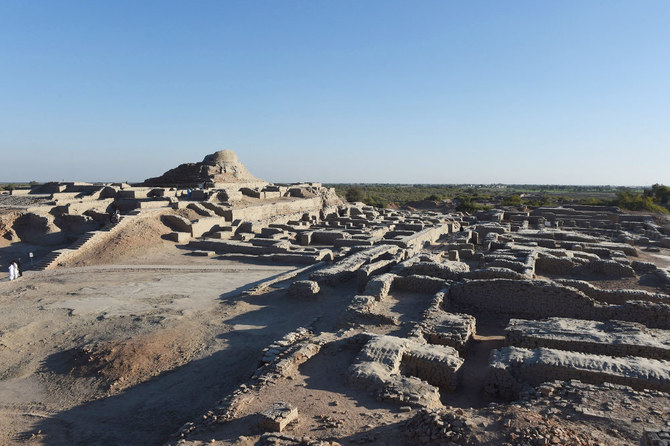
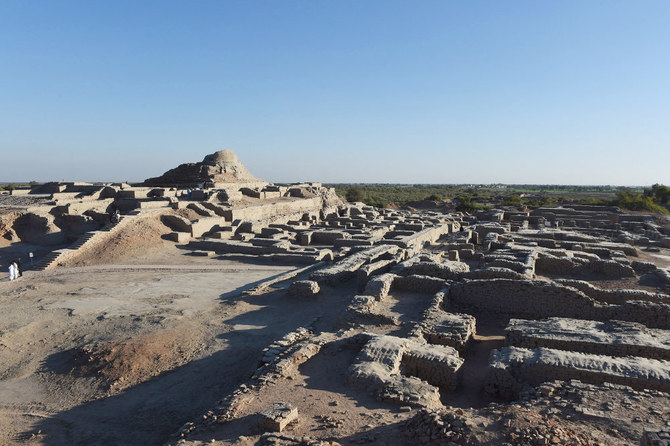
In this file photo taken on February 9, 2017 visitors walk through the UNESCO World Heritage archeological site of Mohenjo Daro some 425 kms north of the Pakistani city of Karachi. (AFP)
Short Url
Updated 20 November 2022
Follow

Climate change ‘main threat’ for World Heritage sites

  • For 50 years, Paris-based UNESCO has compiled a list of World Heritage sites, significant places that are deemed worthy of protection, and is marking the milestone this week in Greece

PARIS: One of the world’s first cities came close to being wiped off the map during tragic floods this summer in Pakistan. Though Mohenjo Daro survived, it has become a symbol of the threat global warming poses to humanity’s cultural heritage.
Built in around 3,000 B.C. by the Indus civilization in modern-day South Asia, Mohenjo Daro was not swept away by the floods, most likely thanks to the genius of its designers.
Perched high above the Indus River, the city was equipped with a primitive drainage system and sewers, meaning much of the floodwaters could be evacuated.
Nearly 1,600 Pakistanis died in the floods and 33 million others were affected in a disaster “probably” made worse by global warming, according to World Weather Attribution, a network of researchers.

HIGHLIGHTS

• In Peru, landslides occurred this year at the foot of Machu Picchu in the Andes mountains.

• In Australia, the protected Great Barrier Reef is experiencing bleaching episodes due to rising water temperatures.

The ancient metropolis “could have disappeared with all the archaeological traces” it contains, said Lazare Eloundou Assamo, the director of the World Heritage program at UN agency UNESCO.
The Pakistani site was “a victim” of climate change and was “very lucky” to still be around, exactly 100 years since it was first discovered in 1922, Assamo said.
Fortunately, “the situation is not catastrophic” in Mohenjo Daro, said Thierry Joffroy, a specialist in brick architecture who visited the site on behalf of UNESCO.
Despite ground sinking in some areas and water damage to some structures, the site “can be repaired,” Joffroy said.
For 50 years, Paris-based UNESCO has compiled a list of World Heritage sites, significant places that are deemed worthy of protection, and is marking the milestone this week in Greece.
“To protect this heritage ourselves ... is to confront the consequences of climate disruption and the loss of biodiversity. It’s the main threat ... that we assess in a tangible way,” UNESCO director Audrey Azoulay told the conference in Delphi on Thursday.
Of its 1,154 World Heritage sites, “one site in five, and more than a third of natural sites, already see this threat as a reality,” she said.
“We are experiencing many more incidents of floods, hurricanes, cyclones, typhoons,” said Rohit Jigyasu of the International Center for the Study of the Conservation and Restoration of Cultural Property (ICCROM).
“We have these climate-related disasters, which are having a huge impact on sites, for example Mohenjo Daro,” he said.
Huge forest fires have scorched the Rocky Mountains in Canada, which are a world heritage site, and this year flames came within 15 kilometers of Delphi as heatwave intensify the severity of wildfires across the Mediterranean basin.
In Peru, meanwhile, landslides occurred this year at the foot of Machu Picchu in the Andes mountains.
Other less noticeable changes can also have serious consequences.
In Australia, the protected Great Barrier Reef is experiencing bleaching episodes due to rising water temperatures.
In Ghana, erosion has washed away part of Fort Prinzenstein, which is conserved as a notable slave trading post.


Afghan barbers under pressure as morality police take on short beards

Updated 4 sec ago
Follow

Afghan barbers under pressure as morality police take on short beards

KABUL: Barbers in Afghanistan risk detention for trimming men’s beards too short, they told AFP, as the Taliban authorities enforce their strict interpretation of Islamic law with increasing zeal.
Last month, the Ministry for the Propagation of Virtue and Prevention of Vice said it was now “obligatory” to grow beards longer than a fist, doubling down on an earlier order.
Minister Khalid Hanafi said it was the government’s “responsibility to guide the nation to have an appearance according to sharia,” or Islamic law.
Officials tasked with promoting virtue “are obliged to implement the Islamic system,” he said.
With ministry officials patrolling city streets to ensure the rule is followed, the men interviewed by AFP all spoke on condition of anonymity due to security concerns.
In the southeastern province of Ghazni, a 30-year-old barber said he was detained for three nights after officials found out that one of his employees had given a client a Western-style haircut.
“First, I was held in a cold hall. Later, after I insisted on being released, they transferred me to a cold (shipping) container,” he said.
He was eventually released without charge and continues to work, but usually hides with his clients when the patrols pass by.
“The thing is that no one can argue or question” the ministry officials, the barber said.
“Everyone fears them.”
He added that in some cases where both a barber and clients were detained, “the clients have been let out, but they kept the barber” in custody.
Last year, three barbers in Kunar province were jailed for three to five months for breaching the ministry’s rules, according to a UN report.

‘Personal space’

Alongside the uptick in enforcement, the religious affairs ministry has also issued stricter orders.
In an eight-page guide to imams issued in November, prayer leaders were told to describe shaving beards as a “major sin” in their sermons.
The religious affairs ministry’s arguments against trimming state that by shaving their beards, men were “trying to look like women.”
The orders have also reached universities — where only men study because women have been banned.
A 22-year-old Kabul University student said lecturers “have warned us... that if we don’t have a proper Islamic appearance, which includes beards and head covering, they will deduct our marks.”
In the capital Kabul, a 25-year-old barber lamented that “there are a lot of restrictions” which go against his young clients’ preference for closer shaves.
“Barbers are private businesses, beards and heads are something personal, they should be able to cut the way they want,” he said.
Hanafi, the virtue propagation minister, has dismissed such arguments, saying last month that telling men “to grow a beard according to sharia” cannot be considered “invading the personal space.”

Business slump

In Afghanistan, the majority are practicing Muslims, but before the Taliban authorities returned to power in 2021, residents of major cities could choose their own appearance.
In areas where Taliban fighters were battling US-backed forces, men would grow beards either out of fear or by choice.
As fewer and fewer men opt for a close shave, the 25-year-old Kabul barber said he was already losing business.
Many civil servants, for example, “used to sort their hair a couple of times a week, but now, most of them have grown beards, they don’t show up even in a month,” he said.
A 50-year-old barber in Kabul said morality patrols “visit and check every day.”
In one incident this month, the barber said that an officer came into the shop and asked: “Why did you cut the hair like this?“
“After trying to explain that he is a child, he told us: ‘No, do Islamic hair, not English hair’.”