

On opening day, cinemagoers appreciate ‘unconventional’ theme of Pakistan’s Oscar entry ‘Joyland’ 

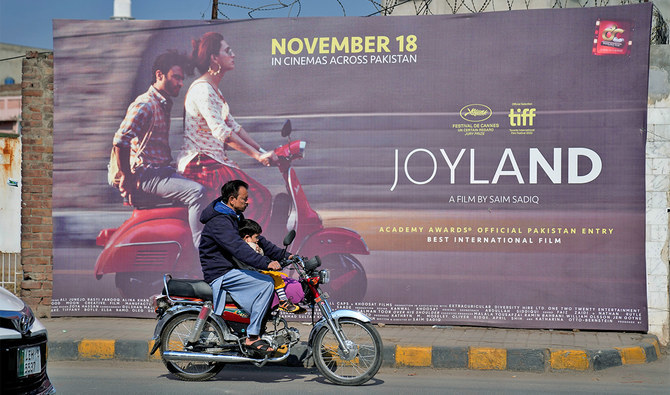
A motorcyclist rides past a promotional hoarding of an upcoming movie "Joyland" displayed outside a cinema, in Lahore, Pakistan, November 17, 2022. (AP)
Short Url
Updated 19 November 2022
Follow

On opening day, cinemagoers appreciate ‘unconventional’ theme of Pakistan’s Oscar entry ‘Joyland’ 

  • Joyland, first Pakistani competitive entry to Cannes Film Festival, received 10-minute standing ovation 
  • The film released in cinemas across Pakistan, except Punjab, on November 18, a week after it was banned 

KARACHI: Young Pakistani cinemagoers have appreciated the “unconventional” theme of the country’s Oscars 2023 entry, “Joyland,” which was released in cinemas in parts of Pakistan on Friday a week after it was banned by the government due to pressure from right-wing religious factions. 

The movie has been the center of discussions in Pakistan for the last few days after the government revoked its censor certificate a week prior to its release. A special committee, set up by Prime Minister Shehbaz Sharif, this week suggested a full-board review of the film and the movie was finally cleared for release a day before the scheduled date, with some cuts. 

Nueplex Cinemas in Karachi are screening the film but most of the single-screen cinemas have not put the film up on their schedule. Even at Nueplex Cinemas, half of the movie’s shows have been placed on the small screen with an occupancy of around 60 people, due to the last-minute announcement of the film’s release. 

The two-hour feature film celebrates “transgender culture” in Pakistan and tells the story of a family torn between modernity and tradition in contemporary Lahore, raising questions through the lives of the characters. 

While the movie still has to see the light of the day in the Punjab province, cinemagoers who watched the show in Karachi on the opening day said they were delighted to see the Pakistani cinema “exploring newer themes.” 

“It’s (Joyland) an unconventional movie and didn’t look like a Pakistani movie at all,” Waqas Tariq, a 33-year-old marketeer, told Arab News. 

Tariq said people should come and watch such movies as no one talks about these issues in Pakistan. 

Joyland won the Cannes “Queer Palm” prize for best feminist-themed movie as well as the Jury Prize in the “Un Certain Regard” competition, a segment focusing on young, innovative cinema talent. 

The first-ever Pakistani competitive entry to the Cannes Film Festival left the audiences slack-jawed and admiring, and got a nearly 10-minute-long standing ovation from the opening night’s crowd. 

At Karachi’s Nueplex Cinema, the second show on the opening day was a houseful, where most people who came to watch Joyland were aged 25-40. 

“When we talk about millennials and Gen Z, the movie will resonate with them but people who are in their 40s, 50s, parents, grandparents, it might offend their sensibilities,” Alia Hanif, 25, told Arab News. 

“The movie highlighted topics that we need to talk about. The transgender community, they are just as human as we are.” 

Ali Naqi, an architect, said the film falls under the social realism genre and it needs a “very mature audience.” 

“It’s no surprise that people are reluctant because it’s not in our culture,” he added. 

Ayesha Ahmed, a 27-year-old doctor by profession, was particularly intrigued by how the film treated mental health. 

“It [the movie] was in-my-face but it should have been. We are at a point where we can’t keep it subtle anymore,” she said. 


Pakistan says defense pact with Saudi Arabia elevated brotherly ties to ‘new heights’

Updated 25 February 2026
Follow

Pakistan says defense pact with Saudi Arabia elevated brotherly ties to ‘new heights’

  • Pakistan, Saudi Arabia signed strategic defense pact last year pledging aggression against one will be treated as attack on both
  • Deputy PM Ishaq Dar says enduring bonds with Islamic and Arab nations form vital pillar of Pakistan’s foreign policy 

ISLAMABAD: Deputy Prime Minister Ishaq Dar said on Wednesday that Pakistan’s defense pact with Saudi Arabia elevated its brotherly ties with the Kingdom to “new heights,” stressing that close ties with Arab and Islamic nations form a key pillar of Islamabad’s foreign policy. 

Pakistan and Saudi Arabia signed a Strategic Mutual Defense Agreement on Sept. 17 last year, pledging that aggression against one country would be treated as an attack on both, enhancing joint deterrence and formalizing decades of military and security cooperation.

Both nations agreed in October 2025 to launch an economic cooperation framework to strengthen trade and investment ties. 

“In the Middle East, our landmark Strategic Mutual Defense Agreement with Saudi Arabia has elevated our brotherly ties to new heights,” Dar said while speaking at the Pakistan Governance Forum 2026 event in Islamabad. 

The Pakistani deputy prime minister was speaking on the topic “Navigating International Relations Amidst Changing Geo-Politics.”

Dar noted that Pakistan has reinforced partnerships with other Middle Eastern nations such as the UAE, Qatar, Jordan, Oman, Egypt and Bahrain. He said these partnerships have yielded “concrete agreements” in investment, agriculture, infrastructure, and energy sectors. 

“Our enduring bonds with Islamic and Arab nations form a vital pillar of our foreign policy, and we will continue to expand our partnerships across Asia, Latin America, and Africa,” he said. 

Dar pointed out that the presidents of Kazakhstan, Uzbekistan and Kyrgyzstan have undertaken visits to Pakistan in recent months, reflecting Central Asian nations’ desire to boost cooperation with Islamabad.

On South Asia, the Pakistani deputy PM said Pakistan has successfully transformed its fraternal ties with Bangladesh into “a substantive partnership.”

“Similarly, the trilateral mechanism involving China, Pakistan, and Bangladesh has been launched with a view to expanding and deepening regional cooperation and synergy,” the Pakistani minister said. 

He said Islamabad has strengthened its “all-weather” partnership with China via the second phase of the multi-billion-dollar China-Pakistan Economic Corridor agreement and “unwavering support” from both sides for each other’s core interests. 

Dar said Pakistan had also reinvigorated its partnership with the US, advancing cooperation in trade, technology, investment, and regional stability. 

“This calibrated approach has enhanced our ability to navigate complexity with skill and confidence, ensuring that our national interests are served without compromising our core foreign policy principles,” he said.