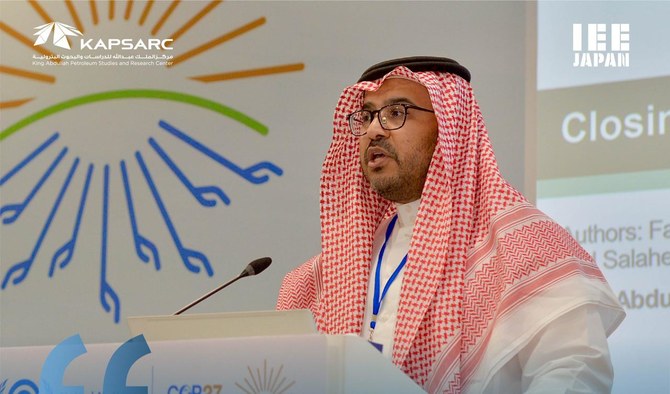

RIYADH: Nations with underdeveloped economies are not getting the support pledged in the Paris Agreement as richer countries are failing to meet their promises, the president of the King Abdullah Petroleum Studies and Research Center has said.
Speaking in a discussion with the Institute of Energy Economics in Japan on the sidelines of the UN Climate Change Conference in Sharm El-Sheikh, Egypt, Fahad Alajlan stressed the critical need for climate finance to reach the goals of the Paris Agreement.
The Paris Agreement, a legally binding international treaty on climate change and net-zero emission goals signed at COP 21 in 2015, saw nations with developed economies committing to channel $100 billion per year by 2020 to assist with energy transition and frameworks to mitigate global warming — a commitment which, Alajlan pointed out, is not being honored.
“We have to address and acknowledge that we come up short and need to do more in climate finance — this is vital,” he said, reflecting KAPSARC’s position as an advisory think-tank within global energy economics and sustainability, providing consulting services to the Saudi energy sector.
Underlining the importance of private capital, Alajlan said that multilateral development banks and donors had a key role to play by de-risking energy and infrastructure projects through equity investment to attract institutional investors.
Alajlan pointed out that energy transformation provides fast opportunities for investment in infrastructure and energy and that Circular Carbon Economy frameworks significantly decrease the need for new investment and new infrastructure.
CCE advocates the reduction, recycling and reuse of carbon emissions across industrial processes, which are goals that are now familiar and accepted across the world as a way of mitigating harmful emissions.
During COP27, KAPSARC launched the second edition of the Circular Carbon Economy Index, a tool to compare how 64 countries are deploying various methods and technologies to reduce their CO2 emissions.
The CCE Index covers 90 percent of the global economy and carbon emissions, according to a statement released by the think tank.
In the 2022 edition, Norway, the Netherlands, Germany, the UK, and Switzerland top the CCE Index. At the bottom are five Sub-Saharan African countries.
The gap between these top and bottom performers is notable, which indicates that countries toward the end of the list in particular will be in need of significant assistance to be able to successfully transition to CCEs.
With regard to CCE Performance, many countries were found not yet deploying some of the most important technologies necessary for achieving full carbon circularity.
Compared with the CCE Index of last year, 57 countries improved their total CCE Index scores in 2022, while seven saw a deterioration in their scores.
Joining the KAPSARC-IEEJ discussion, which aimed to highlight the role of finance in achieving the net-zero energy transition from the Asian perspective, IEEJ's chairman, Tatsuya Terazawa said that the event was a continuation of a memorandum of understanding that his organization signed with KAPSARC in August to promote cooperation and research activity in several fields.
The IEEJ is an energy think tank in Japan that focuses on energy, economic and environmental issues, as well as the geopolitics of the Middle East.