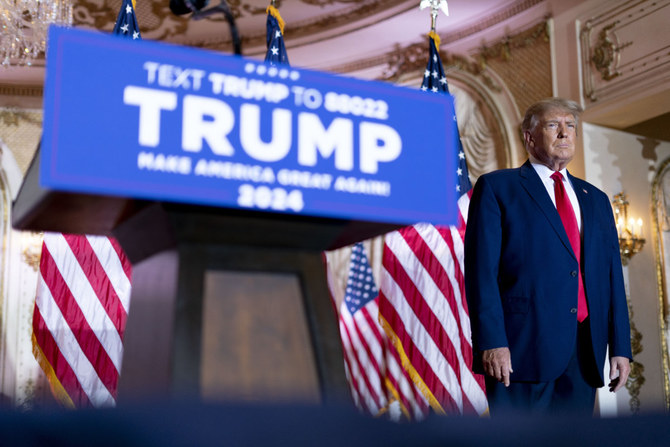
Donald Trump may be running for president, but he still can’t use Facebook.
The social media platform has no plans to reinstate Trump’s account following the former president’s announcement that he will seek a second term in the White House, the company confirmed Wednesday. Trump was kicked off Facebook following the Jan. 6, 2021, attack on the US Capitol.
Trump may not have to wait long to get back on the site, however. His suspension from Facebook is set to be reconsidered in January, two years after it was first imposed.
One change will be immediate: As a candidate, Trump will no longer be subject to Facebook fact checks. That’s because under Facebook rules, comments by elected officials and candidates for office aren’t subject to fact checks on its site. The Associated Press participates in Facebook’s independent fact-checking program.
Throughout his tenure as president, Trump’s use of social media posed a significant challenge to major social media platforms trying to balance the public’s need to hear from their elected leaders with worries about misinformation, harassment and incitement of violence.
Following the Jan. 6 riot, Trump was also kicked off Snapchat, Twitter and Instagram, which is owned by Facebook parent company Meta. Trump’s ability to post videos to his YouTube channel was suspended.
YouTube spokeswoman Ivy Choi said Wednesday the company had no plans to lift the suspension.
Twitter’s new owner, Elon Musk, has said he disagreed with the platform’s decision to bar Trump following the Jan. 6 attack. Musk said no announcement about reinstating banned users will be made until a content moderation council has reviewed the issue
Twitter did not respond to questions about whether Trump’s candidacy will impact the decision. Since his suspension, Trump has started his own social media platform, TruthSocial, and said he has no plans to rejoin Twitter if allowed.
The platforms would be justified if they extend their restrictions on Trump or make them permanent, said Heidi Beirich, founder of the Global Project Against Hate and Extremism and a member of the Real Facebook Oversight Board, a group that has criticized Meta’s response to extremist content and misinformation.
“The big problem is treating candidates as if they’re in a special category and deserve special treatment,” Beirich said. “If you have a set of rules, it should apply to everyone. The decision shouldn’t be a struggle.”
Facebook initially placed a 24-hour suspension on Trump’s account on Jan. 6 after he praised the rioters who stormed the Capitol. Facebook creator and CEO Mark Zuckerberg announced an indefinite suspension on Jan. 7, adding that “the risks of allowing the President to continue to use our service during this period are simply too great.”
The company’s quasi-independent oversight board upheld the ban but directed Facebook to set a time limit. The ban is now set to expire Jan. 7, 2023.


Facebook still banning Trump — for now — despite campaign
https://arab.news/cpfnb
Facebook still banning Trump — for now — despite campaign

- Trump was kicked off Facebook following the Jan. 6, 2021, attack on the US Capitol


Eurovision Sport, Camb.ai to provide live subtitling for Paralympic Winter Games
- Partnership aims to increase accessibility for all audiences
- Milano Cortina Games run from Friday to March 15
LONDON: Eurovision Sport, the European Broadcasting Union’s free-to-air streaming platform, will provide live and on-demand subtitling for coverage of the Milano Cortina 2026 Paralympic Winter Games in partnership with AI language company Camb.ai
The service will run across all competition days, allowing viewers to stream all six Paralympic Winter Games sports on Eurovision Sport with real-time subtitles. The Games open on Friday and run through March 15.
Camb.ai will supply contextual speech-to-text transcription for both live and catch-up coverage, which the organizers said would support accessibility without altering the editorial integrity of broadcasts.
Eurovision Sport Managing Director Alan Fagan said the aim was to make the Games available to “the widest possible audience,” by scaling up digital accessibility across every event on the platform.
The initiative forms part of the EBU’s most extensive digital coverage of a Paralympic Winter Games to date and complements member broadcasters’ linear output.
It also reflects a wider industry push to make live sport easier to follow for viewers watching without sound, people with hearing impairments and audiences consuming content on demand.
Camb.ai’s Chief Technology Officer Akshat Prakash said the company was proud to deepen its partnership with Eurovision Sport, describing the platform as a leader in applying new technology to sports coverage.
The two organizations began working together in 2024, when they delivered what they described as Europe’s first AI-powered real-time translated sports commentary during European Athletics events.