

UNRWA in urgent cash appeal to help Palestinian refugees

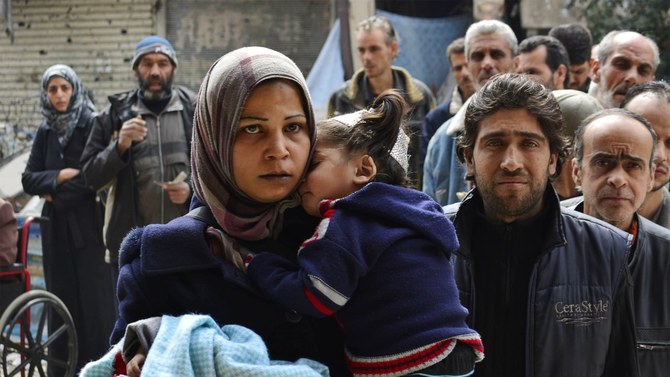
UNRWA ran into financial problems after losing $360 million of US funding cut by former American President Donald Trump in 2018. (Reuters/File Photo)
Short Url
Updated 15 November 2022
Follow

UNRWA in urgent cash appeal to help Palestinian refugees

  • UNRWA urgently needs between $50 million and $80 million

AMMAN: The UN relief agency has warned of a major disruption to services for Palestinian refugees unless it receives an immediate cash injection.

Philippe Lazzarini, commissioner general of the financially troubled UN Relief and Works Agency, said that in the coming weeks, UNRWA urgently needed between $50 million and $80 million “to be able to end the year and keep schools, health centers, and other basic services running.”

The official was addressing a news conference on the sidelines of the biannual UNRWA Advisory Commission meeting in the Jordanian capital Amman on Monday.

He pointed out that many Palestinian refugees in Gaza, the West Bank, Lebanon, Syria, and Jordan were “almost entirely dependent on the agency’s support,” adding that the agency required close to $200 million over the next three years to achieve the objectives of its strategic plan.

Lazzarini noted that Palestinian refugees’ hardships were increasing because of regional conflicts and instability, and the consequences of the coronavirus pandemic.

He said: “This entails securing more funding to meet the refugee communities’ needs because UNRWA cannot operate with the same financial resources.”

The organization has been adopting austerity measures to cope with its increasing financial difficulties but, “UNRWA cannot continue to operate in the same manner in light of the high costs and increased needs of refugees,” he added.

Highlighting that poverty rates in UNRWA-run Palestinian refugee camps — mainly in Gaza, Lebanon, and Syria — had reached “unprecedented levels of around 80 percent,” he said that “40 percent of children in Gaza cannot have breakfast every morning because of the miserable situation.”

He added that In Lebanon, most Palestinian refugees existed below the poverty line and many in Syria lived among “rubble” in the destroyed camps because they had nowhere else to go.

Lazzarini said that the UN agency played a “public sector-like role” in refugee camps, adding that it remained the “largest investment for Palestinian refugees” in the absence of a just solution to the long-running conflict with Israel.

He pointed out that without additional funding, “UNRWA will not be able to continue providing the same quality of services in the education and health sectors” to the 5.7 million Palestinian refugees.

UNRWA, he noted, had reached out to its long-time donors, and succeeded in reinforcing its status and keeping it on the agenda of the international community.

“This support stems from the deep belief held by most UN member states that UNRWA is irreplaceable for the well-being and the fulfilment of the human rights of Palestine refugees.”

Lazzarini hailed Saudi Arabia’s recent contribution of $27 million in support of the agency’s programs and operations in the region.

“It is now my hope that we will resume our solid and predictable partnerships with all Gulf countries, including by reaching again the level of funding that UNRWA received from the Arab countries between 2015 and 2018,” he added.

Also on Monday, Jordanian Foreign Minister Ayman Safadi called on the international community to maintain necessary financial support to UNRWA.

Opening the meeting in Amman, the minister underlined the centrality of the agency’s “indispensable” role in providing essential services for Palestinian refugees.

Safadi highlighted the need, “to translate the political support for the agency into sustainable financial support that could bridge the agency’s budget deficit and help it continue to serve Palestinian refugees.”

UNRWA ran into financial problems after losing $360 million of US funding cut by former American President Donald Trump in 2018.

In April 2021, President Joe Biden’s administration announced it would provide $235 million in US aid to the Palestinians, two-thirds of which goes to UNRWA.


Lebanon says 7 killed in Israeli strike on central Beirut

Updated 4 sec ago
Follow

Lebanon says 7 killed in Israeli strike on central Beirut

Beirut, Lebanon: Lebanon said an Israeli strike on central Beirut’s seafront killed at least seven people early on Thursday, another attack in the heart of the capital as Iran-backed Hezbollah launched more missiles at Israel.
The Israeli military said separately it had carried out strikes on Beirut’s southern suburbs overnight against Hezbollah, which had announced a major new operation against Israel.
Local media aired footage showing smoke rising along the seaside road area after the strike in central Beirut, which state-run National News Agency (NNA) said targeted a car.
“The Israeli enemy strike on Ramlet Al-Bayda in Beirut led to an initial toll of seven dead and 21 wounded,” the health ministry said in a statement.
It was the third attack in the heart of the capital since the Middle East war began. Israel has also repeatedly hit the southern suburbs of Beirut where Israeli military said on Thursday it had hit 10 Hezbollah targets.
The NNA reported on Thursday that Israeli strikes had also hit several towns in southern Lebanon, including Taybeh and Al-Sultaniyya as well as Qana, near the city of Tyre.
Hezbollah said early Thursday that it had fired off missiles at an Israeli military intelligence base in the suburbs of Tel Aviv.
Lebanon was drawn into the Middle East war last week when Hezbollah attacked Israel in response to the killing of Iranian supreme leader Ayatollah Ali Khamenei in US-Israeli strikes.
Israel, which kept up its strikes in Lebanon even before the war despite a 2024 ceasefire with Hezbollah, has since launched air raids across Lebanon and sent ground troops into border areas.
Its offensive has killed more than 630 people, according to Lebanese authorities, while more than 800,000 people have registered as displaced, with around 126,000 of them staying in collective shelters.
Some displaced people have been sleeping out in the open or in tents on the streets of Beirut, including in the seaside area of Ramlet Al-Bayda.

- Hezbollah operation -

Late Wednesday, French President Emmanuel Macron called for Israel to halt its ground offensive in Lebanon and on Iran-backed group Hezbollah to “immediately” stop attacks, after speaking with the country’s president Joseph Aoun.
Iran’s Revolutionary Guards said earlier that they had carried out a joint missile operation with ally Hezbollah against targets in Israel.
In turn, the Israeli military said early Thursday that “over the past hours, the IDF has begun a wide-scale wave of strikes targeting terror infrastructure belonging to the Hezbollah terrorist organization across Lebanon.”
It also said it hit “dozens of launchers” as well as Hezbollah intelligence and command sites in south Beirut.
It followed a string of Hezbollah statements saying its fighters fired barrages of rockets, advanced missiles and drones at towns, military bases and other locations, mainly in the Israel’s north.
On Wednesday, Israel pounded south Beirut and the country’s south and east, with the health ministry reporting several strikes that each killed at least eight people.
Authorities said a strike on an apartment in the densely populated Aisha Bakkar area in central Beirut wounded four people.
On Sunday, Israel hit a seafront hotel not far from Ramlet Al-Bayda, saying it was targeting Iranian foreign operations officers. Iran later said the raid killed four of its diplomats.