

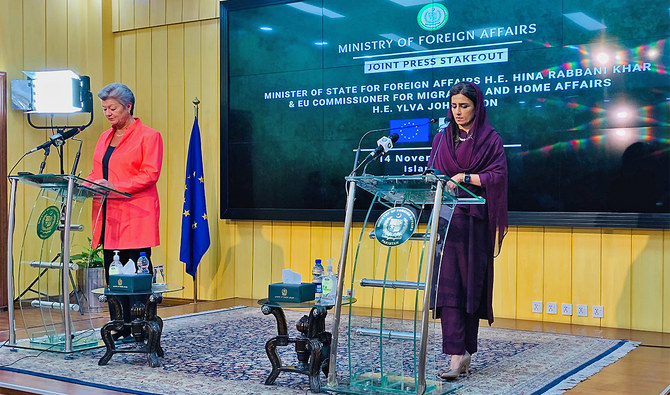

ISLAMABAD: European Union (EU) Commissioner for Migration and Home Affairs, Ylva Johansson, said on Monday the EU and Pakistan had launched a “comprehensive dialogue” on issues such as migration and mobility as European countries sought skilled workers.
Johansson arrived in Islamabad on Sunday on a two-day visit and held meetings on migration, mobility, border management, and security cooperation.
“I am very happy that we together have launched today this comprehensive dialogue on migration and mobility as EU is an aging society and we are lacking skilled workers in many areas at different levels,” Johansson said at a joint press conference with Pakistan’s state minister for foreign affairs, Hina Rabbani Khar, in Islamabad.
“Pakistan is very much prepared in the area of legal migration to the EU and I am happy to explore and intensify our cooperation on the legal migration,” she said, adding that both needed to work together on counter smuggling and irregular arrivals, and step up return and re-admission.
“In all these areas we are also ready to step up our financial contributions and other ways to cooperate with Pakistan,” Johansson added.
Recognizing Pakistan as a very important strategic partner, she said the EU was committed to building on 60 years of relations in diverse areas, including trade.
“I have seen that Pakistani authorities are making good and sound border management and sophisticated counter-terrorism strategies that are being designed and implemented. These efforts are necessary and are well advanced,” the EU Commissioner added, saying this illustrated a “responsible approach” by Pakistan as an influential and leading actor in the region.
“The stable security situation is in the interest of all including beyond the region, that is why I would like to see deeper cooperation in the area of security between Pakistan and the EU,” she added.
In her remarks, Khar said Pakistan gave high importance to a sustained engagement with the EU, especially on GSP Plus status.
GSP+ is a special trade arrangement offered to developing economies by European nations in return for their commitment to implement 27 international conventions on human rights, environmental protection and governance.
On 21 September 2021, in its review of the GSP+ scheme, the European Commission introduced six new conventions, pertaining in particular to children’s rights, environmental safety and persons with disabilities.
Last April, the European Parliament moved a resolution against Pakistan, seeking an immediate review of its eligibility for GSP+ status over what it called violence and discrimination against religious minorities and other vulnerable groups, as well as a crackdown on media. The EU Ambassador to Islamabad said last October the South Asian nation would have to “redouble” its efforts to meet international rights conventions in order to continue to be a part of GSP+.
The current GSP framework will come to an end in December 2023.
“Through GSP Plus, we have seen an escalation in two-way exports of more than 60 percent,” Khar said. “I think this is a win-win situation and therefore we are looking toward the ongoing dialogue on that and the continuation of that to offer possibilities for the two.”
She said Pakistan was continuously working to minimize the possibility of illegal migration, but also wanted doors opened for legalized migration.
“Pakistan with its 65 percent young population is well-placed today to provide the EU skilled workforce in various areas, including information technology,” she said, hoping that the dialogue on migration and mobility would be fruitful and add another dimension to Pakistan-EU ties.


