

UAE President Mohamed bin Zayed inaugurates Sheikh Zayed Grand Mosque in Indonesia

1 / 5
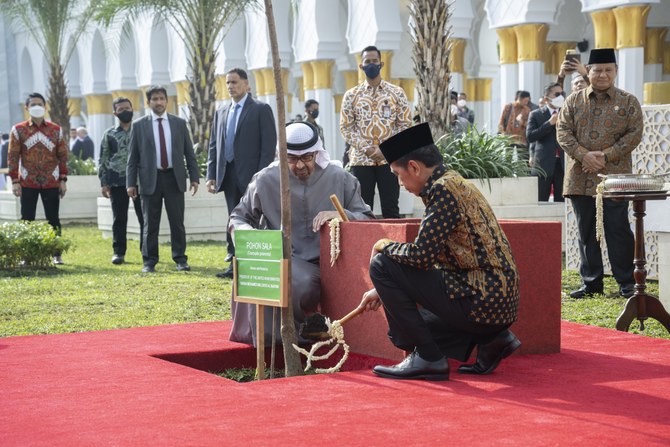
UAE President Mohamed bin Zayed and his Indonesian counterpart Joko Widodo attended the inauguration ceremony of Sheikh Zayed Grand Mosque in Solo. (WAM)
2 / 5
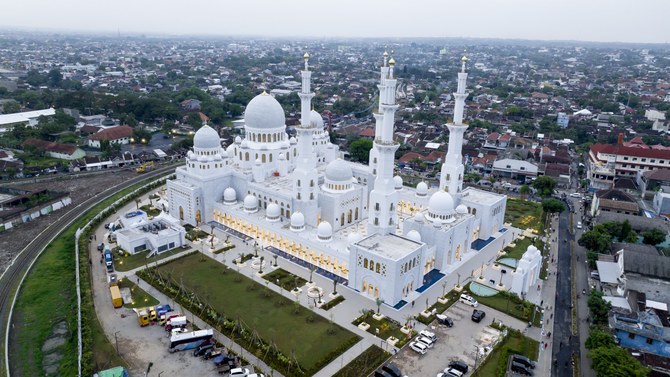
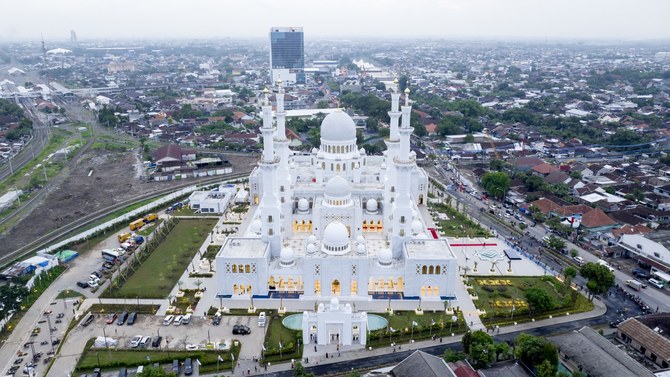
The new mosque in Solo has 56 domes, 4 minarets, and 32 pillars in the main prayer area. (WAM)
3 / 5
The architecture of Sheikh Zayed Grand Mosque in Solo includes some traditional Indonesian designs. (WAM)
4 / 5
The Sheikh Zayed Grand Mosque in Solo is a replica of the one in Abu Dhabi and was gifted by the UAE President during his visit to Indonesia for G20 Summit. (WAM)
5 / 5
UAE President Mohamed bin Zayed and his Indonesian counterpart Joko Widodo planted Sala, a symbolic national plant in Solo, outside the mosque's courtyard. (WAM)
Short Url
Updated 14 November 2022
Follow

UAE President Mohamed bin Zayed inaugurates Sheikh Zayed Grand Mosque in Indonesia

  • The mosque is a replica of the popular landmark in Abu Dhabi
  • Sheikh Zayed Grand Mosque in Solo has 56 domes, accomodates 10,000 worshippers

SURAKARTA, Indonesia: UAE President Mohamed bin Zayed has inaugurated the Sheikh Zayed Grand Mosque in Solo with his Indonesian counterpart Joko Widodo during a ceremony on Monday.
The mosque is a replica of the popular landmark in Abu Dhabi, named after the UAE’s late President Sheikh Zayed bin Sultan Al-Nahyan.
“The architecture includes some traditional Indonesian designs. Local materials in Indonesia were used in the making of the mosque, which accommodates 10,000 worshipers,” read a statement on the Emirates News Agency (WAM).
The new mosque in Solo, gifted by the UAE leader during his visit to the G20 Summit in Bali, has 56 domes, 4 minarets, and 32 pillars in the main prayer area, according to WAM.
Mohamed bin Zayed tweeted, “Named in honour of the UAE’s Founding Father, the Mosque represents his values of peace and goodwill, reflecting the longstanding ties that exist between our two countries.”


Joko Widodo said the Sheikh Zayed Grand Mosque in Solo “will become a place of prayer, a center for Islamic studies, and the center of a religious tourism destination.
He thanked the UAE for the “exceptional monument” that reflected the deeply-rooted relations and common values between both countries.

The inauguration ceremony was attended by delegates and senior officials from both countries.
Abu Dhabi’s Sheikh Zayed Grand Mosque, opened in 2007, is one of the world’s largest mosques and an architectural icon that combines Islamic architecture and design. It is also a major tourist destination in the capital.


Cambodia takes back looted historic artifacts handled by British art dealer

Updated 28 February 2026
Follow

Cambodia takes back looted historic artifacts handled by British art dealer

  • The objects were returned under a 2020 agreement between the Ministry of Culture and Fine Arts and the family of the late Douglas Latchford, a British art collector and dealer who allegedly had the items smuggled out of Cambodia

PHNOM PENH, Cambodia: Cambodian officials on Friday received more than six dozen historic artifacts described as part of the country’s cultural heritage that had been looted during decades of war and instability.
At a ceremony attended by Deputy Prime Minister Hun Many, the 74 items were unveiled at the National Museum in Phnom Penh after their repatriation from the United Kingdom.
The objects were returned under a 2020 agreement between the Ministry of Culture and Fine Arts and the family of the late Douglas Latchford, a British art collector and dealer who allegedly had the items smuggled out of Cambodia.
“This substantial restitution represents one of the most important returns of Khmer cultural heritage in recent years, following major repatriations in 2021 and 2023 from the same collection,” the Culture Ministry said in a statement. “It marks a significant step forward in Cambodia’s continued efforts to recover, preserve, and restore its ancestral legacy for future generations.”
The artifacts were described as dating from the pre-Angkorian period through the height of the Angkor Empire, including “monumental sandstone sculptures, refined bronze works, and significant ritual objects.” The Angkor Empire, which extended from the ninth to the 15th century, is best known for the Angkor Wat archaeological site, the nation’s biggest tourist attraction.
Latchford was a prominent antiquities dealer who allegedly orchestrated an operation to sell looted Cambodian sculptures on the international market.
From 1970 to the 1980s, during Cambodia’s civil wars and the communist Khmer Rouge ‘s brutal reign, organized looting networks sent artifacts to Latchford, who then sold them to Western collectors, dealers, and institutions. These pieces were often physically damaged, having been pried off temple walls or other structures by the looters.
Latchford was indicted in a New York federal court in 2019 on charges including wire fraud and conspiracy. He died in 2020, aged 88, before he could be extradited to face charges.
Cambodia, like neighboring Thailand, has benefited from a trend in recent decades involving the repatriation of art and archaeological treasures. These include ancient Asian artworks as well as pieces lost or stolen during turmoil in places such as Syria, Iraq and Nazi-occupied Europe. New York’s Metropolitan Museum of Art is one of the prominent institutions that has been returning illegally smuggled art, including to Cambodia.
“The ancient artifacts created and preserved by our ancestors are now being returned to Cambodia, bringing warmth and joy, following the country’s return to peace,” said Hun Many, who is the younger brother of Prime Minister Hun Manet.