Now Pakistan must learn how to close out big games — Shan Masood

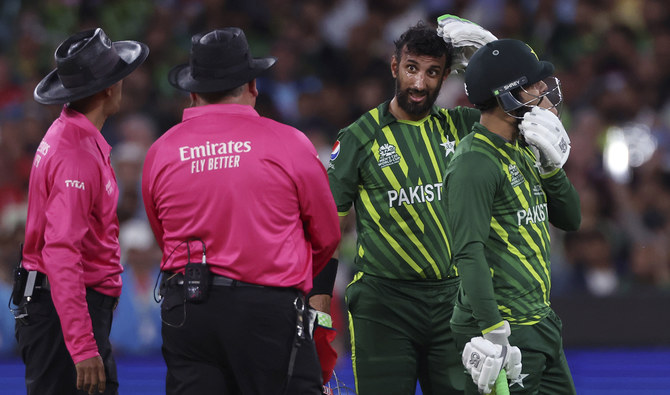
The umpires check on Pakistan's Shan Masood, second right, after he is hit in the head by a delivery from England during the final of the T20 World Cup Cricket tournament at the Melbourne Cricket Ground in Melbourne, Australia, on November 13, 2022. (AP)
Short Url
Updated 13 November 2022
Follow

Now Pakistan must learn how to close out big games — Shan Masood

  • Pakistan pushed England all the way in Melbourne but fell to a five-wicket defeat with six balls remaining
  • Masood top-scored with 38 and said he took responsibility for not staying around longer for a bigger total

MELBOURNE: Pakistan can take pride in getting to the World Cup final but now their young team must take the next step -- learning how to close out tight games, said batsman Shan Masood on Sunday. 

Babar Azam's men pushed England all the way at the Melbourne Cricket Ground but fell to a five-wicket defeat with six balls remaining after setting a below-par 138-run target to win. 

Masood top-scored with 38 and said he took responsibility for not staying around longer to put together a bigger total. 

"There were stages especially with the bat that we could have finished things off really well," he said. 

"Personally, I take blame for it. We were aiming for 170 and having looked at the way the innings ended, we could have used a batsman staying in and getting us to at least 155-160, which would have been good on that pitch." 

Instead, they fell short, leaving it up to their renowned pace attack to blunt England. But Ben Stokes's unbeaten 52 was enough to see his team to a second T20 World Cup triumph following their 2010 victory. 

Pakistan suffered a blow when strike bowler Shaheen Afridi was injured catching Harry Brooks in the deep and unable to complete his final two overs at the death. 

"We could have done with his two overs at the end," Masood said. 

"I hope he is OK. It's his knee. From what I am hearing all his ligament tests are clear." 

Despite the defeat, Pakistan's performance in Australia exceeded expectations after they lost their first two matches in the Super 12 to India and Zimbabwe and scraped into the semi-finals courtesy of South Africa's shock defeat to the Netherlands a week ago. 

Masood said the young team had a bright future, but needed to learn how to win the tight moments. 

"The games that we won, we won them quite comfortably," he said. 

"The good sign is that when we lost, we lost close games. So you realise that these things are in your own hands. 

"The three games we lost to India, Zimbabwe and now England there were opportunities where we could have closed out those games. 

"I think the next step this young team has to take is finishing games, finishing out close moments. 

"But I just feel the way Babar is leading this team, the leadership group in Shadab (Khan) and (Mohammad) Rizwan, I've got no doubts that with future World Cups coming this side will be a constant threat and among the top teams." 


Pakistan Navy tests missile, loitering munitions and unmanned vessel at Arabian Sea

Updated 5 sec ago
Follow

Pakistan Navy tests missile, loitering munitions and unmanned vessel at Arabian Sea

  • The exercise reflects growing focus on air defense and autonomous systems in modern warfare

ISLAMABAD: Pakistan’s navy conducted live firing of a surface-to-air missile, tested loitering munitions and carried out open-sea trials of an unmanned surface vessel during a major exercise in the North Arabian Sea on Saturday, highlighting a growing focus on air defense and unmanned warfare amid evolving regional security dynamics.

The exercise, which demonstrated both conventional and autonomous capabilities, comes at a time when Pakistan is increasingly emphasizing advanced technology and multi-domain operations following last year’s four-day conflict with nuclear-armed India, which reinforced the importance of air defense, surveillance and precision strike systems.

“Pakistan Navy demonstrated its operational readiness and combat preparedness through a comprehensive exercise in the North Arabian Sea, showcasing both conventional and unmanned capabilities, as per dictates of evolving naval warfare,” the Navy’s Directorate General Public Relations said in a statement.

“The exercise included the successful live firing of LY-80(N) Surface to Air Missile (SAM) from Vertical Launching System at extended range, validating the long-range capabilities of Pakistan Navy’s modern air defense systems,” it added. “LY-80(N) SAM successfully engaged and neutralized an aerial target, demonstrating Pakistan Navy’s robust air defense capabilities.”

The statement said the exercise also featured the successful engagement of surface targets using a loitering munition, which it said demonstrated the navy’s precision strike capability.

“Successful open-sea trials of Unmanned Surface Vessel (USV) were also conducted, marking a significant leap in autonomous naval technology,” it continued. “The trials validated the platform’s ability to combine high-speed performance with mission-critical durability.”

Pakistan’s armed forces routinely hold large-scale exercises to enhance operational readiness, but recent drills have placed greater emphasis on emerging technologies, reflecting lessons drawn from modern conflicts.

Key capabilities demonstrated during the exercise included extreme maneuverability, precision navigation and weather resilience.

Chief of the Naval Staff Admiral Naveed Ashraf commended officers and men of the Pakistan Navy for their professionalism and operational competence, reiterating the navy’s resolve to ensure the seaward defense of the country and safeguard its maritime interests.