BEIJING: Chinese authorities should take a more targeted approach to tackle COVID-19 outbreaks and rectify any extra “layers” of measures, the state-run Xinhua news agency reported on Thursday, as cities reeled under tighter curbs as cases spread.
China is grappling with its highest tallies of coronavirus cases since April, raising questions about its zero-COVID policy that has frustrated the public and inflicted damage on the world’s second-largest economy. New domestic cases rose to 8,824 on Wednesday, according to health authority data.
China has repeatedly said it would stick to the zero-COVID policy despite the growing outbreaks but pressure is growing on the central government to rein in over-zealous authorities in the provinces fearing blame for failing to contain the virus.
Thousands of government officials have been punished for various perceived failings in the nearly three years of the pandemic.
“All localities will further improve the level of scientific and precise prevention and control, strive to achieve the greatest prevention and control effect at the least cost, and minimize the impact of the epidemic on economic and social development,” Xinhua reported.
It cited improvements in the implementation of measures in some major cities such as Zhengzhou, in the central province of Henan.
When infections were found in certain buildings in Zhengzhou only the surrounding areas were being closed and the entire community was not being “controlled indiscriminately,” Xinhua reported.
The economic costs of COVID-19 in China, where the virus first emerged in December 2019, are being felt in most sectors.
Haima Automobile said logistics and personnel movements at its Zhengzhou base have been heavily impacted by COVID-19 since October.
This month, Apple supplier and iPhone assembler Foxconn was rocked by discontent over stringent COVID-19 measures, with many workers fleeing the site.
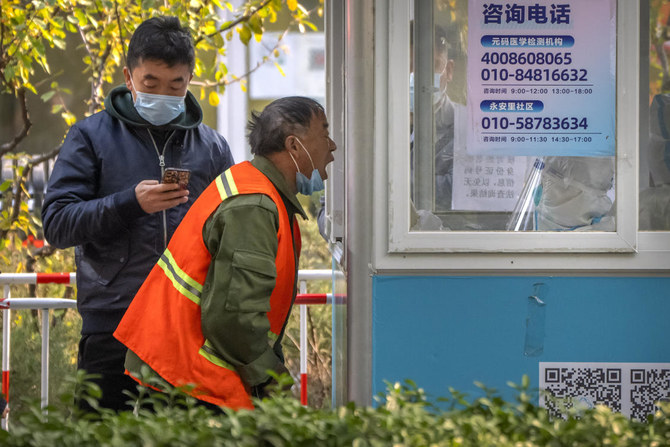
In Guangzhou, a southern city of about 19 million where cases hit more than 2,000 for a third straight day on Thursday, officials have launched mass testing, for the time being resisting a city-wide lockdown.
But some residents suspect a lockdown like the one endured by the financial hub of Shanghai for months this year may be coming.
Mason Long, who works for a Guangzhou gaming company, said a full lockdown could happen, with most of the city’s 11 districts already have under some form of new COVID-19 restriction.
“Panyu district just announced that it’s restricting travel in and out, so that’s three districts to announce that,” Long said.
“The rest of us in other districts are super worried this will be applied to the entire city and we’ll be facing a Shanghai-style lockdown. I personally think it could.”
Many people have already moved to other cities, or are planning to do so, he said.


China warns against extra ‘layers’ of COVID-19 curbs as outbreaks widen
https://arab.news/vht39
China warns against extra ‘layers’ of COVID-19 curbs as outbreaks widen

- China has repeatedly said it would stick to the zero-COVID policy despite the growing outbreaks
- The economic costs of COVID-19 in China are being felt in most sectors


Kremlin welcomes US sanctions waiver says US and Russia share interest in stable energy markets
DUBAI: Russia sees a U.S. sanctions waiver on its oil as an attempt by Washington to stabilise global energy markets, and the two countries have a shared interest in this, Kremlin spokesman Dmitry Peskov said on Friday.
"We see actions by the United States aimed at trying to stabilise energy markets. In this respect, our interests coincide," he said.
US Treasury Secretary Scott Bessent announced a temporary authorisation allowing countries around the world to purchase Russian oil currently stranded at sea on Thursday extending a measure that had previously been granted only to Indian refiners.
Bessent stressed in a post on X that the authorisation would not provide significant financial benefit to the Russian government.
“This narrowly tailored, short-term measure applies only to oil already in transit and will not provide significant financial benefit to the Russian government, which derives the majority of its energy revenue from taxes assessed at the point of extraction,” Bessent said on a post on X.
However, the measure received mix reviews in European capitals, with many fearing it could help replenish Russia's assualt on Ukraine.
"I am concerned that we are further filling Putin's war chest," German Economy Minister Katherina Reiche said in Berlin on Friday.
Reiche said that she saw both sides to the United States' decision to issue a 30-day waiver for the purchase of Russian oil products, understanding the increasing ecnomic and political turnout from the oil crisis, particurlarly in South Korea and Japan.
"It seems to me that domestic political pressure in the United States is very, very high," Reiche said.
German Chancellor Friedrich Merz was more direct, saying on Friday that it was wrong to ease sanctions against Russia for whatever reason. The sentiment was echoed by Norway’s Prime Minister, who also said sanctions should not be eased.
Oil prices held gains above $100 Friday and most equity markets dropped after Iran's leader called for the blocking of the crucial Strait of Hormuz and the opening up of new fronts in the war against the United States and Israel.
With the conflict heading towards its third week and showing no signs of ending, investors are growing increasingly worried about an extended crisis that could fan inflation and hammer the global economy.