

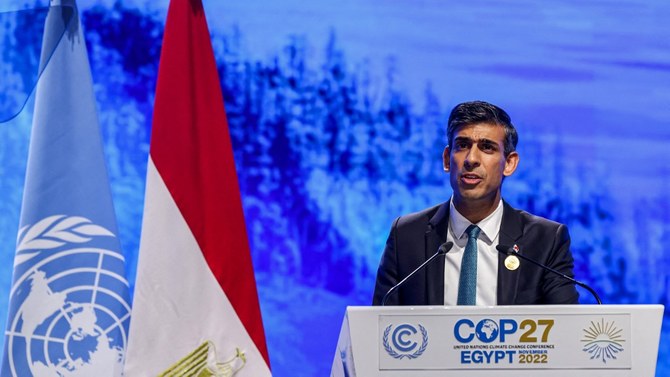
Viral videos of Rishi Sunak’s mysterious rushing out of Egypt’s COP27 stir social media debate

Short Url
Updated 09 November 2022
Follow

Viral videos of Rishi Sunak’s mysterious rushing out of Egypt’s COP27 stir social media debate

  • Speculations about the PM’s abrupt exit range from having had a bad meal to a national emergency

LONDON: A video of British Prime Minister Rishi Sunak running off the stage and being rushed out of the room by aides during Monday’s panel at COP27 has gone viral on the internet with people speculating about the reasons for the abrupt exit.

A video posted by Leo Hickman, journalist and director at Carbon Brief UK, shows Sunak being approached by his aides on stage before being escorted out of the room.

“UK prime minister @RishiSunak has just been rushed out of the room by his aides during the middle of the launch for forests partnership at #COP27,” said Hickman in a tweet.

Sunak was on stage for a climate change event when his aides interrupted him, according to Hickman, who posted a video of the incident. In quick succession, two of his aides came and persuaded Sunak to leave the event.

“About 2 mins before he left, an aide came onto stage and was whispering in his ear for more than a minute…there was a discussion going on about, it seems, whether to leave at that moment. Sunak stayed but another aide made decision to go back to him and urge him to leave,” he added.

People took to social media to speculate on the possible reasons for the sudden exit, ranging from Sunak having had a bad meal to a national emergency.

One user took to Twitter to poke fun at the recent events that have stormed the British government in the last few months, writing: “The UK Govt was in danger of looking remotely competent. Normal service resumed.”


Although no official statement from Downing Street has been issued to explain the reason behind the PM’s dramatic departure, it is widely assumed that he left early to prepare for a keynote climate change speech later in the afternoon.

Arab News tried to get an official statement from No. 10, but no comment was received at the time of publishing.

In his speech, the British PM urged countries to deliver on the Glasgow Climate Pact and reiterated the UK’s commitment to donating £11.6 billion ($13.3 billion) to a climate change fund.

Sunak also stated that the UK would triple the amount of money set aside for the Adaptation Fund, a capital used to finance concrete adaptation projects in developing countries, to £1.5 billion by 2025.

Sunak, who only last week said he would attend COP27, went on to echo the words of French President Emmanuel Macron by saying Russia’s invasion of Ukraine must not be used as an excuse to row back on climate change promises.


These shy, scaly anteaters are the most trafficked mammals in the world

Updated 4 sec ago
Follow

These shy, scaly anteaters are the most trafficked mammals in the world

CAPE TOWN, South Africa: They are hunted for their unique scales, and the demand makes them the most trafficked mammal in the world.
Wildlife conservationists are again raising the plight of pangolins, the shy, scaly anteaters found in parts of Africa and Asia, on World Pangolin Day on Saturday.
Pangolins or pangolin products outstrip any other mammal when it comes to wildlife smuggling, with more than half a million pangolins seized in anti-trafficking operations between 2016 and 2024, according to a report last year by CITES, the global authority on the trading of endangered plant and animal species.
The World Wildlife Fund estimates that over a million pangolins were taken from the wild over the last decade, including those that were never intercepted.
Pangolins meat is a delicacy in places, but the driving force behind the illegal trade is their scales, which are made of keratin, the protein also found in human hair and fingernails. The scales are in high demand in China and other parts of Asia due to the unproven belief that they cure a range of ailments when made into traditional medicine.
There are eight pangolin species, four in Africa and four in Asia. All of them face a high, very high or extremely high risk of extinction.
While they’re sometimes known as scaly anteaters, pangolins are not related in any way to anteaters or armadillos.
They are unique in that they are the only mammals covered completely in keratin scales, which overlap and have sharp edges. They are the perfect defense mechanism, allowing a pangolin to roll up into an armored ball that even lions struggle to get to grip with, leaving the nocturnal ant and termite eaters with few natural predators.
But they have no real defense against human hunters. And in conservation terms, they don’t resonate in the way that elephants, rhinos or tigers do despite their fascinating intricacies — like their sticky insect-nabbing tongues being almost as long as their bodies.
While some reports indicate a downward trend in pangolin trafficking since the COVID-19 pandemic, they are still being poached at an alarming rate across parts of Africa, according to conservationists.
Nigeria is one of the global hot spots. There, Dr. Mark Ofua, a wildlife veterinarian and the West Africa representative for the Wild Africa conservation group, has rescued pangolins for more than a decade, which started with him scouring bushmeat markets for animals he could buy and save. He runs an animal rescue center and a pangolin orphanage in Lagos.
His mission is to raise awareness of pangolins in Nigeria through a wildlife show for kids and a tactic of convincing entertainers, musicians and other celebrities with millions of social media followers to be involved in conservation campaigns — or just be seen with a pangolin.
Nigeria is home to three of the four African pangolin species, but they are not well known among the country’s 240 million people.
Ofua’s drive for pangolin publicity stems from an encounter with a group of well-dressed young men while he was once transporting pangolins he had rescued in a cage. The men pointed at them and asked him what they were, Ofua said.
“Oh, those are baby dragons,” he joked. But it got him thinking.
“There is a dark side to that admission,” Ofua said. “If people do not even know what a pangolin looks like, how do you protect them?”