

UAE lifts COVID-19 restrictions

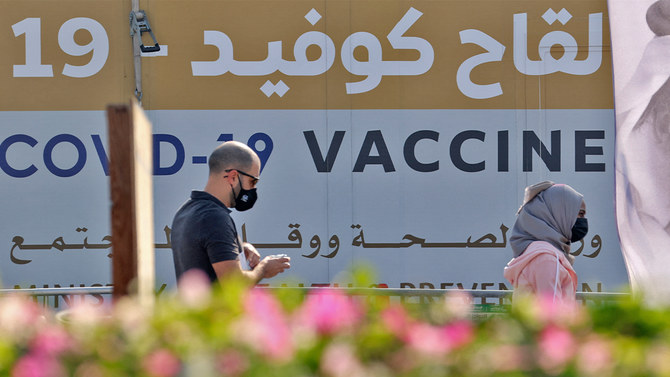
A man and a woman walk past a huge health ministry COVID-19 vaccines announcement outside a medical centre in Dubai, UAE, on February 16, 2021. (AFP/File)
Short Url
Updated 07 November 2022
Follow

UAE lifts COVID-19 restrictions

  • Wearing masks in the UAE will now be optional at all open and closed spaces, including places of worship
  • But despite the lifting of COVID-19 restrictions, PCR testing and treatment facilities will continue to operate

DUBAI: The UAE government has lifted precautionary measures related to COVID-19 as the country further eases restrictions earlier implemented to protect public health.

Wearing masks in the UAE will now be optional in all open and closed facilities, including places of worship and mosques, except for health facilities and centers for people of determination, where it will be mandatory, Dr. Saif Al-Dhaheri, spokesperson of the National Emergency Crisis and Disasters Management Authority (NCEMA), said in an earlier briefing.

“As for mosques and musallas, we also announce that praying on personal mats will be optional, as it is no longer mandatory after the date of activating the decision. As for the Al Hosn App use will be limited to proof of vaccination certificates and test results inside and outside the country upon request. Thus, green pass is not required to enter public facilities and sites,” the spokesperson said in a report from state news agency WAM.

Organizers of sports activities also have the option to require PCR tests or vaccination certificates as requisite to participate or attend their events.

“Last September, we announced several measures to ease restrictions related to COVID-19. Today, we announce the second phase of the easing of restrictions, after studying the epidemiological situation in the country while monitoring occupancy rates in hospitals and intensive care for COVID-19 cases,” Dr. Al-Dhaheri said.

Despite the lifting of COVID-19 restrictions, PCR testing and treatment health facilities would continue to operate and individuals with positive results are still required to undergo five days of isolation to prevent spread of the disease.

Dr. Al-Dhaheri also clarified health authorities would continue to monitor the ‘epidemiological situation in the country, which are to be announced on an ongoing basis,’ and the recent announcements could be updated depending on the situation.


Iraqis cover soil with clay to curb sandstorms

Updated 4 sec ago
Follow

Iraqis cover soil with clay to curb sandstorms

  • Dust storms have cloaked cities and villages in an endless ochre haze

BAGHDAD: Deep in Iraq’s southern desert, bulldozers and earthmovers spread layers of moist clay over sand dunes as part of a broader effort to fight increasingly frequent sandstorms.

Iraq has long suffered from sand and dust storms, but in recent years they have become more frequent and intense as the country falls prey to the effects of climate change.
Sand and dust storms — driven by severe drought, rising temperatures and deforestation — have cloaked cities and villages in an endless ochre haze, grounded flights and filled hospitals with patients suffering from breathing difficulties.
Iraqi authorities have warned that these suffocating storms will intensify further, adding urgency to address the root of the problem.
In a relatively small area between the cities of Nasiriyah and Samawah, not far from ancient Sumerian ruins, laborers are working hard to stabilize the soil by applying a layer of moist clay 20-25 centimeters thick.
The project also includes planting heat-tolerant seedlings like Prosopis and Conocarpus to further stabilize the soil.
“The main goal is to reduce the impact of transboundary dust storms,” said Udai Taha Lafta from UN-Habitat, which is leading the project to combat sandstorms with Iraqi expertise.
“It is a vital area despite its small size, and will hopefully help reduce dust storms next summer,” Lafta said.
A short-term objective is to shield a southern highway where many traffic accidents have occurred due to poor visibility during dust storms.
The Ministry of Environment estimates that Iraq now faces about 243 storms per year, and the frequency is expected to increase to 300 “dust days” by 2050 unless drastic mitigation measures are adopted.
In 2023, Iraqi authorities teamed up with the UN-Habitat and the Kuwait Fund for Arab Economic Development in areas that have been identified as major sources of sandstorms.
The project has been implementing several methods in three southern areas, including digging water canals and supplying electricity to pump water from the Euphrates river, preparing barren lands for vegetation.
One of the project’s ultimate goals is to increase green spaces and for farmers to eventually sustain the lands after droughts and chronic water shortages have drastically reduced agricultural areas.
Qahtan Al-Mhana, from the Agriculture Ministry, said that stabilising the soil gives agricultural efforts in sandy areas a chance to endure.
He added that Iraq has extensive “successful” experience in combating desertification and dust storms by stabilising sand dunes.
Since the 1970s, the country has implemented such projects, but after decades of turmoil, environmental challenges have largely fallen by the wayside.
With the severe recent impact of climate change, “work has resumed,” said Najm Abed Taresh from Dhi Qar University. “We are making slow but 
steady progress.”