

Head of government commission to probe Arshad Sharif’s killing says can’t proceed with assignment

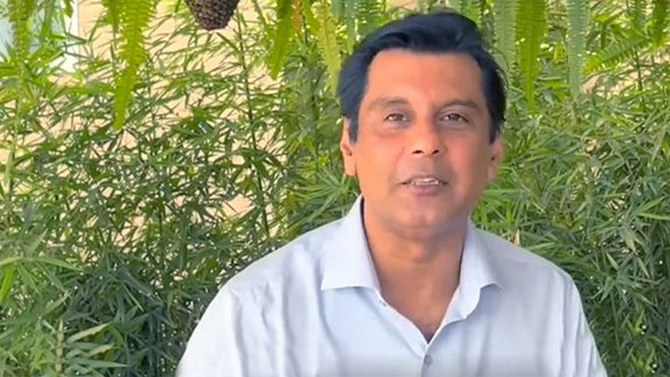
The image shows slain Pakistani journalist Arshad Sharif on October 6, 2022. (Arshad Sharif Official/YouTube)
Short Url
Updated 07 November 2022
Follow

Head of government commission to probe Arshad Sharif’s killing says can’t proceed with assignment

  • The retired Lahore High Court judge maintains Sharif’s family is not satisfied with the investigation mechanism
  • He says a media representative should also have been part of the commission in the interest of justice in the case

ISLAMABAD: A retired Pakistani judge, who was nominated by the government to head an inquiry commission to probe journalist Arshad Sharif’s killing in Kenya, told the federal authorities on Sunday his three-member team would not be able to proceed with the assignment.

The commission was announced at the beginning of the month to thoroughly investigate the circumstances of Sharif’s death in the East African state.

The government appointed a retired Lahore High Court judge, Abdul Shakoor Paracha, as its head while nominating additional inspector general Dr. Usman Anwar and Intelligence Bureau deputy director general Omar Shahid Hamid to assist him.

However, the retired judge said it was not possible for the commission to proceed since the mother of the slain journalist had already “expressed dissatisfaction” with the investigation mechanism.

“She has already moved an application to the [Honorable] Chief Justice of Pakistan seeking justice,” he said in a statement shared with journalists. “A member of the Commission [Omar Shahid Hamid] had already visited Nairobi and it is not legally sustainable that he can be part of the commission based on his previous findings. Finally, no representative of the media was part of the commission which in my thinking is necessary so that the justice is not only served but is seen when done so.”

Sharif, who did a talk show with a local news channel, was killed on October 23 when his car sped up and drove through a checkpoint outside the Kenyan capital, prompting the police to open fire.

The law enforcement officials in Nairobi expressed regret over the incident, saying it was a case of “mistaken identity” during a search for a car involved in a child abduction case.

Prior to that, the deceased journalist, who of late had been a harsh critic of the incumbent government and the military, had to leave the country after several cases related to charges of sedition and others were filed against him.

He was believed to have been in the United Arab Emirates since he left Pakistan, though he then traveled to Kenya from the Emirates.

Sharif’s mother, in a recent letter to the chief justice of Pakistan, demanded a “high-power judicial commission” to “determine the real motive and identify criminals behind this heinous crime.”

She also criticized how the government was dealing with her son’s killing.

“The Prime Minister in his statement had made an announcement that a letter will be written to Islamabad High Court to appoint a high-power judicial commission,” she continued. “However, unfortunately, contradictory to his statement one retired Justice Abdul Shakoor Piracha and two federal government officials have been made members of the commission which indicates malafide intentions of the government.”

The retired judge also said in his statement the prime minister had announced to let the chief justice constitute a commission in Sharif’s killing.


Pakistani, Bangladeshi officials discuss trade, investment and aviation as ties thaw

Updated 28 December 2025
Follow

Pakistani, Bangladeshi officials discuss trade, investment and aviation as ties thaw

  • Pakistan and Bangladesh were once one nation, but they split in 1971 as a result of a bloody civil war
  • Ties between Pakistan, Bangladesh have warmed up since last year and both nations have resumed sea trade

ISLAMABAD: Pakistan's High Commissioner to Bangladesh Imran Haider on Sunday met Chief Adviser Muhammad Yunus in Dhaka, the latter's office said on, with the two figures discussing trade, investment and aviation.

Pakistan and Bangladesh were once one nation, but they split in 1971 as a result of a bloody civil war, which saw the part previously referred to as East Pakistan seceding to form the independent nation of Bangladesh.

Ties between Pakistan and Bangladesh have warmed up since former prime minister Sheikh Hasina’s ouster as a result of a student-led uprising in August 2024. Relations remain frosty between Dhaka and New Delhi over India’s decision to grant asylum to Hasina.

Pakistan has attempted to forge closer ties with Bangladesh in recent months and both South Asian nations last year began sea trade, followed by efforts to expand government-to-government commerce.

"During the meeting, both sides discussed ways to expand cooperation in trade, investment, and aviation as well as scaling up cultural, educational and medical exchanges to further strengthen bilateral relations between the two South Asian nations," Yunus's office said in a statement on X.

In 2023-24 Pakistan exported goods worth $661 million to Bangladesh, while its imports were only $57 million, according to the Trade Development Authority of Pakistan. In Aug. this year, the Pakistani and Bangladeshi commerce ministries signed a memorandum of understanding to establish a Joint Working Group on Trade, aiming to raise their bilateral trade volume to $1 billion in the financial year that began in July.

The Pakistani high commissioner noted that bilateral trade has recorded a 20 percent growth compared to last year, with business communities from both countries actively exploring new investment opportunities, according to the statement.

He highlighted a significant increase in cultural exchanges, adding that Bangladeshi students have shown strong interest in higher education opportunities in Pakistan, particularly in medical sciences, nanotechnology, and artificial intelligence. Haider also said that Dhaka-Karachi direct flights are expected to start in January.

"Chief Adviser Professor Muhammad Yunus welcomed the growing interactions between the two countries and emphasized the importance of increased visits as well as cultural, educational and people-to-people exchanges among SAARC (South Asian Association for Regional Cooperation) member states," the statement read.

"Professor Yunus also underscored the need to further boost Bangladesh–Pakistan trade and expressed hope that during Mr. Haider’s tenure, both countries would explore new avenues for investment and joint venture businesses."