

Saudi Arabia considers new mining index in diversification push

Short Url
Updated 04 November 2022
Follow

Saudi Arabia considers new mining index in diversification push

SYDNEY: Saudi Arabia is considering setting up a new metals and mining stock exchange index as it looks to expand its resources sector to diversify away from hydrocarbons, a senior government official said on Friday.

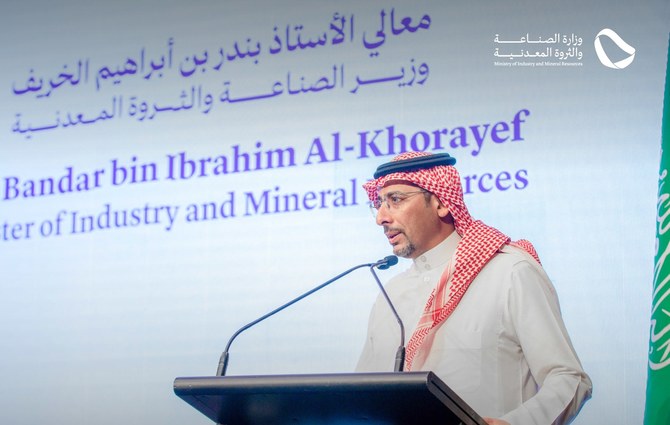
Mining Minister Bandar bin Ibrahim Al-Khorayef told Reuters in an interview in Sydney that his team met with Australian counterparts to learn more about a mining index, similar to Australia’s ASX 300 Metals & Mining sub-index that lists metals and mining firms including producers of gold, steel and precious metals.

“It is something we are studying ... but we have not made up our mind if it would be successful,” Al-Khorayef told Reuters.

“We have a secondary stock market in Saudi...its still evolving. We want to see if its better to have something for mining,” he said.

He did not say how many companies would potentially be included in the index.

Saudi Arabia’s stock exchange consists of the Tadawul main market and a parallel market that companies can join with fewer reporting requirements.

Riyadh’s efforts to build an economy that is not dependent on oil include a shift toward mining to explore the country’s untapped reserves of resources from copper to phosphate and gold.

The minister is at the International Mining and Resources Conference in Sydney this week to drum up investment interest. He said on Wednesday that the kingdom plans to award over a dozen mining exploration licenses to international investors.

Al-Khorayef said the separate index for mining would help put more focus on Saudi’s mining industry, and will enable them to benchmark it with markets like Australia, the UK and others.

“The idea is to help the sector grow faster. We definitely see a need for small and medium firms in the sector to access capital through capital markets,” he said.

Saudi’s stock markets are currently dominated by real estate, energy and trading firms, while there are a just a small number of mining companies with the state miner Saudi Arabian Mining Co, the Gulf’s largest miner, leading the pack.

“The whole idea (of a mining index) is to ensure that we have something that financing companies or financial institutions like banks can have good visibility on,” he said.

SEEKING PARTNERSHIPS

The Saudi government believes it has unused mineral resources worth about $1.33 trillion, with vast quantities of aluminum, phosphate, gold, copper and uranium, Al-Khorayef said.

Al-Khorayef said he held discussions with several mining companies in Sydney this week, including global mining giants like BHP Group, about collaborating on the exchange of knowledge, expertise and the adoption of their successful business model.

“In terms of ability to finance a lot of projects, Saudi Arabia is quite good. But we are always seeking partnerships because we are a great believer that it’s through collaboration that we can succeed,” he said.

“We want to encourage people who offer services to mining companies to come to Saudi either directly or through partnering with some local people. Everyone out there should be looking at Saudi as a potential market,” he said.

Saudi is hosting the Future Minerals Forum in Riyadh in January, where it hopes to announce more details of its plans for the mining sector.


Saudi ports brace for cargo surge as shipping lines reroute

Updated 09 March 2026
Follow

Saudi ports brace for cargo surge as shipping lines reroute

RIYADH: Preliminary estimates suggest that several global shipping lines could reroute part of their operations to Saudi Arabia’s Red Sea ports, potentially adding 250,000 containers and 70,000 vehicles per month, according to Rayan Qutub, head of the Logistics Council at the Jeddah Chamber of Commerce, in an interview with Al-Eqtisadiah.

“Any disruption in the Strait of Hormuz not only affects maritime traffic in the Arabian Gulf but could also reshape global trade routes,” Qutub said, highlighting the strait’s status as one of the world’s most critical maritime chokepoints for energy and goods transport.

With rising regional tensions, international shipping companies are reassessing their routes, adjusting shipping lines, or exploring alternative sea lanes. This signals that the current challenges extend beyond the Arabian Gulf, impacting the global supply chain as a whole.

Limited impact on US, European shipments

The effects of these developments will not be uniform across trade routes. Qutub noted that goods from China and India, which rely heavily on routes through the Arabian Gulf, are most vulnerable to disruption. In contrast, shipments from Europe and the US typically traverse western maritime routes via the Suez Canal and the Red Sea, making them less susceptible to regional disturbances.

Saudi Arabia’s strategic location, he emphasized, strengthens the resilience of regional trade. The Kingdom operates an integrated network of Red Sea ports — including Jeddah, Rabigh, Yanbu, and Neom — that have benefited from substantial infrastructure upgrades and technological enhancements in recent years, boosting their capacity to absorb increased cargo volumes.

Red Sea bookings

Several major carriers, including MSC, CMA CGM, and Maersk, have already opened bookings to Saudi Red Sea ports, signaling a shift in operational focus to these strategically positioned hubs.

However, Qutub warned that rerouted shipments could increase sailing times. Cargo from Asia, which normally takes 30-45 days, might now require longer voyages via the Cape of Good Hope and the Mediterranean, potentially extending transit to 60-75 days in some cases.

These changes are also reflected in rising shipping costs, driven by longer routes, higher fuel consumption, and increased insurance premiums — a typical response when global trade patterns shift due to geopolitical pressures.

Qutub emphasized that Saudi Arabia’s transport and logistics sector is managing these developments through coordinated government oversight. The Ministry of Transport and Logistics, the Logistics National Committee, and the Logistics Partnership Council recently convened to evaluate the impact on trade and supply chains. Regular weekly meetings have been established to monitor developments and implement solutions to safeguard the stability of supplies and continuity of trade.

He noted that the Kingdom’s logistical readiness is the result of long-term strategic investments, encompassing ports, airports, road networks, rail systems, and logistics zones. Today, Saudi logistics integrates maritime, land, rail, and air transport, enabling a resilient response to global disruptions.

Qutub also highlighted the need for the private sector to continuously review logistics and crisis management strategies, develop alternative plans, and manage strategic stockpiles. Such measures are essential to mitigate temporary fluctuations in global trade and ensure smooth supply chain operations.