HIGHLIGHTS from a 1970 ‘Pictorial Guide to Saudi Arabia’ on show at Sharjah International Book Fair  

Short Url
Updated 03 November 2022
Follow

HIGHLIGHTS from a 1970 ‘Pictorial Guide to Saudi Arabia’ on show at Sharjah International Book Fair  

SHARJAH: The Sharjah International Book Fair, which runs from Nov. 2-13, features a collection of rare books that offer pictorial insight into 1970s Saudi Arabia. Here are some of the highlights from the showcase. 

‘Makkah-Taif Highway’ 

For this year’s book fair, Peter Harrington Rare Books presents several books focusing on the Kingdom, including this guide produced locally to “promote Saudi Arabia as a vibrant and welcoming tourist destination” in 1970. Among the highlights is the Makkah to Taif highway, a “fantastic drive” at 1800 meters above sea level that is “one of the many achievements of H.M. King Faisal.”  


‘Makkah-Taif Highway’ ​​​​​. (Supplied)​​

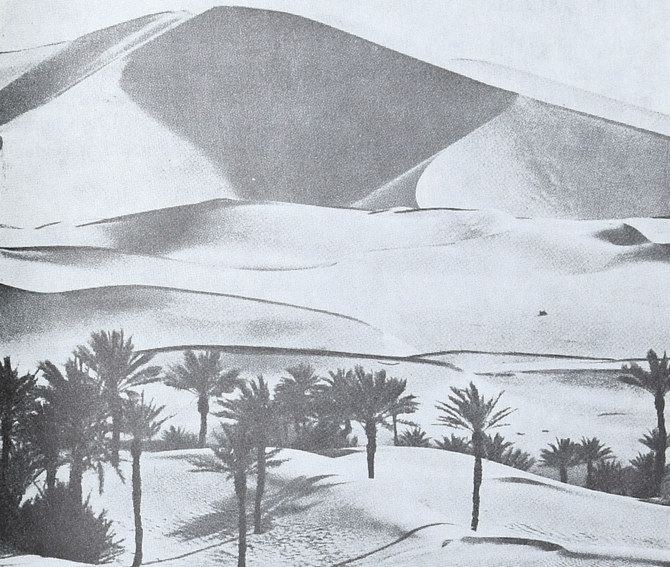
‘The Empty Quarter’ 

Naturally, the guide includes the “staggering geographical phenomenon” known as The Empty Quarter, which is, it explains “the largest continuous body of sand in the world — considerably larger than France. “From the air, the dunes have a rich, warm, red color in contrast to the sabkha which varies from a whitish collar around the dunes to a light gray elsewhere,” it states. 


‘The Empty Quarter’ ​​​​​​. (Supplied)

‘Hawks and Falcons’ 

In its sections on the Kingdom’s wildlife, alongside chapters on Arabian horses and camels, the guide focuses on hawks and falcons. “Desert hawks are trained to hunt all species of birds, rabbits and gazelles,” the guide says, adding that the birds refuse to breed in captivity, which “may account for the, sometimes, unbelievably high prices” of the birds, which make this “a costly hobby indeed.” 


‘Hawks and Falcons’ . (Supplied)


Director Kaouther Ben Hania rejects Berlin honor over Gaza

Updated 20 February 2026
Follow

Director Kaouther Ben Hania rejects Berlin honor over Gaza

DUBAI: Kaouther Ben Hania, the Tunisian filmmaker behind “The Voice of Hind Rajab,” refused to accept an award at a Berlin ceremony this week after an Israeli general was recognized at the same event.

The director was due to receive the Most Valuable Film award at the Cinema for Peace gala, held alongside the Berlinale, but chose to leave the prize behind.

On stage, Ben Hania said the moment carried a sense of responsibility rather than celebration. She used her remarks to demand justice and accountability for Hind Rajab, a five-year-old Palestinian girl killed by Israeli soldiers in Gaza in 2024, along with two paramedics who were shot while trying to reach her.


A post shared by @artists4ceasefire

“Justice means accountability. Without accountability, there is no peace,” Ben Hania said.

“The Israeli army killed Hind Rajab; killed her family; killed the two paramedics who came to save her, with the complicity of the world’s most powerful governments and institutions,” she said.

“I refuse to let their deaths become a backdrop for a polite speech about peace. Not while the structures that enabled them remain untouched.”

Ben Hania said she would accept the honor “with joy” only when peace is treated as a legal and moral duty, grounded in accountability for genocide.