Pakistan, China central bank yuan clearing deal to reduce reliance on US dollar – analysts

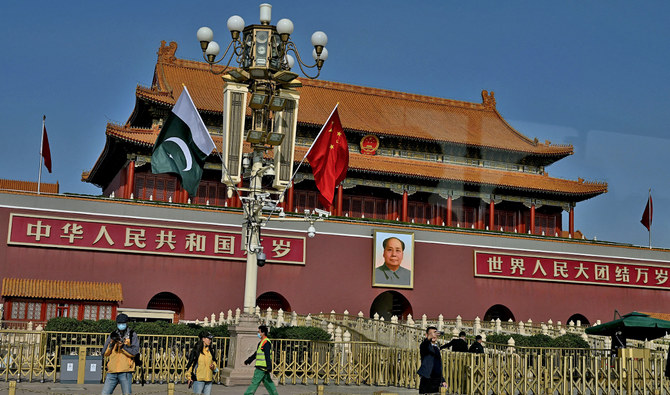
The Pakistan and Chinese national flags are seen together near the Tiananmen Gate in Beijing on November 1, 2022. Pakistan Prime Minister Shahbaz Sharif is set to arrive in China on November 1 for a two-day visit. (AFP/File)
Short Url
Updated 03 November 2022
Follow

Pakistan, China central bank yuan clearing deal to reduce reliance on US dollar – analysts

  • Agreement to boost usage of RMB for transactions between Chinese, Pakistani enterprises and banks
  • Pakistani traders say move to help avoid currency settlement via New York, make products more competitive 

KARACHI: The central banks of China and Pakistan have signed an agreement on establishing RMB (Renminbi) clearing arrangements in Pakistan, a move that would decrease both countries’ reliance on US dollars, analysts and traders said on Thursday. 

The Memorandum of Understanding (MoU) was signed between the People’s Bank of China (PBoC) and the State Bank of Pakistan (SBP) on Wednesday. Governor SBP Jameel Ahmad and Governor PBoC Yi Gang inked the memorandum, the PBOC said. 

“The establishment of the RMB clearing arrangement in Pakistan will further boost usage of RMB for cross-border transactions among Chinese and Pakistani enterprises and financial institutions,” the PBOC said in a statement. 

“This will also promote bilateral trade and investment between the two countries,” the bank added. 

No more details were offered by both sides at the time of the signing. However, Pakistani analysts and traders said the move was meant to reduce reliance on the US dollar. The decision comes at a time when Islamabad faces huge forex reserves depletion as the rupee faces pressure from increasing imports. 

“The development is meant [to bring about] less reliance on the USD (US dollar) and [encourage] more trade in RMB,” Muhammad Sohail, Chief Executive Officer of Topline Securities, told Arab News. Topline Securities is a Karachi-based brokerage firm. 

Pakistani traders said the decision will make bilateral trade between the two countries more competitive and avoid the lengthy process of routing dollar settlements through New York. 

“The major benefit of this agreement would be that Chinese products that will come to Pakistan or the Pakistani products that will go to China will be more competitive due to transactions in our own currencies,” Jawaid Ilyas, Chairman of the Pakistan-China Business Council told Arab News. 

Most dollar base payments and settlements conducted by local banks are cleared in New York for international payments. From there, the currency is sent to the respective bank for its conversion into local currencies. 

At present, the process is a bit complex. Pakistani customers make payments to local banks, who then transfer money to New York where settlements take place. From there, the money flows to the respective Chinese bank where the US dollars are converted into RMB, according to the Pakistani traders. 

“We will be able to avoid this long procedure,” Ilyas explained. “Now, the settlement would be made by both banks, so this is very good for trade.” 

Ilyas said a maximum level of currency swap would be decided by both banks, which they haven’t disclosed. 

The trade between Pakistan and China is heavily tilted in Beijing’s favor, comprising more imports and less exports. 

Overall, exports from Pakistan to China have increased by 2 percent to $2.57 billion during the first nine months of the current calendar year. The bilateral trade volume remained at $20.19 billion with 3 percent growth when compared to the same period in 2021, according to official data shared by China. 


Pakistan reviews austerity measures amid Middle East crisis, urges strict nationwide implementation

Updated 11 March 2026
Follow

Pakistan reviews austerity measures amid Middle East crisis, urges strict nationwide implementation

  • Deputy Prime Minister Ishaq Dar chairs review meeting of austerity steps
  • Officials briefed on salary cuts, school closures, four‑day week, petrol conservation

ISLAMABAD: Pakistan’s government on Wednesday assessed progress on a sweeping set of austerity measures introduced to mitigate the country’s economic strain from sharply rising global oil prices and supply disruptions linked to the ongoing war in the Middle East.

Prime Minister Shehbaz Sharif this week announced a series of austerity steps, including a four‑day work week for government offices, requiring 50  percent of staff to work from home, cutting fuel allowances for official vehicles by half, grounding up to 60  percent of the government fleet and closing all schools for two weeks to conserve fuel amid the global oil crisis.

The measures were unveiled in response to global oil market volatility triggered by the conflict involving the United States, Israel and Iran, which has disrupted supply routes such as the Strait of Hormuz and pushed crude prices sharply higher, straining Pakistan’s heavily import‑dependent energy sector.

“The meeting stressed the importance of strict and transparent adherence to the austerity measures, promoting fiscal responsibility and prudent use of public resources,” Deputy Prime Minister and Foreign Minister Senator Mohammad Ishaq Dar said in a statement.

He was chairing a meeting of the Committee for Monitoring and Implementation of Conservation and Additional Austerity Measures, constituted under the directions of the PM, bringing together federal and provincial officials to review execution of the broad cost‑cutting plan. 

Dar emphasized the government’s commitment to enforcing the PM’s austerity steps nationwide. The committee’s review also covered reductions in departmental expenditure, deductions from salaries of senior officials earning over Rs. 300,000 ($1,120), and coordination with provincial administrations to ensure uniform implementation of the plan.

Participants at the meeting reiterated that all ministries and divisions must continue strict monitoring and reporting, with transparent oversight mechanisms, as Pakistan navigates the economic pressures from the prolonged Middle East crisis and its fallout on global energy and trade markets.