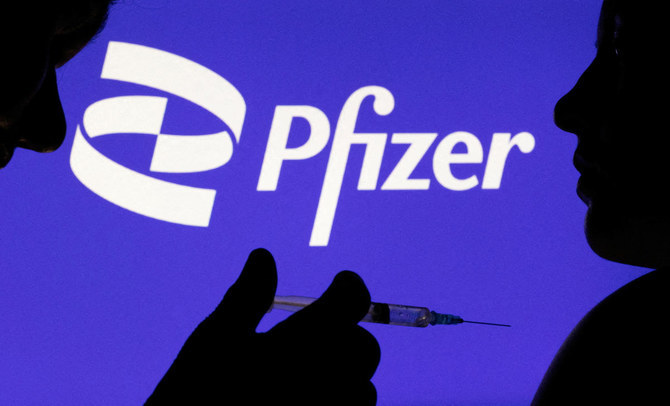
Pfizer boosts COVID-19 vaccine sales forecast by $2bn

Pfizer Inc on Tuesday raised its forecast for annual sales of its COVID-19 vaccine by $2 billion to $34 billion on demand for Omicron-targeted boosters. (Reuters)
Short Url
Updated 03 November 2022
Follow

Pfizer boosts COVID-19 vaccine sales forecast by $2bn

  • Sales of the COVID-19 vaccine have eased from pandemic highs on soft demand for the original shots
  • "Our COVID-19 franchises will remain multi-billion-dollar revenue generators for the foreseeable future," said Chief Executive Officer Albert Bourla

DUBAI: Pfizer Inc. on Tuesday raised its forecast for annual sales of its COVID-19 vaccine by $2 billion to $34 billion on demand for omicron-targeted boosters, helping allay some investor worries over growth for the vaccinations.
The US drugmaker’s shares rose 2.4 percent to $447.67 in morning trading as its third-quarter profit beat estimates, mainly due to better-than-expected sales of the vaccine.
The upbeat earnings also sent shares of rival COVID-19 vaccine makers higher. Novavax Inc. rose 11 percent, while Moderna Inc. gained about 4 percent.
Sales of the COVID-19 vaccine have eased from pandemic highs on soft demand for the original shots, sparking concerns over demand over the next few years.
In response, Pfizer plans to roughly quadruple the price of the vaccine, which it sells with German partner BioNTech, in the United States once the government stops buying doses and shifts to a private market.
“Our COVID-19 franchises will remain multi-billion-dollar revenue generators for the foreseeable future,” Chief Executive Officer Albert Bourla said in prepared remarks ahead of a conference call.
Meanwhile, Pfizer is also expected to face the loss of patents for some key drugs between 2025 and 2030. The company has turned to deals such as its recent $5.4 billion acquisition of Global Blood Therapeutics Inc. and its $11.6 billion purchase of Biohaven to beef up its pipeline.
While some will point to the massive Comirnaty beat as unsustainable, “we’re not yet throwing in the towel given an emerging pipeline and significant balance sheet flexibility,,” said BMO Capital Markets analyst Evan Seigerman.
Third-quarter sales of the COVID-19 vaccine came in at $4.40 billion, blowing past estimates of $2.60 billion.
However, $7.51 billion in sales of the company’s COVID-19 pill Paxlovid missed estimates of $7.66 billion.
Pfizer earned $1.78 per share in the third quarter, beating estimates of $1.39.
Separately, the company said its experimental respiratory syncytial virus (RSV) vaccine was found to be effective in a late-stage study in preventing severe infections in infants when given to expectant mothers.


Industry leaders highlight Riyadh’s Metro, infrastructure as investment catalysts

Updated 29 December 2025
Follow

Industry leaders highlight Riyadh’s Metro, infrastructure as investment catalysts

RIYADH: Saudi Arabia’s capital, Riyadh, is experiencing a transformative phase in its real estate sector, with the construction market projected to reach approximately $100 billion in 2025, accompanied by an anticipated annual growth rate of 5.4 percent through 2029.

The Kingdom is simultaneously advancing its data center capacity at an accelerated pace, with an impressive 2.7 GW currently in the pipeline. This expansion underscores the critical role of strategic land and power planning in establishing national infrastructure as a cornerstone of economic growth.

These insights were shared by leading industry experts during JLL’s recent client event in Riyadh, which focused on the city’s macroeconomic landscape and emerging trends across office, residential, retail, hospitality, and pioneering sectors, including AI infrastructure and Transit-Oriented Development.

Saud Al-Sulaimani, Country Lead and Head of Capital Markets at JLL Saudi Arabia, commented: “Riyadh is positioned at the forefront of Saudi Arabia’s Vision 2030, offering unparalleled opportunities for both investors and developers. National priorities are continuously recalibrated to ensure strategic alignment of projects and foster deeper collaboration with the private sector.”

He added: “Recent regulatory developments, including the introduction of the White Land Tax and the rent freeze, are designed to stabilize the market and are expected to drive renewed focus on delivering premium-quality assets. This dynamic environment, coupled with evolving construction cost considerations in select segments, is fundamentally reshaping the market landscape while accelerating progress toward our national objectives.”

The event further underscored the transformative impact of infrastructure initiatives. Mireille Azzam Vidjen, Head of Consulting for the Middle East and Africa at JLL, highlighted Riyadh’s transit revolution. She detailed the Riyadh Metro, a $22.5 billion investment encompassing 176 kilometers, six lines, and 84 stations, providing extensive geographic coverage, with a depth of 9.8 km per 100 sq. km. This strategic development generates significant TOD opportunities, with properties in proximity potentially commanding a 20-30 percent premium. JLL emphasized the importance of implementing climate-responsive last-mile solutions to enhance mobility and accessibility, particularly given Riyadh’s extreme temperatures.

Gaurav Mathur, Head of Data Centers at JLL, emphasized the rapid expansion of the Kingdom’s AI infrastructure, signaling a critical area for technological investment and innovation.

Focusing on the construction sector, Maroun Deeb, Head of Projects and Development Services, KSA at JLL, explained that the industry is actively navigating complexities such as skilled labor availability, material costs, and supply chain dynamics.

He highlighted the adoption of Building Information Modeling as a key driver for enhancing operational efficiency and project delivery.