

Palestinian anger mounts amid Israeli election blockade

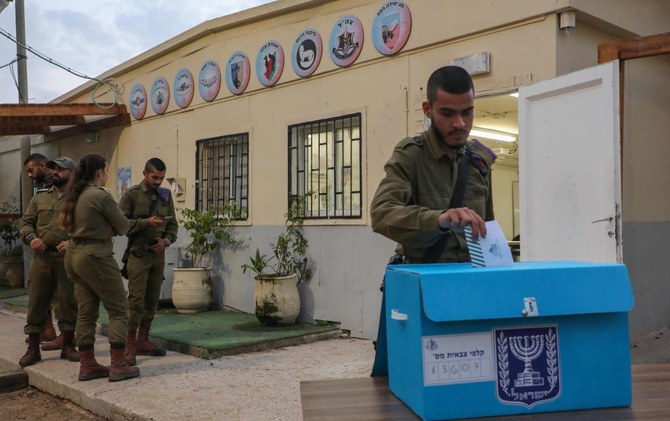
An Israeli soldier casts a ballot a day early in the Israeli general elections at the Kerem Shalom army base in the south of Israel near the border with the Gaza strip, Oct. 31, 2022. (AFP)
Short Url
Updated 31 October 2022
Follow

Palestinian anger mounts amid Israeli election blockade

  • West Bank, Gaza crossings shut down on voting day over security fears
  • More than 130,000 Palestinian workers will be unable to enter Israel, and the import and export of goods will be halted

RAMALLAH: Israeli security authorities oversaw a complete closure of West Bank and Gaza Strip crossings on the eve of parliamentary elections, fearing Palestinian armed attacks against Israeli targets during voting day, either inside Israel or in the West Bank.

All of the West Bank and Gaza Strip crossings with Israel will remain shut between midnight on Oct. 31 until midnight on Nov. 1 in view of Tuesday’s election.

More than 130,000 Palestinian workers will be unable to enter Israel, and the import and export of goods will be halted.

The Palestinian economy will suffer hundreds of thousands of dollars in losses because of the closure, Palestinian economic experts told Arab News.

Israel claimed that its intelligence services had received dozens of security reports that Palestinians were planning to carry out armed attacks in the West Bank and inside Israel, before and after the elections.

A surge in warnings over the past two days has raised fears among the Israeli military establishment about the possibility of attacks during election day.

The Israel Kan public TV channel reported that the Israeli intelligence services had received about 100 security warnings over the past few days concerning possible military attacks against Israeli Defense Forces targets and settlers in the West Bank

In response, the state of alert in Jerusalem was raised to the maximum level and Israeli military forces in Hebron were reinforced.

Israeli security services say that the rise in attacks and their extension from the north of the West Bank to the south — as happened on Oct. 29 in Hebron — has raised deep concerns.

On Sunday evening, Israeli Prime Minister Yair Lapid ordered the reinforcement of Israeli operative security forces in the Hebron area and the rest of the West Bank, beginning Sunday evening, and the continuation of high alert measures in all arenas, according to a statement by the PM’s office.

“We will act vigorously against the perpetrators of the attacks and their senders,” he said.

A senior Palestinian official who requested anonymity warned Arab News that armed attacks by Palestinians during the election period could result in vote swings toward right-wing figures such as Benjamin Netanyahu and Itamar Ben-Gvir.

Some 650,000 settlers living in the occupied West Bank are expected to vote in Tuesday’s elections, making up a powerful voting bloc.

A senior Israeli army officer warned that the army might arrest wanted Palestinians who decide to surrender to Palestinian security services.

“We will not accept the killers of the soldier near Nablus two weeks ago surrendering themselves to the Palestinian security services ... even if they surrender, we will know how they can be caught.”

He added that the Israeli army and Shin Bet were engaged in a manhunt to find the assailants and prevent another shooting.

It is feared that the Israeli officer’s threat might hinder the efforts of the Palestinian Authority and its security services, who have tried to persuade members of the armed group the Lions’ Den to surrender.

Five senior members of the group surrendered to Palestinian security services last week, fearing that they would continue to be pursued by the Israeli army or killed.

“The Israelis do not want the Palestinian security to succeed in handling the security situation and practicing its authority inside the Palestinian cities,” a senior security official from the Palestinian Authority told Arab News.

“Therefore, every time the Palestinian security manages to take control over security, the Israelis foil us either by their multi-incursions or provocative declarations.”


Israel confirms ban on 37 NGOs in Gaza

A Palestinian woman carries wood for fire in the Nuseirat refugee camp in the central Gaza Strip on December 31, 2025. (AFP)
Updated 54 min 36 sec ago
Follow

Israel confirms ban on 37 NGOs in Gaza

  • UN has warned that this will exacerbate the humanitarian crisis in the war-ravaged Palestinian territory
  • Several NGOS have said the requirements contravene international humanitarian law or endanger their independence

JERUSALEM: Israel on Thursday said 37 humanitarian agencies supplying aid in Gaza had not met a deadline to meet “security and transparency standards,” and would be banned from the territory, despite an international outcry.
The international NGOs, which had been ordered to disclose detailed information on their Palestinian staff, will now be required to cease operations by March 1.
The United Nations has warned that this will exacerbate the humanitarian crisis in the war-ravaged Palestinian territory.
“Organizations that have failed to meet required security and transparency standards will have their licenses suspended,” Israel’s Ministry of Diaspora Affairs and Combating Antisemitism said in a statement.
Several NGOS have said the requirements contravene international humanitarian law or endanger their independence.
Israel says the new regulation aims to prevent bodies it accuses of supporting terrorism from operating in the Palestinian territories.
Prominent humanitarian organizations hit by the ban include Doctors Without Borders (MSF), the Norwegian Refugee Council (NRC), World Vision International and Oxfam, according to a ministry list.
In MSF’s case, Israel accused it of having two employees who were members of Palestinian militant groups Islamic Jihad and Hamas.
MSF said this week the request to share a list of its staff “may be in violation of Israel’s obligations under international humanitarian law” and said it “would never knowingly employ people engaging in military activity.”
‘Critical requirement’ 
NRC spokesperson Shaina Low told AFP its local staff are “exhausted” and international staff “bring them an extra layer of help and security. Their presence is a protection.”
Submitting the names of local staff is “not negotiable,” she said. “We offered alternatives, they refused,” hse said, of the Israeli regulators.
The ministry said Thursday: “The primary failure identified was the refusal to provide complete and verifiable information regarding their employees, a critical requirement designed to prevent the infiltration of terrorist operatives into humanitarian structures.”
In March, Israel gave NGOs 10 months to comply with the new rules, which demand the “full disclosure of personnel, funding sources, and operational structures.”
The deadline expired on Wednesday.
The 37 NGOs “were formally notified that their licenses would be revoked as of January 1, 2026, and that they must complete the cessation of their activities by March 1, 2026,” the ministry said Thursday.
A ministry spokesperson told AFP that following the revocation of their licenses, aid groups could no longer bring assistance into Gaza from Thursday.
However, they could have their licenses reinstated if they submitted the required documents before March 1.
Minister of Diaspora Affairs and Combating Antisemitism Amichai Chikli said “the message is clear: humanitarian assistance is welcome — the exploitation of humanitarian frameworks for terrorism is not.”
‘Weaponization of bureaucracy’
On Thursday, 18 Israel-based left-wing NGOs denounced the decision to ban their international peers, saying “the new registration framework violates core humanitarian principles of independence and neutrality.”
“This weaponization of bureaucracy institutionalizes barriers to aid and forces vital organizations to suspend operations,” they said.
UN Palestinian refugee agency chief Philippe Lazzarini had said the move sets a “dangerous precedent.”
“Failing to push back against attempts to control the work of aid organizations will further undermine the basic humanitarian principles of neutrality, independence, impartiality and humanity underpinning aid work across the world,” he said on X.
On Tuesday, the foreign ministers of 10 countries, including France and Britain, urged Israel to “guarantee access” to aid in the Gaza Strip, where they said the humanitarian situation remains “catastrophic.”
A fragile ceasefire has been in place since October, following a deadly war waged by Israel in response to Hamas’s unprecedented October 7, 2023 attack on Israel.
Nearly 80 percent of buildings in Gaza have been destroyed or damaged by the war, according to UN data.
About 1.5 million of Gaza’s more than two million residents have lost their homes, said Amjad Al-Shawa, director of the Palestinian NGO Network in Gaza.