

Pakistan’s ousted PM denies contact with government, says negotiating with ‘establishment’ for fair elections

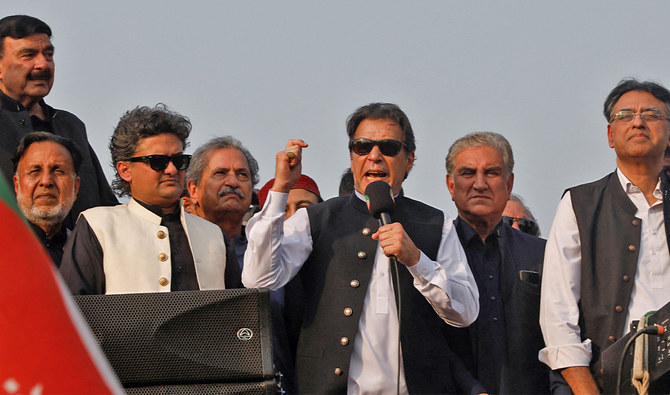
Pakistan's former prime minister Imran Khan addresses his supporters as he attends what they call 'a true freedom march', to pressure the government to announce new elections, in Lahore, Pakistan October 28, 2022. (REUTERS)
Short Url
Updated 30 October 2022
Follow

Pakistan’s ousted PM denies contact with government, says negotiating with ‘establishment’ for fair elections

  • Imran Khan tells Indian media not to celebrate political turmoil in Pakistan since the nation continues to support the army
  • Khan says he wants a strong army to protect the freedom of his country, calls his recent statements ‘constructive criticism’

ISLAMABAD: Pakistan’s former prime minister Imran Khan said on Sunday he was only negotiating with the country’s powerful security establishment for free and fair elections, adding he had not reached out to Prime Minister Shehbaz Sharif who did not have much political power.

Khan, who is also the chairman of Pakistan Tehreek-e-Insaf (PTI) party, was ousted from power in a parliamentary vote of no-confidence in April. He kicked off his “long march” to Islamabad from Lahore’s Liberty Chowk on Friday, hoping to mount pressure on the government and ultimately force it to announce a date for early elections.

His comment to the protest march earlier today was made in response to Sharif’s statement that the PTI chief had contacted him through a mutual acquaintance one month ago to suggest names of possible candidates who could be appointed as army chief.

“Sharif said I had sent him a message to sit down and discuss the army chief’s appointment,” Khan said while addressing the participants of his protest march to Islamabad near Muridke.

“Is there any point in talking to you,” he asked. “Do you have the power to give to me anything?”

However, Khan acknowledged he held negotiations with the establishment on the single-point agenda focusing on free and fair elections.

“I only spoke to them [the establishment] and demanded one thing which was to conduct fair and transparent elections in the country and did not say anything else,” he added. “I still say today that we want clean and transparent elections. We will accept whatever decision the people of Pakistan make.”

“Today I will ask the establishment: It was you who filed cases against these people [leaders of the current coalition government],” he continued. “You told us how corrupt they were. Your JIT [joint investigation team] proved how corrupt Nawaz Sharif was during his time. It was said how big a thief Asif Ali Zardari was. And now you have decided to support them?”

Addressing the notion that his rift with the army had been played up by the Indian media, Khan said the whole nation stood with the country’s military, adding that his criticism was only for the betterment of the institution.

“In India, the media is celebrating that Imran Khan and the army are at odds with each other,” he said. “There is no such thing. We stand with our army, but when we criticize it, it is constructive criticism.”

“I want my army to be strong and the whole nation stands with the army since the army is mine and the country is also mine and we need a strong army to protect the freedom of the country,” he added.

Khan told his protest march on Saturday the army chief, General Qamar Javed Bajwa, should take action against officials of Pakistan’s Inter-Services Intelligence (ISI) agency, who, he said, were allegedly involved in the custodial torture of his party leaders.

The PTI leader also maintained during an interview with an international news organization that a recent press conference held by the directors general of the military’s media wing, ISPR, and the ISI spy agency contained “lies and half-truths” against him.

According to his senior party leaders, Khan’s protest march is moving toward Islamabad at a glacial pace since thousands of his supporters are walking with his container.

They also maintain that their caravan will only continue its journey during daytime for “security reasons.”

Speaking to Arab News, Farrukh Habib, the central information secretary of Khan’s PTI party, said the march would travel from Muridke to Gujranwala where its participants would stay overnight.

Pakistan urges world to treat water insecurity as global risk, flags India treaty suspension

Updated 5 sec ago
Follow

Pakistan urges world to treat water insecurity as global risk, flags India treaty suspension

  • Pakistan says it is strengthening water management but national action alone is insufficient
  • India unilaterally suspended Indus Waters Treaty last year, leading to irregular river flows

ISLAMABAD: Pakistan on Tuesday urged the international community to recognize water insecurity as a “systemic global risk,” warning that disruptions in shared river basins threaten food security, livelihoods and regional stability, as it criticized India’s handling of transboundary water flows.

The call comes amid heightened tensions after India’s unilateral decision last year to hold the 1960 Indus Waters Treaty “in abeyance,” a move Islamabad says has undermined predictability in river flows and compounded climate-driven vulnerabilities downstream.

“Across regions, water insecurity has become a systemic risk, affecting food production, energy systems, public health, livelihoods and human security,” Pakistan’s Acting Permanent Representative to the United Nations, Ambassador Usman Jadoon, told a UN policy roundtable on global water stress.

“For Pakistan, this is a lived reality,” he said, describing the country as a climate-vulnerable, lower-riparian state facing floods, droughts, accelerated glacier melt, groundwater depletion and rapid population growth, all of which are placing strain on already stressed water systems.

Jadoon said Pakistan was strengthening water resilience through integrated planning, flood protection, irrigation rehabilitation, groundwater replenishment and ecosystem restoration, including initiatives such as Living Indus and Recharge Pakistan, but warned that domestic measures alone were insufficient.

He noted the Indus River Basin sustains one of the world’s largest contiguous irrigation systems, provides more than 80 percent of Pakistan’s agricultural water needs and supports the livelihoods of over 240 million people.

The Pakistani diplomat said the Indus Waters Treaty had for decades provided a framework for equitable water management, but India’s decision to suspend its operation, followed by unannounced flow disruptions and the withholding of hydrological data, had created an unprecedented challenge for Pakistan’s water security.

Pakistan has said the treaty remains legally binding and does not permit unilateral suspension or modification.

The issue has gained urgency as Pakistan continues to recover from last year’s monsoon floods, which killed more than 1,000 people and devastated farmland in Punjab, the country’s eastern breadbasket, in what officials described as severe riverine flooding.

Last month, Deputy Prime Minister Ishaq Dar said Pakistan had observed abrupt variations in river flows from India, creating uncertainty for farmers in Punjab during critical periods of the agricultural cycle.

“As we move toward the 2026 UN Water Conference, Pakistan believes the process must acknowledge water insecurity as a systemic global risk, place cooperation and respect for international water law at the center of shared water governance, and ensure that commitments translate into real protection for vulnerable downstream communities,” Jadoon said.