



KARACHI: Pakistan’s currency and stock markets on Friday closed the week on a bearish note, dealers and analysts said, amid a shortage of US dollars and the announcement of an anti-government march to Islamabad by former prime minister Imran Khan.
Pakistan’s national currency lost its value by 0.44 percent as the greenback closed the weekend session at Rs222.47 in the interbank market, though the rupee has gained its value by 2.6 percent in the month of October, following the arrival of Ishaq Dar as the country’s new finance minister.
Analysts say the currency is under pressure due to growing demand for dollar and a persistent shortage in the market, despite $1.5 billion inflows from the Asian Development Bank (ADB).
“The rupee is under pressure owing to the shortage of dollar,” Tahir Abbas, head of research at Karachi-based Arif Habib Limited brokerage firm, told Arab News on Saturday.
“It is not that Darnomics has lost its charm but the shortage of greenback in the market that is exerting pressure on rupee.”
Dubbed Darnomics, Dar’s approach kept the rupee stable between Rs98 and Rs105 against the US dollar during his last stint in office from 2013-2017, but he was widely criticized for deliberately undervaluing the rupee by pumping dollars in the market.
The currency market has seen little stability since Dar’s arrival in late September, following the resignation of his predecessor, Miftah Ismail.
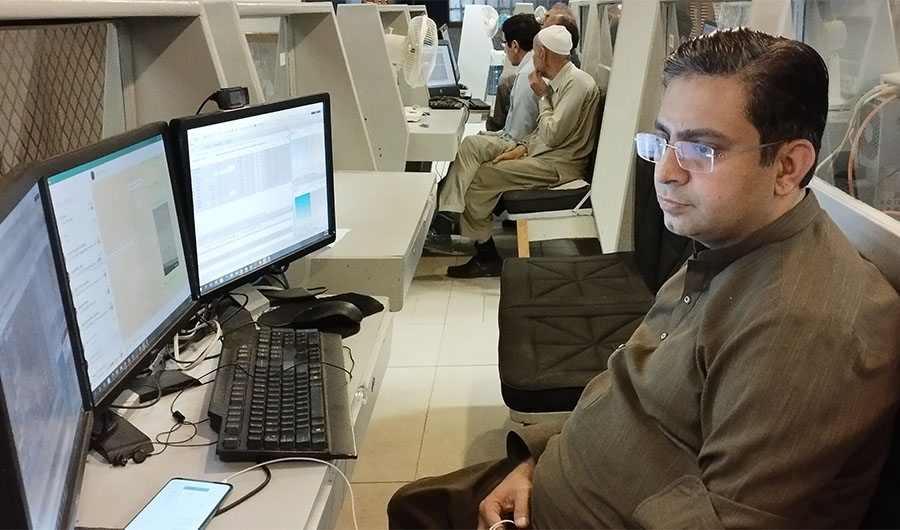
An equity trader is looking at computer screens on October 27, 2022 during active session in the trading hall of Pakistan Stock Exchange (PSX). (AN Photo by Khurshid Ahmed)
Abbas recalled the country is expected to receive over $4 billion from multilateral and bilateral donors by December this year, which would boost forex reserves and the exchange rate.
“Pakistan is expecting $2 billion from the World Bank, around $1 billion through UN aid, while the 9th review of the International Monetary Fund (IMF) program is due next month that would also clear the way for around $1 billion,” he said.
Pakistani experts expect the visit of Prime Minister Shehbaz Sharif to China will also bear fruit in terms of more inflows and rescheduling of current loans.
“All these developments are expected to boost the currency to around Rs215 in the interbank market in the coming months,” Abbas explained.
Pakistan’s equity market also reacted on Friday to the weakening currency and the increasing political uncertainty after the start of the long march by Khan and his supporters.
The benchmark KSE-100 index lost 462.53 points to close at 41,140 points at the end of the weekend trading session.
“Stocks fell sharply lower on political uncertainty on PTI’s call for long march,” Ahsan Mehanti, a senior equity analyst, told Arab News.
“The slump in rupee, global equity rout and weak earnings outlook played a catalyst role in bearish close.”
Khan kicked off his march to the capital from Lahore, the capital of the northeastern Punjab province, to press the government for snap elections.
The former premier maintains his ouster, through a parliamentary no-trust vote in April, was part of a conspiracy orchestrated by the United States. Washington and Khan’s rivals deny the allegation.
The march has the potential to spark violence, which would plunge the impoverished country, already reeling from an economic crisis and unprecedented floods, further into turmoil.
As the marchers are expected to reach Islamabad in the first week of November, Pakistani stock analysts expect jittery trading sessions at the market.


