

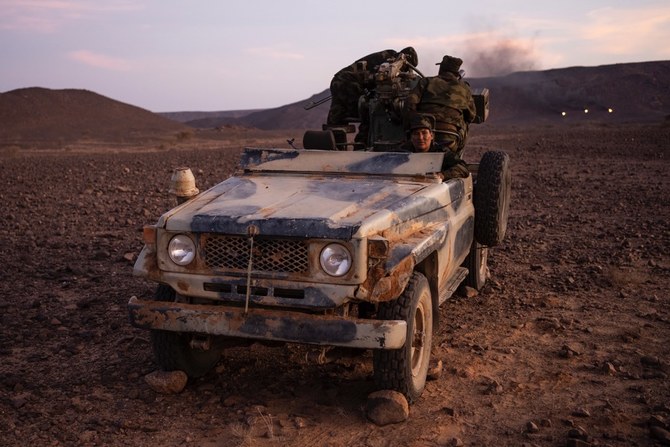

NEW YORK: The UN Security Council has called for a revival of UN-led negotiations on the disputed Western Sahara in a resolution that expressed “deep concern” at the breakdown of the 1991 ceasefire between Morocco and the pro-independence Polisario Front whose decades-old dispute shows no sign of ending.
The vote was 13-0 with Russia and Kenya abstaining.
Morocco annexed Western Sahara, a former Spanish colony believed to have considerable offshore oil deposits and mineral resources, in 1975, sparking a conflict with the Polisario Front.
The UN brokered the 1991 cease-fire and established a peacekeeping mission to monitor the truce and help prepare a referendum on the territory’s future that has never taken place because of disagreements on who is eligible to vote.
Morocco has proposed wide-ranging autonomy for Western Sahara. But the Polisario Front insists the local population, which it estimates at 350,000 to 500,000, has the right to a referendum. The US-drafted resolution extended the mandate of the UN peacekeeping mission charged with carrying out the referendum, known as MINURSO, until Oct. 31, 2023.
The resolution calls on the parties to resume UN-led negotiations without preconditions, “taking into account the efforts made since 2006 and subsequent developments with a view to achieving a just, lasting and mutually acceptable political solution, which will provide for the self-determination of the people of Western Sahara.”
It says this should be done “in the context of arrangements consistent with the principles and purposes of the Charter of the United Nations and noting the role and the responsibilities of the parties in this respect.”
Kenya’s UN Ambassador Martin Kimani said his government voted for the resolution last year in hopes that the UN mission would return “to its core objective of implementing a referendum for the self-determination of the people of Western Sahara.
But he said progress has been limited and the resolution adopted Thursday “continues a gradual but noticeable shift away from the mandate and will not assist the parties to achieve a just, lasting, and mutually acceptable political solution as originally intended.”
Jeffrey DeLaurentis, US deputy ambassador, welcomed the council’s support, saying the Biden administration continues “to view Morocco’s autonomy plan as serious, credible, and realistic.”
He called a political solution “vital to promoting a peaceful and prosperous future for the people of Western Sahara and the region.”
But the Polisario Front ended the ceasefire in November 2020 and resumed its armed struggle following a border confrontation with Morocco which continues today, and in comments after the vote the two sides remained at odds about the future.
The resolution calls on the parties “to demonstrate political will and work in an atmosphere propitious for dialogue in order to advance negotiations.”
It expresses “strong support” for Secretary-General Antonio Guterres’ personal envoy for Western Sahara, Staffan de Mistura, and “strongly encourages” Morocco, the Polisario Front and neighboring countries Algeria and Mauritania to engage with him.
Two round-table meetings of the four parties in December 2018 and March 2019 failed to make any headway on the key issue of how to provide for self-determination.
But Morocco’s UN Ambassador Omar Hilale said after Thursday’s vote that they were “very fruitful and positive and substantial” because “we had very deep discussion on autonomy, on the guarantees, on the need for Polisario to design and to accept autonomy, and also on the elections.”
He expressed hope that de Mistura “will succeed in calling for another round-table,” lamenting that a year has been lost because Algeria, which backs the Polisario, has said it will not attend.
“Let’s hope that the wisdom will prevail in Algeria, and we can come back to the round-table because there will be no solution without discussion all together and having compromise” on Morocco’s autonomy proposal, Hilale said.
He claimed that the resolution adopted on Thursday “irreversibly consecrates, like the resolutions of the council since 2007, the pre-eminence, credibility and seriousness of the Moroccan autonomy initiative as the sole and only solution to this regional dispute.”


