

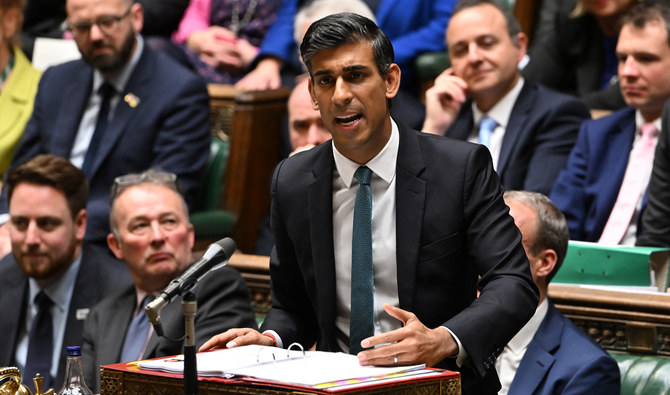

GUJRANWALA, Pakistan: Britain’s new prime minister, Rishi Sunak, has embraced his Indian and Hindu heritage but he also has roots in present-day Pakistan, in the city of Gujranwala, where his paternal grandparents lived during Britain’s colonial rule.
The city saw some of the deadliest sectarian riots during the 1947 partition that carved out India and Pakistan from the former British Empire.
Today, many in Gujranwala, an industrial hub in eastern Punjab province along the border with India, say the new UK leader is uniquely positioned to push for a solution to the Kashmir crisis — the main point of contention between the two South Asian rivals.
Sunak’s grandfather Ramdas Sunak and grandmother Suhag Rani lived in Gujranwala until 1935 and though most of the city’s residents today have no memory of those long-ago days, they say they feel jubilant over the 42-year-old politician’s victory.
They hope diplomatic ties between Pakistan and Britain will improve under Rishi Sunak, who on Tuesday became Britain’s youngest premier.
It is a “matter of happiness” that some of the new UK premier’s ancestors hailed from here, said Omar Ali, a wrestler — a sport that has made Gujranwala famous world over.
College professor Khurram Shehzad said he hoped Sunak would work not only to strengthen relations between Pakistan and Britain but also bring a “new era of success” for Pakistan and India.
City authorities say most records were destroyed during the sectarian violence surrounding the partition, and that there is no proof of where exactly Sunak’s grandfather lived — though popular belief points to Machli Bazaar, where most of the city’s Hindu community once lived.
An abandoned Hindu temple stands as testament to the community’s life here before the partition forced a mass migration to India.
The name, Machli Bazaar, translates roughly as “fish market” and the neighborhood is known for its delicious food and eateries. Throngs of food lovers visit every year — and not just for the fried fish but also other delicacies.
Sunak’s appointment “is an honor for us and for our city, and we are hopeful that in the coming days Pakistan and Britain’s diplomatic relations will improve,” said Hafiz Umar, whose family has a long history in Machli Bazar.
“It seems Rishi Sunak’s priority will be to handle economic challenges at home but we hope he will also try to resolve the issue of Kashmir, which is the main cause of the rift between Pakistan and India,” said Musarrat Jamshed Cheema, a Punjab government spokesperson.
Pakistan and India have a history of bitter relations and fought two of their three wars over the disputed Himalayan region, which is divided between them but claimed by both in its entirety. Sunak has not been publicly outspoken on the issue of Kashmir. His premiership is likely to be dominated at home by an economic crisis that has left millions in the country struggling to pay their food and energy bills and abroad with the ongoing war in Ukraine and how to approach relations with China.
From Punjab, Sunak’s grandparents moved to East Africa in the late 1930s, before finally settling in the UK in the 1960s. Sunak was born in 1980 in Southampton on England’s south coast.
In neighboring India, where millions celebrated Diwali on Monday, a Hindu festival that symbolizes the victory of light over darkness, many are star-struck by Sunak’s success as the youngest British premier, and claim him as their own.
They also point out another of Sunak’s associations with India — he is married to Akshata Murty, whose father is Indian billionaire N.R. Narayana Murthy, founder of tech giant Infosys.
After Sunak’s nomination, Pakistani Prime Minister Shahbaz Sharif took to Twitter to offer his best wishes.
“Congratulations to @RishiSunak on his nomination as leader of the Conservative Party and next Prime Minister of the UK. I look forward to working with him to advance shared interests and further deepen the abiding — partnership,” Sharif said.
India’s Prime Minister Narendra Modi was also quick to offer congratulations. “As you become UK PM, I look forward to working closely together on global issues, and implementing Roadmap 2030. Special Diwali wishes to the ‘living bridge’ of UK Indians, as we transform our historic ties into a modern partnership,” Modi said.


