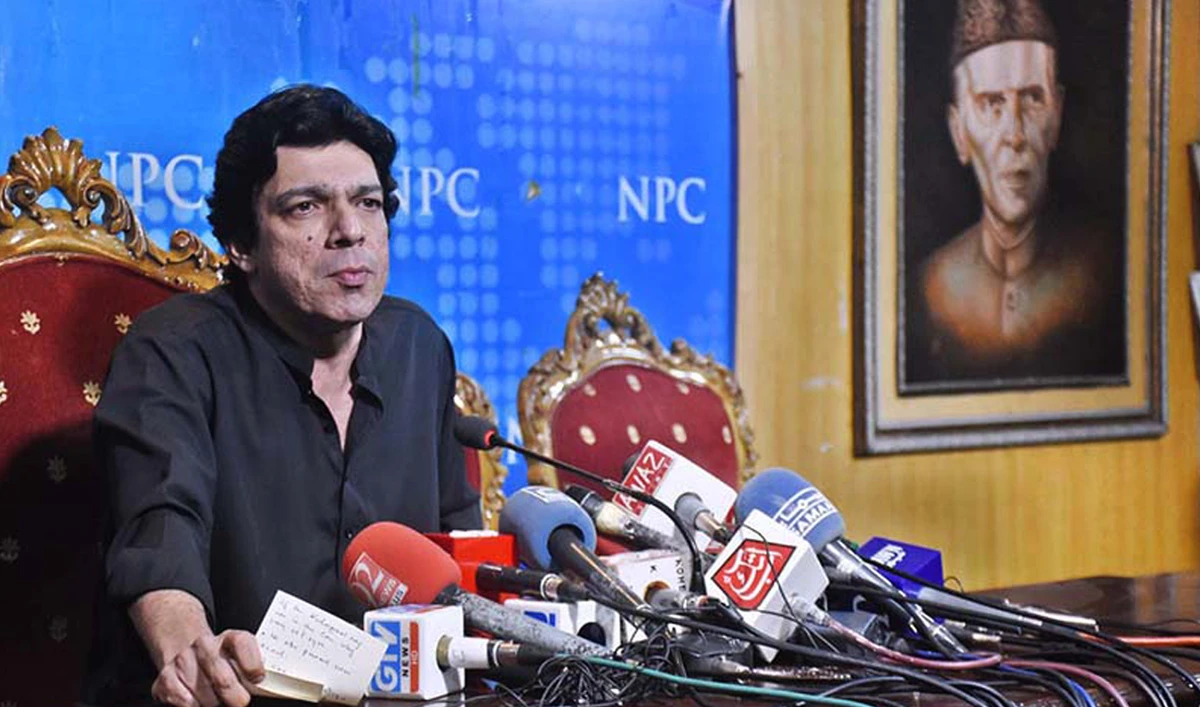
ISLAMABAD: A leader of former prime minister Imran Khan’s political party told a news conference on Wednesday Arshad Sharif’s killing in Kenya was masterminded in Pakistan and he was shot from close range.
According to the authorities in the East African country, the Pakistani journalist was killed Sunday night when the car he was in sped up and drove through a checkpoint outside the Kenyan capital, prompting police to open fire. Nairobi police say the shooting was being treated as a case of mistaken identity.
However, Faisal Vawda, who served as federal minister for water resources in Khan’s administration, called Sharif’s “murder” premeditated while claiming that he was shot by someone inside his vehicle.
“It is not like 20 bullets were fired and Arshad Sharif was martyred,” he told journalists at the National Press Club in Islamabad. “In my estimation, Arshad Sharif was shot from inside the car or at close range.”
He said the slain Pakistani journalist had only received “two bullets in his chest and head.”
Vawda maintained no one would find Sharif’s cellphone or laptop since all evidence in the case had already been erased. He said he knew all these facts since he had never lost contact with the journalist.
The former federal minister refused to identify anyone behind Sharif’s killing, though he said he had named them in a video and given “millions of dollars” to kill them if he was shot.
He also maintained the establishment had played no role in Sharif’s killing since he had positive relations with them.
Vawda said he foresaw plenty of blood and funerals in the coming days, adding he was willing to share all the evidence in Sharif’s murder case with his party chairman along with the top intelligence agencies of the country.
Pakistani opposition politician says Arshad Sharif murder premeditated, was shot from close range from inside car
https://arab.news/v2nka
Pakistani opposition politician says Arshad Sharif murder premeditated, was shot from close range from inside car
- Faisal Vawda says slain Pakistani journalist had only received "two bullets in his chest and head"
- Says Sharif’s cellphone or laptop could not be found as all evidence in the case had been erased
Pakistani politicians urge dialogue with Imran Khan’s party as PM offers talks
- National Dialogue Committee group organizes summit attended by prominent lawyers, politicians and journalists in Islamabad
- Participants urge government to lift alleged ban on political activities and media restrictions, form committee for negotiations
ISLAMABAD: Participants of a meeting featuring prominent politicians, lawyers and civil society members on Wednesday urged the government to initiate talks with former prime minister Imran Khan’s Pakistan Tehreek-e-Insaf (PTI) party, lift alleged bans on political activities after Prime Minister Shehbaz Sharif recently invited the PTI for talks.
The summit was organized by the National Dialogue Committee (NDC), a political group formed last month by former PTI members Chaudhry Fawad Husain, ex-Sindh governor Imran Ismail and Mehmood Moulvi. The NDC has called for efforts to ease political tensions in the country and facilitate dialogue between the government and Khan’s party.
The development takes place amid rising tensions between the PTI and Pakistan’s military and government. Khan, who remains in jail on a slew of charges he says are politically motivated, blames the military and the government for colluding to keep him away from power by rigging the 2024 general election and implicating him in false cases. Both deny his allegations.
Since Khan was ousted in a parliamentary vote in April 2022, the PTI has complained of a widespread state crackdown, while Khan and his senior party colleagues have been embroiled in dozens of legal cases. Prime Minister Shehbaz Sharif last month invited the PTI for talks during a meeting of the federal cabinet, saying harmony among political forces was essential for the country’s progress.
“The prime objective of the dialogue is that we want to bring the political temperatures down,” Ismail told Arab News after the conference concluded.
“At the moment, the heat is so much that people— especially in politics— they do not want to sit across the table and discuss the pertaining issues of Pakistan which is blocking the way for investment.”
Former prime minister Shahid Khaqan Abbasi, who heads the Awaam Pakistan political party, attended the summit along with Jamaat-e-Islami senior leader Liaquat Baloch, Muttahida Quami Movement-Pakistan’s Waseem Akhtar and Haroon Ur Rashid, president of the Supreme Court Bar Association. Journalists Asma Shirazi and Fahd Husain also attended the meeting.
Members of the Pakistan Peoples Party, the ruling Pakistan Muslim League-Nawaz (PML-N) and the PTI did not attend the gathering.
The NDC urged Prime Minister Shehbaz Sharif, President Asif Ali Zardari and PML-N chief Nawaz Sharif to initiate talks with the opposition. It said after the government forms its team, the NDC will announce the names of the opposition negotiating team after holding consultations with its jailed members.
“Let us create some environment. Let us bring some temperatures down and then we will do it,” Ismail said regarding a potential meeting with the jailed Khan.
Muhammad Ali Saif, a former adviser to the Khyber Pakhtunkhwa chief minister, told participants of the meeting that Pakistan was currently in a “dysfunctional state” due to extreme political polarization.
“The tension between the PTI and the institutions, particularly the army, at the moment is the most fundamental, the most prominent and the most crucial issue,” Saif noted.
‘CHANGED FACES’
The summit proposed six specific confidence-building measures. These included lifting an alleged ban on political activities and the appointment of the leaders of opposition in Pakistan’s Senate and National Assembly.
The joint communique called for the immediate release of women political prisoners, such as Khan’s wife Bushra Bibi and PTI leader Yasmin Rashid, and the withdrawal of cases against supporters of political parties.
The communiqué also called for an end to media censorship and proposed that the government and opposition should “neither use the Pakistan Armed Forces for their politics nor engage in negative propaganda against them.”
Amir Khan, an overseas Pakistani businessperson, complained that frequent political changes in the country had undermined investors’ confidence.
“I came here with investment ideas, I came to know that faces have changed after a year,” Amir Khan said, referring to the frequent change in government personnel.
Khan’s party, on the other hand, has been calling for a “meaningful” political dialogue with the government.
However, it has accused the government of denying PTI members meetings with Khan in the Rawalpindi prison where he remains incarcerated.
“For dialogue to be meaningful, it is essential that these authorized representatives are allowed regular and unhindered access to Imran Khan so that any engagement accurately reflects his views and PTI’s collective position,” PTI leader Azhar Leghari told Arab News last week.