

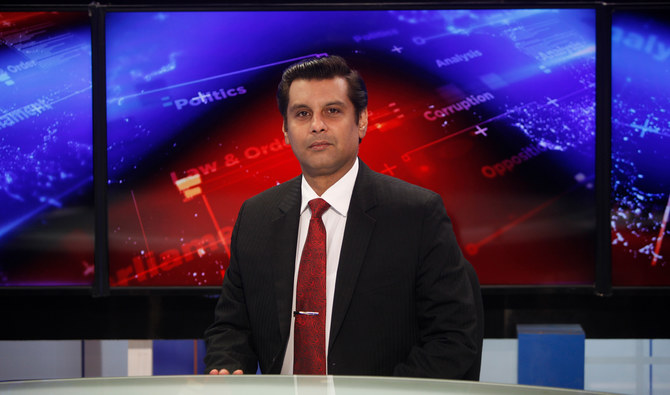

ISLAMABAD: Prominent Pakistani journalists and colleagues of outspoken anchor Arshad Sharif have expressed shock and horror at his mysterious killing last week in Kenya, with some saying the incident would spark new fears in the media fraternity and others arguing it would embolden them to speak truth to power.
Kenyan police said Sharif was killed Sunday night when the car he was in sped up and drove through a checkpoint outside the Kenyan capital of Nairobi, prompting police to open fire at the vehicle. The shooting was being treated as a case of “mistaken identity,” senior police officials have said.
A hugely popular talk show host, Sharif was of late a harsh critic of the current ruling coalition and the powerful army, and fled the country in August, citing threats to his life. He was also widely considered a staunch supporter of ex-PM Imran Khan and his Pakistan Tehreek-e-Insaf (PTI) opposition party. At the time he left Pakistan, he was facing a slew of court cases related to charges of sedition and others. He was believed to have been in the United Arab Emirates since he left Pakistan and had recently traveled to Kenya.
The Pakistan government on Wednesday announced it was sending a two-member team to Kenya to “ascertain the facts” surrounding Sharif’s murder. His body arrived in Pakistan in the wee hours of Wednesday.
“Nothing could be more tragic than this brazen killing of Arshad Sharif,” Mohammad Malick, a senior journalist and primetime news anchor, told Arab News. “He was a very brave man killed by cowards, he was a tall guy brought down by dwarfs.”
Malick said the “brazenness” of the killing had instilled fear in the journalism community.
“The message is very clear for the media in Pakistan. If a big name like Sharif can be silenced so brazenly, he worked for a very big channel [ARY News], he was a very big journalist himself. So now imagine the fear it has created among the ranks,” the journalist said.
Senior journalist Asma Shirazi, who hosts a primetime show on Aaj News, said a killing like Sharif’s anywhere in the world “creates fear, people feel pressure.”
“This kind of murder, killings, it creates fear and we will not be able to perform our duties freely if this continues,” she told Arab News. “After Arshad’s murder, I have spoken to so many friends and they are under pressure that how can we work in Pakistan.”
Ajmal Jami, a special correspondent and talk show host at Pakistan’s Dunya News channel who worked for many years with Sharif, said the killing was “haunting” him.
“Obviously if someone like Arshad, someone of his caliber, is being killed, then people like us, who are mid-career, who are young, who used to follow these seniors, definitely they will be under tremendous pressure, tremendous fears, and that will make our jobs a little bit more difficult,” he said.
“In Pakistan, all the rulers, they tried to curb the freedom of the media and tried to control them and tried to manage them and things are getting difficult. But this very incident, I must say, it will haunt all of us for a really long time,” Jami added.
Khawar Ghumman, bureau chief of ARY News where Sharif was last employed, said it was natural for other journalists to feel unsafe when a colleague was mysteriously killed.
“Other journalists will feel unsafe, would feel quite unsure about their lives,” he said. “But as a journalist I personally think we have to face all these circumstances if we want Pakistan to progress, to move forward as a democratic country.”
Malick too said he hoped the killing would, in the long run, empower, instead of silence, Pakistani journalists.
“This fear is going to be a momentary thing and I think we are going to bounce back,” he said. “Some red lines have been crossed and hopefully, instead of silencing or scaring the media in Pakistan, it’s actually going to have the opposite effect.”


