Iran protestor shot dead after tearing down supreme leader poster

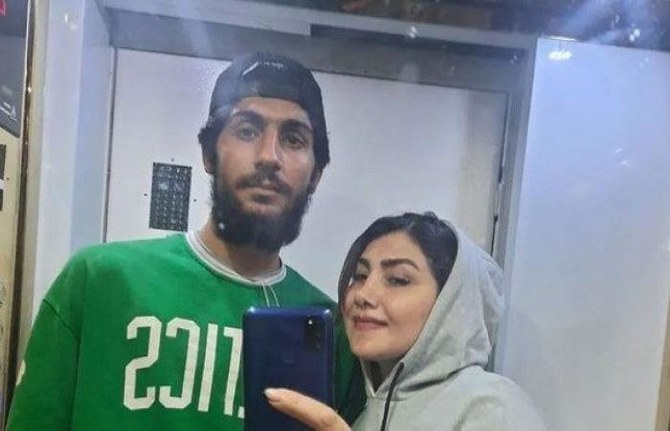
Erfan Rezaei’s mother Farzaneh Barzekar posted a picture of them together two days before his death. (Social media)
Short Url
Updated 25 October 2022
Follow

Iran protestor shot dead after tearing down supreme leader poster

  • Erfan Rezaei, 21, was shot in the shoulder and back by a pistol at close range during protests
  • A source said his family was under pressure to say he had been killed by protesters

LONDON: Security forces in Iran killed a man in September after he tore down a poster of Supreme Leader Ali Khamenei in the city of Amol, BBC Persian reported on Monday.

Erfan Rezaei, 21, was shot in the shoulder and back by a pistol at close range during protests.

A source said his family was under pressure to say he had been killed by protesters.

Not long after the protest, Rezaei’s mother, Farzaneh Barzekar, was told by officials that he had been admitted to hospital.

Hospital nurses refused to tell her where Rezaei was, but after three hours of trying to find him, Barzekar found his blood-soaked clothes outside an operating theater and fainted.

Rezaei died as a result of severe damage to his kidney and spleen caused by the bullet wound to his back. The bullet was fired by a pistol from a distance of 5 meters, the BBC reported.

His body was given to his family on the condition that they held a quiet funeral, which reportedly was only allowed because Rezaei's father was a veteran of the Iran-Iraq War, and Iranians revere those who fought in the 1980-88 conflict.

“Every day, I look at your picture for hours and cry. I look at your empty bed and your books. I read your books out loud to your empty bed,” Rezaei's mother posted on Instagram two weeks ago, underneath a video of his grave.

Anti-government protests were sparked across the country following the death in custody of Mahsa Amini, a 22-year-old woman who was detained by the Iranian morality police for allegedly wearing her hijab “improperly.”

Wednesday will mark 40 days since Amini’s death and the end of the traditional mourning period in Iran.


Saudi, Arab and muslim ministers voice deep concern over worsening humanitarian crisis in Gaza

Updated 18 sec ago
Follow

Saudi, Arab and muslim ministers voice deep concern over worsening humanitarian crisis in Gaza

DUBAI: The foreign ministers of Saudi Arabia, Jordan, the United Arab Emirates, Indonesia, Pakistan, Turkiye, Qatar and Egypt expressed deep concern over the rapidly deteriorating humanitarian situation in the Gaza Strip on Friday.

A statement published by the Saudi Ministry of Foreign Affairs on X cited severe weather conditions and restrictions on humanitarian access as key factors exacerbating civilian suffering.

It said flooded camps, collapsed structures, damaged tents and exposure to cold temperatures had significantly increased risks to civilian lives, particularly among children, women, the elderly and those with medical vulnerabilities.

The ministers warned that the combination of malnutrition, poor shelter and lack of clean water has heightened the risk of disease outbreaks, placing additional strain on Gaza’s fragile health system.

The statement commended the efforts of UN agencies, particularly UNRWA, as well as international humanitarian organizations, for continuing to provide assistance under extremely challenging conditions.

The ministers stressed that humanitarian organizations must be allowed to operate in Gaza and the occupied West Bank in a sustained, predictable and unrestricted manner, describing any obstruction of their work as unacceptable.

The statement highlighted support for UN Security Council Resolution 2803 and US President Donald Trump’s “Comprehensive Plan,” as well as the ministers’ intention to contribute to efforts aimed at sustaining the ceasefire, ending the war in Gaza, and enabling early recovery and reconstruction.

The ministers also called on the international community to fulfill its legal and moral responsibilities, urging Israel, as the occupying power, to immediately lift restrictions on the entry and distribution of essential supplies, including shelter materials, medical aid, fuel, clean water and sanitation support.

They also demanded the immediate, full, and unhindered delivery of humanitarian assistance into Gaza through the UN and its agencies, the rehabilitation of critical infrastructure and hospitals, and the opening of the Rafah Crossing in both directions, in line with Trump’s plan.