

Sustainable development tops agenda at UN Day event in Riyadh

1 / 5
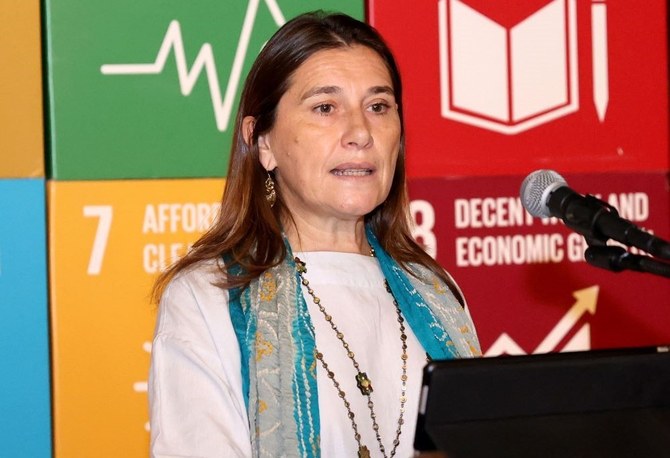
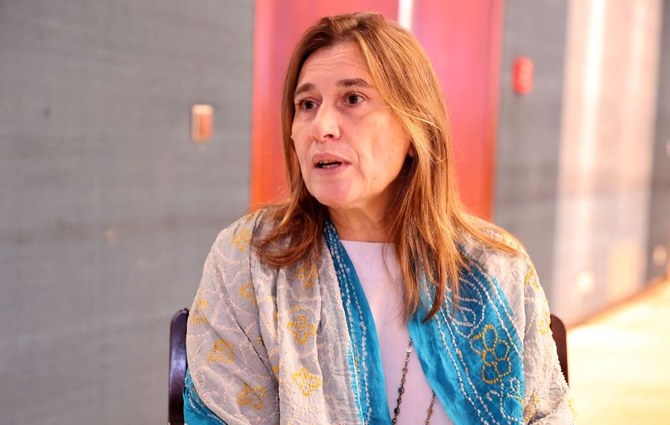
Nathalie Fustier is the Resident Coordinator in Saudi Arabia, responsible for overseeing and facilitating the work of all of the UN agencies across the country. (Meshaal Al Qadeer)
2 / 5
Nathalie Fustier is the Resident Coordinator in Saudi Arabia, responsible for overseeing and facilitating the work of all of the UN agencies across the country. (Meshaal Al Qadeer)
3 / 5
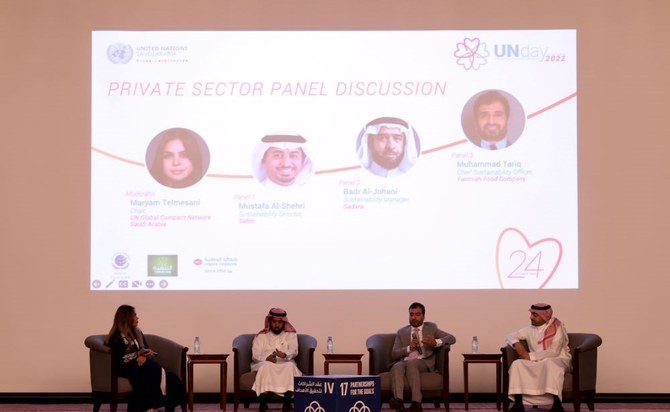
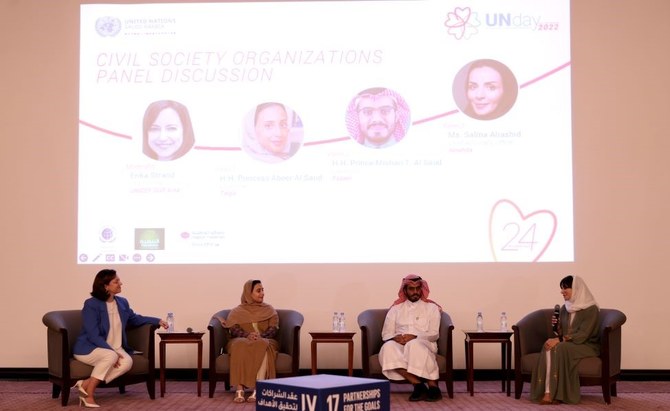
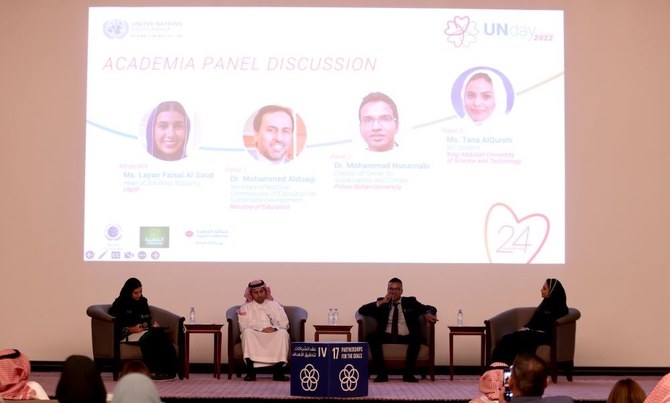
The UN Day in Saudi Arabia marked its ratification through panel discussions on partnerships and sustainability. (Meshaal Al Qadeer)
4 / 5
The UN Day in Saudi Arabia marked its ratification through panel discussions on partnerships and sustainability. (Meshaal Al Qadeer)
5 / 5
The UN Day in Saudi Arabia marked its ratification through panel discussions on partnerships and sustainability. (Meshaal Al Qadeer)
Short Url
Updated 25 October 2022
Follow

Sustainable development tops agenda at UN Day event in Riyadh

  • UN’s Nathalie Fustier: The Kingdom has a leading role to play because it’s a global power, a retinal power, and the role model in a sense
  • Fustier: If the Kingdom is embracing the sustainable development goals and proposing a way forward to do better with Agenda 2030, a lot of countries might be interested in following suit

RIYADH: Sustainable development topped the agenda as Saudi education, private sector, and civil society leaders met in Riyadh to mark the 77th UN Day.

Under the theme Together Toward the Goals, delegates took part in a series of panel discussions.

Nathalie Fustier, the UN’s resident coordinator in Saudi Arabia, told Arab News: “The Kingdom has a leading role to play because it’s a global power, a retinal power, and the role model in a sense.

“So, if the Kingdom is really embracing the sustainable development goals and proposing a way forward to do better with the (UN) Agenda 2030 (17 global sustainable development goals), a lot of countries might be interested in following suit.

“I think the theme of today is a partnership; we believe strongly in partnership in this team in the UN, because without partnerships you cannot achieve anything in the globalized world.

“Partnership in a society is the government but also the private sector, academia, and civil society, and we have been trying to bring them together since day one.

“It has been a lot of effort for us, but we succeeded with the launch of the local network of the global compact,” she said.

UN Day is an annual celebration marking the ratification of the UN Charter signed in 1945 by the representatives of 50 countries, including Saudi Arabia.

The three panel sessions that took place in Riyadh began with keynote speeches from Fustier, and Hattan Bin Samman, general supervisor of sustainable development at the Saudi Ministry of Economy and Planning.

Bin Samman said: “Our partnership with the UN, while longstanding, is starting a new era today. An era defined by mutual delivery, achievement, and impact on the local, regional, and international levels.”

Fustier said: “In Saudi Arabia, the partnership has been instrumental in the progress we have made in sustainable development. This reminds us that the UN 2030 Agenda will only succeed if all actors from every segment of society work together to drive forward the real change required to deliver the SDGs and (the central promise of the 2030 Agenda to) leave no one behind.”

Maryam Telmesani, from the UN Global Compact Network Saudi Arabia, hosted the first panel session that concentrated on the role of the private sector in sustainable development.

The second round of talks centered on the involvement of civil society organizations, while the third set of discussions focused on academia.

“The UN sustainable development cooperation framework is the main tool if you want to frame the cooperation between the United Nations and the government of Saudi Arabia,” Fustier added.

The UNSDCF, signed in June, will run until 2026 and prioritize people, the planet, prosperity, and peace and partnership to implement the 2030 Agenda.

Fustier said: “It is a work that has been developed jointly with the authorities, particularly the Ministry of Economy and Planning, but also with the Ministry of Foreign Affairs, and we hope that it will lead our work toward the priority of the Kingdom and together we will do better in achieving the sustainable development goals.

“It is important to stress that Agenda 2030 is close to the culture of Saudi Arabia, it’s not something that is alien, it is something that should be embraced,” she added.


Defense Minister Prince Khalid bin Salman inaugurates 3rd World Defense Show in Riyadh

Updated 09 February 2026
Follow

Defense Minister Prince Khalid bin Salman inaugurates 3rd World Defense Show in Riyadh

  • Organized by the General Authority for Military Industries (GAMI), the five-day event will run until February 12
  • Prince Khalid launched several key initiatives, including the launch of several defense firms and signing of cooperation deals
  • The show is also serving as a launchpad for cutting-edge security technologies across various government sectors

RIYADH: Minister of Defense Prince Khalid bin Salman inaugurated the third edition of the World Defense Show (WDS) on Sunday on behalf of Crown Prince Mohammed bin Salman.

Organized by the General Authority for Military Industries (GAMI), the five-day event will run until February 12, showcasing the Kingdom’s rapid strides toward strategic independence and technological leadership in the defense sector.

The 2026 edition features a purpose-built venue with a 2,700-meter runway for live air and land demonstrations, underscoring the show’s status as a premier global defense event.

GAMI Governor Ahmad Al-Ohali emphasized that the show reflects Saudi Arabia's commitment to localizing over 50 percent of military spending in line with Vision 2030, fostering an integrated ecosystem where government bodies and international partners collaborate on innovation.

The event brings together official delegations, government entities, and leading international companies specializing in the defense and security sectors. (SPA)

Strategic agreements and major launches

The opening day witnessed significant activity at the Saudi Arabian Military Industries (SAMI) Group pavilion, where Prince Khalid launched several key initiatives:

New entities: The inauguration of SAMI Land Company, SAMI Autonomous Company, and the SAMI Land Industrial Complex.

Supply chain: The unveiling of the SAMI Local Content Program (RUKN) and the HEET Program.

International cooperation: A memorandum of understanding was signed between the Saudi General Authority for Defense Development and the Korean Agency for Defense Development to cooperate on advanced military research.

Defense deals: The Minister signed cooperation agreements with Slovakia, Malaysia, and Somalia.

Defense Minister Prince Khalid signed cooperation agreements with Slovakia, Malaysia, and Somalia. (SPA)

Technological debuts & innovations

The show is also serving as a launchpad for cutting-edge security technologies across various government sectors:

AI-Powered Lucid Gravity: Public Security debuted its advanced Lucid Gravity electric security vehicle at the Ministry of Interior's pavilion. The vehicle integrates state-of-the-art artificial intelligence and specialized security equipment designed to accelerate emergency response times and support field operations.

Public Security’s advanced Lucid Gravity electric security vehicle is displayed at the Ministry of Interior’s pavilion. (SPA)

This high-tech addition highlights Public Security’s shift toward smart, sustainable security solutions. By leveraging predictive intelligence and advanced command-and-control systems, the Lucid Gravity exemplifies the ministry’s commitment to protecting the Kingdom through integrated technological innovation and sustainable mobility.

Smart Helmet: Also at the Ministry of Interior’s pavilion, the General Directorate of Civil Defense unveiled its smart helmet. Designed to revolutionize public safety and emergency response, the helmet features day-and-night cameras and specialized sensors to detect hazardous materials in hard-to-reach locations.

The device serves as a mobile command node, delivering live video feeds directly to command-and-control centers. By enabling real-time data analysis and faster decision-making, the smart helmet significantly reduces incident response times and enhances personnel safety in high-risk environments.

The smart helmet features day-and-night cameras and specialized sensors to detect hazardous materials in hard-to-reach locations. (SPA)

Border Security: The General Directorate of Border Guard (GDBG) showcased an integrated security system featuring radar and thermal cameras capable of detecting drones and classifying moving targets to protect critical infrastructure.

It also functions as an early warning system for critical facilities and border areas and is fully integrated with command and control systems.

Border Guard's ntegrated security system features radar and thermal cameras capable of detecting drones and classifying moving targets to protect critical infrastructure. (SPA)

Counter-Terrorism: The Islamic Military Counter Terrorism Coalition (IMCTC) presented a comprehensive framework integrating intellectual, media, and military domains to combat extremism and terror financing.

Visitors are briefed on specialized programs designed to raise the readiness of national personnel and foster sustainable institutional cooperation among member states to combat extremism. On the event’s opening day, the pavilion hosted high-level delegations, including ministers, military leaders, and ambassadors who reviewed the coalition's pivotal role in coordinating international security efforts and commended its initiatives that support regional and global stability.

A view of the Islamic Military Counter Terrorism Coalition pavilion. (SPA)

Meteorology: The National Center for Meteorology (NCM) displayed advanced weather systems essential for ensuring the safety of the event's air shows and military operations.

At its dedicated pavilion, the NCM is showcasing its latest advanced meteorological technologies and systems. These solutions serve both the military and civilian sectors, providing accurate data to support beneficiary entities' operational processes and highlighting the center's pivotal role in national security and safety.

NCM's latest meteorological technologies and systems serve both the military and civilian sectors

World Defense Show CEO Andrew Pearcey noted that participation is expected to surpass previous records, reflecting the event's growing importance on the international stage. The show continues through February 12.