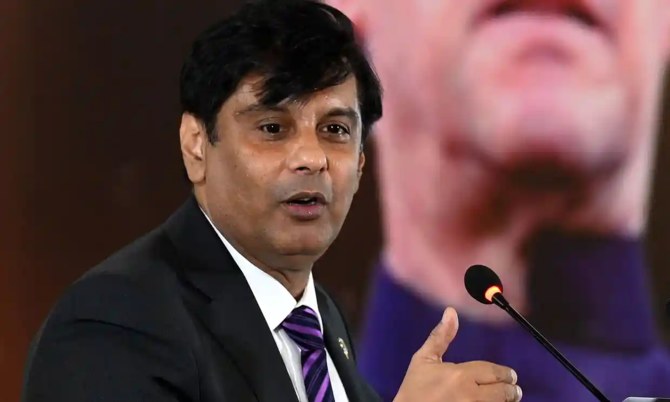

ISLAMABAD: Prominent Pakistani anchorman Arshad Sharif was shot dead in Kenya, his wife said on Monday, while the Kenyan media reported that the journalist was killed by police in a case of “mistaken identity.”
Sharif’s talk show “Power Play” for years aired Monday to Thursday on the ARY news channel, which has been critical of Pakistan’s new Prime Minister Shahbaz Sharif and the military.
He was himself considered a harsh critic of the current ruling coalition and army and fled the country in August after remarks by a politician on a news bulletin he hosted were deemed “seditious” by the country’s media regulator and government.
In August, weeks after the channel was suspended over the allegedly seditious comments and its license revoked, it announced it was parting ways with Sharif.
“I lost a friend, husband, and my favorite journalist (Arshad Sharif) today, as per police he was shot in Kenya,” his wife Javeria Siddique said in a tweet. “Respect our privacy. Remember us in your prayers.”
Kenya’s Star newspaper reported that Sharif was “shot in the head and killed by police after he and his driver allegedly breached a roadblock that had been set up to check on motor vehicles using the route.”
Sharif and his driver were traveling from Magadi town to the capital Nairobi when they were flagged down at a roadblock manned by police officers, police told the Star.
The Independent Policing Oversight Authority in Kenya would investigate the killing, the newspaper said.
“We had an incident of shooting which turned out to be a case of mistaken identity involving a journalist. We will release more information later,” a senior Kenyan police officer was quoted as saying.
“According to police, at the roadblock, there was a call for police to intercept a car similar to the one they were driving following a carjacking incident in Pangani area, Nairobi where a child was taken hostage.
“And a few minutes later, Sharif’s car emerged at the roadblock, and they were stopped and asked to identify themselves,” the Star said.
“They allegedly failed to stop and drove past the roadblock. This prompted a brief chase and shooting that left Sharif dead. Their car rolled and his driver was injured and taken to hospital.”
In a statement, Pakistan’s Information Minister Marriyum Aurangzeb said that Sharif’s body had been identified by the country’s high commissioner, Syeda Saqlain, in Kenya, adding that the legal process for its repatriation had also been launched.
The minister said Pakistani authorities in Nairobi had requested local officials to complete the regulatory process as soon as possible.
Prior to that, she called Sharif’s mother to offer condolences and share all the information available with the government related to the killing of her son.
The Pakistani PM also expressed his sadness over the news of Sharif’s death and took to Twitter to offer condolences to his family. President Arif Alvi, who in 2019 presented him with the Pride of Performance award, said it was “a great loss.”
Pakistan’s military media wing, the ISPR, also issued a brief condolence statement.
In a tweet, the Human Rights Commission of Pakistan said that the incident had sent “shock waves through the journalist community” in the country, and it called for a “transparent inquiry” into the circumstances of Sharif’s death.
A demand for a “judicial investigation” was also made by former prime minister, Imran Khan, who in a tweet said: “Shocked at the brutal murder of Arshad Sharif who paid the ultimate price for speaking the truth - his life.
“He had to leave the country and be in hiding abroad but he continued to speak the truth on social media, exposing the powerful. Today the entire nation mourns his death.”