

Pakistan kicks off anti-polio campaign on World Polio Day

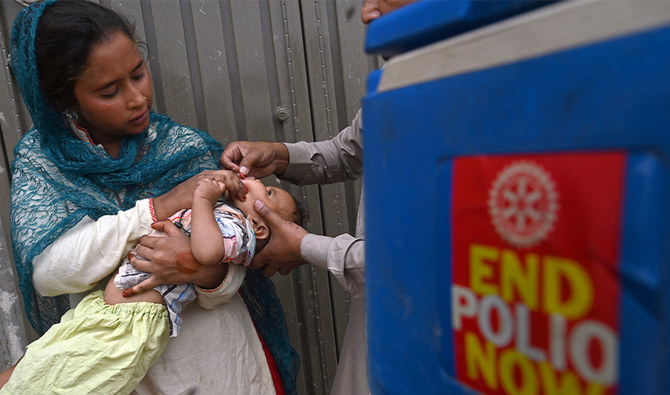
A health worker administers polio vaccine drops to a child during a door-to-door polio vaccination campaign at a slum area in Lahore on May 23, 2022. (AFP/FILE)
Short Url
Updated 24 October 2022
Follow

Pakistan kicks off anti-polio campaign on World Polio Day

  • The country has reported several polio cases in its tribal areas since the beginning of the year
  • Officials fear more cases may emerge in the country in the wake of the recent floods in Pakistan

ISLAMABAD: Pakistan on Monday launched a special immunization campaign to mark World Polio Day, which is annually observed on October 24, while asking parents to get their children vaccinated. 
At least 20 polio cases have been reported in the country since the beginning of the year which has led to international concern about the deteriorating situation of the disease in Pakistan. 
Officials have also expressed fear that more such cases may emerge in flood-affected areas where millions of people have been displaced and it is not easy to access all the families with young children. 
Pakistan and Afghanistan are the only two countries which are battling to prevent the spread of wild poliovirus despite spending millions of dollars on immunization campaigns. 
“Special anti-polio campaign started today,” Pakistan Polio Eradication Program announced in a Twitter post. “Polio workers will go door to door in certain districts to administer polio vaccine to children to protect them from the polio virus. Parents should do their duty and go ahead and secure the future of their children.” 


It said in another social media post that Pakistan was spending World Polio Day to protect “mothers and children from infectious diseases and provide them with a healthy future.” 
Polio is a disabling and life-threatening disease which spreads from person to person and infects spinal cord, causing paralysis. 
All polio cases in Pakistan this year have been reported from the country’s northwestern tribal areas where many parents refuse to allow health teams to administer polio drops to their children. 
Pakistan’s foreign minister Bilawal Bhutto-Zardari requested people to allow vaccination teams to do their work, pointing out that eradicating the disease had become a “challenge” to the whole nation. 


Pakistan Railways to complete first phase of largest digitization drive by June 2026

Updated 12 sec ago
Follow

Pakistan Railways to complete first phase of largest digitization drive by June 2026

  • Project introduces GPS tracking, fiber network, command centers to cut delays, accidents
  • Railways say first phase funded from own revenue amid broader IMF-backed reform push

ISLAMABAD: Pakistan Railways will complete the first phase of its largest-ever digitization program by June 2026, the country’s railways minister said this week, as the state-run operator moves to modernize operations, improve safety and reduce chronic delays across its aging rail network.

The initiative, known as the Railway Advanced Infrastructure Network (RAIN), is a nationwide digital overhaul designed to introduce real-time monitoring, centralized operational control and data-driven decision-making across Pakistan Railways, which has long struggled with safety lapses, service disruptions and financial losses.

The project comes as Pakistan faces sustained pressure to reform loss-making state-owned enterprises under an International Monetary Fund-backed stabilization program, with transport infrastructure seen as critical to improving economic efficiency and public services in a country of more than 240 million people.

Pakistan Railways, once the backbone of long-distance transport in the country, has seen its share of passenger and freight traffic decline over decades due to underinvestment, competition from road transport and repeated safety incidents. Officials say the RAIN project is intended to reverse that trend by modernizing core infrastructure and restoring public confidence in rail travel.

“The RAIN Project will significantly reduce train delays and accidents, enhance passenger services, and improve overall operational efficiency,” Railways Minister Muhammad Hanif Abbasi said, according to an official statement issued after he chaired a review meeting on the project.

According to the railways ministry, Phase-I of the RAIN program will be financed entirely through Pakistan Railways’ own revenue, part of efforts to improve financial discipline and reduce reliance on government subsidies.

The first phase includes the installation of Global Positioning System (GPS) tracking on all trains and locomotives, allowing railway authorities to monitor train movements in real time and respond more quickly to disruptions or emergencies.

It also includes the establishment of command and control centers at Pakistan Railways’ headquarters in Lahore and at all divisional offices, enabling centralized oversight of operations and faster decision-making during accidents or delays.

Another major component is the fiber-optic networking of around 1,700 kilometers of the main ML-1 railway line, Pakistan’s busiest north-south corridor linking major cities and ports, to support high-speed data transmission and digital monitoring systems.

The project further includes the rollout of “safe and smart” railway stations at major hubs, modelled on upgrades already carried out at Rawalpindi station, alongside the provision of high-speed Internet services at selected stations to improve passenger experience and operational coordination.

The railways ministry said additional details on subsequent phases of the digitization program would be announced in due course.