Western powers see Russia’s ‘dirty bomb’ claim against Ukraine as pretext for escalation

1 / 2
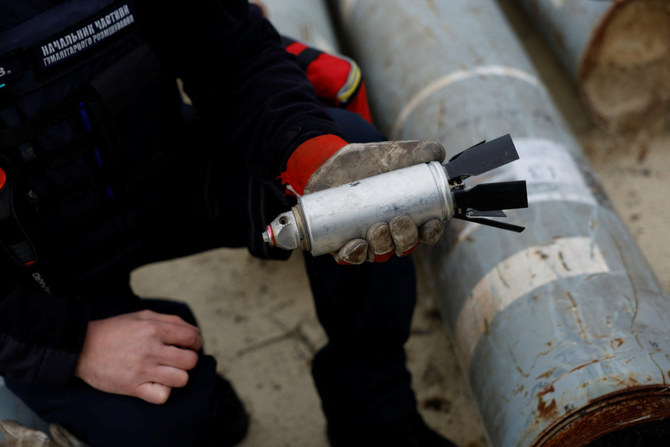
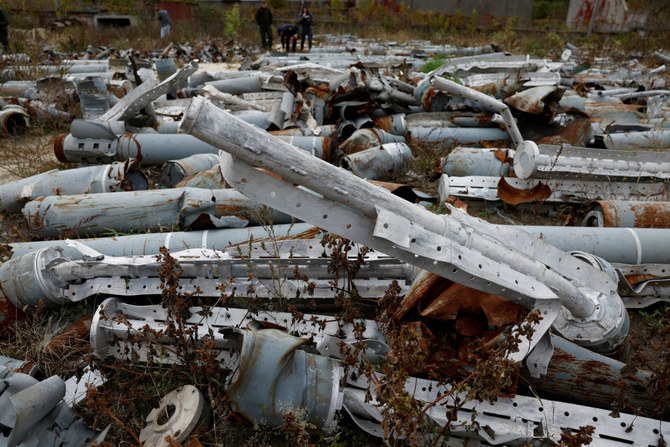
Pieces of Russian Smerch rockets that did not explode on impact were recovered by the Ukrainian military in Kharkiv region on October 21, 2022. (Reuters)
2 / 2
Pieces of Russian Smerch rockets that did not explode on impact were recovered by the Ukrainian military in Kharkiv region on October 21, 2022. (Reuters)
Short Url
Updated 24 October 2022
Follow

Western powers see Russia’s ‘dirty bomb’ claim against Ukraine as pretext for escalation

  • A so-called dirty bomb, which does not involve a nuclear explosion, is designed to contaminate a wide area with radioactive material
  • Ukraine sharply denounced Moscow’s claims, calling the allegation a Russian ploy for just such an attack in Moscow’s eight-month-old war

WASHINGTON: The United States, Britain and France on Sunday jointly dismissed Russian claims that Ukraine is preparing to use a dirty bomb and warned Moscow against using any pretext for escalating the conflict.
Russian Defense Minister Sergei Shoigu made the allegation about a possible dirty bomb attack in a round of telephone conversations with Western defense chiefs earlier Sunday.
“Our countries made clear that we all reject Russia’s transparently false allegations that Ukraine is preparing to use a dirty bomb on its own territory,” the US State Department said in a joint statement with the British and French governments.
“The world would see through any attempt to use this allegation as a pretext for escalation,” the statement went on. “We further reject any pretext for escalation by Russia.”
A so-called dirty bomb is designed to contaminate a wide area with radioactive material, making it dangerous for civilians. It does not involve a nuclear explosion.
Ukrainian President Volodymyr Zelensky sharply denounced Moscow’s claims, calling the allegation a Russian ploy for just such an attack in Moscow’s eight-month-old war against its pro-Western neighbor. “The world should react as harshly as possible,” he said.
“If Russia calls and says that Ukraine is allegedly preparing something, it means one thing: Russia has already prepared all this,” Zelensky said in a video address on social media.
“Even the very Russian threat of nuclear weapons — and even more so against our country, which has given up its nuclear arsenal... is a reason for both sanctions and for even greater strengthening of support for Ukraine,” said Zelensky.
Shoigu conducted a round of telephone consultations with counterparts from Britain, France and Turkey, all NATO members, after first speaking Friday with Austin.
In those calls, Shoigu conveyed “concerns about possible provocations by Ukraine with the use of a ‘dirty bomb,’” the Russian Defense Ministry said.
Shoigu and Austin spoke Sunday, in what the Pentagon said was a follow-up call requested by Russia to their call Friday.
“Secretary Austin rejected any pretext for Russian escalation and reaffirmed the value of continued communication amid Russia’s unlawful and unjustified war against Ukraine,” said a statement afterward from Pentagon press secretary Pat Ryder.
When Shoigu and Austin spoke on Friday, it was only their second call since Moscow sent troops to Ukraine on February 24.


Shamima Begum’s case revived after top European court’s intervention

Shamima Begum left east London aged 15 and traveled to Daesh-held territory in Syria in 2015. (File/AFP)
Updated 11 sec ago
Follow

Shamima Begum’s case revived after top European court’s intervention

  • European Court of Human Rights challenges British govt’s citizenship deprivation order
  • Begum, 26, left London as a teenager to marry a Daesh fighter, with concerns she was trafficked

LONDON: The longtime appeal by Shamima Begum to return to the UK has been revived after the European Court of Human Rights challenged the British government’s block on her return.

The 26-year-old, who left east London aged 15 and traveled to Daesh-held territory in Syria in 2015, had her British citizenship stripped by the then home secretary, Sajid Javid, The Times reported.

The Strasbourg court’s intervention means the UK must now consider if it acted unlawfully under the framework of the European Convention of Human Rights in stripping her citizenship in 2019.

Begum traveled with two friends to Syria. There, she became a child bride to Dutch national Yago Riedijk and had three children who all died as infants.

The court is examining whether the 2019 decision breached the ECHR’s Article Four, which prohibits slavery, servitude and forced labor.

As part of the examination, it could be found that the UK failed in its duty to identify Begum as a potential victim of trafficking and protect her from harm.

Begum’s journey to Syria made national headlines in the UK. The Times newspaper later discovered her whereabouts at a prison camp in Syria operated by Kurdish security forces, where she remains today.

In stripping her citizenship, Javid said the decision was “conducive to the public good.”

He also argued she was eligible for Bangladeshi nationality through her parents, to avoid rendering her stateless.

However, Bangladesh has said repeatedly that Begum is not a citizen of the country.

Begum’s lawyers, from the firm Birnberg Peirce, filed a submission to the Strasbourg court which argued that the UK failed to ask fundamental questions before stripping her citizenship, including concerns over child trafficking.

Gareth Peirce said the UK could now confront previously ignored questions as a result of the court’s intervention, providing “an unprecedented opportunity.”

She added: “It is impossible to dispute that a 15-year-old British child was lured and deceived for the purposes of sexual exploitation.

“It is equally impossible not to acknowledge the catalogue of failures to protect a child known to be at risk.”

The Strasbourg court’s move meant that it was “impossible now not to have real hope of a resolution,” she said, adding that the Begum case raised profound questions about the UK’s responsibility to victims of grooming and trafficking.

Despite years of litigation, Begum has failed to overturn the citizenship deprivation order. She has stated her desire to return to Britain.

In 2020, the Special Immigration Appeals Commission found that conditions in the camp where she is held, Al-Roj, were inhuman and degrading, but that national security considerations prevented any change to her case.

Later, the Supreme Court ruled that Begum was ineligible to return to Britain to take part in the appeal against her citizenship deprivation.

The Strasbourg court could reject appeals by Begum’s lawyers after considering the UK Home Office’s response to its questions.

If the latest appeal is upheld, however, ministers would have to “take account” of the court’s judgment. The court’s rulings are technically binding but lack an enforcement mechanism.

The Strasbourg court is now set to consider written submissions from both sides before deciding whether the case should proceed to a full hearing. A final judgment could take many months.

A Home Office spokesman said: “The government will always protect the UK and its citizens. That is why Shamima Begum — who posed a national security threat — had her British citizenship revoked and is unable to return to the UK.

“We will robustly defend any decision made to protect our national security.”

Maya Foa, CEO of Reprieve, a charity that has campaigned for the return of women and children from Syria, said: “This case only reached the European court because successive UK governments failed to take simple steps to resolve a common problem.

“While our security allies have all been bringing their people home, Britain has been burying its head in the sand. Casting British men, women and children into a legal black hole is a negligent policy that betrays a lack of faith in our justice system.”