

Jordan launches national nutrition strategy for 2023-2030

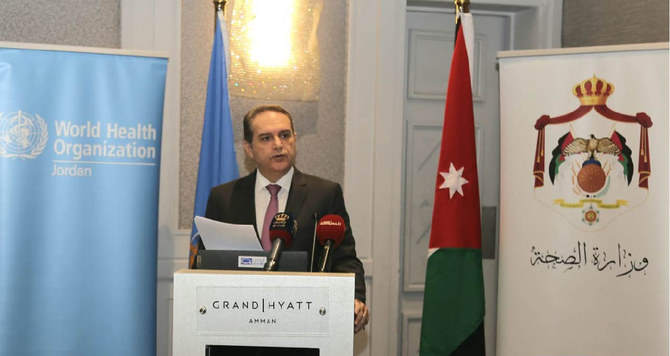
Health Minister Firas Al-Hawari speaks at a ceremony marking the launch of the National Nutrition Strategy. (Petra)
Short Url
Updated 23 October 2022
Follow

Jordan launches national nutrition strategy for 2023-2030

  • Approach targets malnutrition, obesity, micronutrient deficiencies and diet-related diseases

AMMAN: Jordan’s Ministry of Health launched the country’s 2023-2030 National Nutrition Strategy on Sunday in collaboration with the World Health Organization, Jordan News Agency reported.

The approach seeks to improve the nutritional status of all groups in Jordanian society to prevent malnutrition and obesity, as well as diet-related noncommunicable diseases.

It comes within the royal vision of achieving economic and social development objectives.

During the launch ceremony, Health Minister Firas Al-Hawari said that Jordan has made significant nutritional advances in recent decades, citing progress in addressing childhood malnutrition as evidenced by low prevalence rates of stunting and wasting.

Hawari also noted the government’s initiative to enrich wheat flour with iron and other nutrients in order to combat the spread of iodine deficiency and severe anemia.

According to the minister, a national study conducted in 2019 to evaluate micronutrient deficiencies and the nutritional status of Jordanians and Syrian refugees found a decrease in the prevalence of anemia and Vitamin A deficiency among children under the age of five, reaching 19 percent and 8 percent, respectively.

Child stunting was recorded at 7 percent, and wasting at less than 1 percent.

However, the study revealed that 63 percent of the population was vitamin D deficient, while 11 percent and 19 percent were folic acid and vitamin B12 deficient, respectively.

The study also found that the prevalence of adults recording an overweight or obese BMI was 59 percent.

“Appropriate nutrition is vital to human health and a fundamental right. Changes in diets and lifestyles in the countries of the Eastern Mediterranean region led to the spread of unhealthy dietary patterns, resulting in an increase in obesity, diet-related noncommunicable diseases, low exclusive breastfeeding rates and micronutrient deficiencies,” WHO Representative in Jordan Jamila Al-Rabi said.


Syrian government foils Daesh plot to attack churches and New Year celebrations

Updated 02 January 2026
Follow

Syrian government foils Daesh plot to attack churches and New Year celebrations

  • Bomber kills soldier in Aleppo, detonates explosives injuring 2 others

ALEPPO, DAMASCUS: The Syrian Interior Ministry announced on Thursday that it had thwarted a Daesh plot to carry out suicide attacks targeting New Year celebrations and churches, particularly in Aleppo.
The ministry said in a statement that, as part of ongoing counterterrorism efforts and careful monitoring of Daesh cells in cooperation with partner agencies, it had received intelligence indicating plans for suicide attacks targeting New Year celebrations in several provinces, particularly Aleppo, with a focus on churches and civilian gathering areas.
The ministry added that it took preemptive measures, including reinforcing security around churches, deploying mobile and fixed patrols, and setting up checkpoints across the city.
During operations at a checkpoint in Aleppo’s Bab Al-Faraj district, security forces intercepted a suspected Daesh member who opened fire. One internal security soldier was killed, and the attacker detonated explosives, injuring two others.
Daesh recently increased its attacks in Syria, and was blamed for an attack last month in Palmyra that killed three Americans.
On Dec. 13, two US soldiers and an American civilian were killed in an attack Washington blamed on a lone Daesh gunman in Palmyra.
In retaliation, American forces struck scores of Daesh targets in Syria.
Syrian authorities have also carried out several operations against Daesh since then, saying on Dec. 25 they had killed a senior leader of the group.