Hackers breach Iran’s atomic energy agency, protests persist

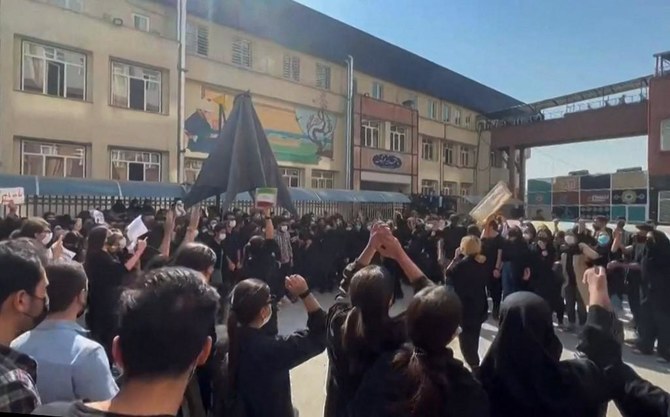
Iranian students chant “Freedom” as they rally at Tehran’s University of Science and Culture. (File/AFP)
Short Url
Updated 23 October 2022
Follow

Hackers breach Iran’s atomic energy agency, protests persist

  • An anonymous hacking group claimed responsibility for the attack, demanding Tehran release political prisoners arrested in the recent nationwide protests

DUBAI: Iran’s atomic energy agency alleged on Sunday that hackers acting on behalf of an unidentified foreign country broke into a subsidiary’s network and had free access to its email system.
An anonymous hacking group claimed responsibility for the attack on Iran’s Atomic Energy Organization, demanding Tehran release political prisoners arrested in the recent nationwide protests. The group said it leaked 50 gigabytes of internal emails, contracts and construction plans related to Iran’s Russian-backed nuclear power plant in Bushehr. It was unclear whether the breached system contained classified material.
The hack comes as Iran continues to face nationwide unrest first sparked by the Sept. 16 death of Mahsa Amini, a 22-year-old woman in police custody for allegedly not adhering to the country’s strict Islamic dress code. On Sunday, Iran’s leading teachers’ association reported that sit-ins canceled classes at multiple schools across the country in protest over the government’s crackdown on student protesters.
The protests first focused on Iran’s state-mandated hijab, or headscarf, for women but transformed into one of the most serious challenges to the country’s ruling clerics. Protesters have clashed with police and even called for the downfall of the Islamic Republic itself. Security forces have fired live ammunition and tear gas to disperse demonstrations, killing over 200 people, according to estimates by rights groups.
Iran’s civil nuclear arm said hackers breached the email system used by a company operating the country’s sole nuclear power plant in the southern port city of Bushehr. The agency blamed a “foreign country” for the attack, without elaborating. Iran has previously accused the United States and Israel for cyberattacks that have impaired the country’s infrastructure.
“These illegal efforts are done out of desperation is for attracting public attention,” the organization said.
An anonymous hacking group, calling itself “Black Reward,” published what appeared to be images of contracts, plans and equipment at the Bushehr plant, which went online over a decade ago with help from Russia.
“Unlike Westerners, we do not flirt with criminal mullahs,” the group wrote, announcing the hack on its Telegram channel.
Meanwhile The Coordination Council for Teachers Union, Iran’s leading teachers’ association that has been vocal in the protests, reported that schools, largely in Iran’s Kurdish provinces, heeded its call to boycott classes Sunday in protest over the deaths and detentions of students in the past month of unrest. There was no immediate acknowledgement of the strikes from authorities.
The union shared photos of teachers holding up protest signs saying “Woman, Life, Freedom” instead of teaching at schools in the Kurdish cities of Sanandaj, Marivan, Kermanshah and Saqez, as well as in the West Azerbaijan and mountainous Hamadan provinces.
“Schools have become barracks and tear gas is thrown in the faces of elementary school students,” one teacher wrote in a letter shared by the union. “History will record the names of this brave generation.”
Campuses have long been a flash point for unrest in Iran, including during the 1953 student protests under the Western-backed shah and during the 1999 pro-democracy demonstrations under former reformist President Mohammad Khatami.
At the prestigious Sharif University of Technology in Tehran, the scene of an hours-long siege by security forces earlier this month that ended with dozens of students arrested, protests erupted as students tore down the barrier dividing men from women in the campus cafeteria, a students’ association said.
“Freedom! Freedom! Freedom!” the massive crowd of students shouted at the top of their lungs, pumping their fists in the air.


How Gaza’s winter became another front in an unfinished war

Updated 8 sec ago
Follow

How Gaza’s winter became another front in an unfinished war

  • Winter storms have submerged and upended tents and brought down bombed-out homes across the enclave
  • At least nine infants have died of hypothermia in recent weeks amid reported Israeli restrictions on aid entry

LONDON: Gaza’s winter nights have grown longer and deadlier as torrential rains, flooding and bitter cold batter hundreds of thousands of Palestinians already wearied by more than two years of Israeli bombardment. Many are so malnourished they lack even the body fat needed to withstand the cold.

Families across the enclave stay awake through the night gripping their tents to keep them from being torn away by strong winds or swept off by floodwaters, all while fearful of a sudden Israeli airstrike. Parents carry children for hours, and at times older children carry younger ones to protect them from drowning.

“When it rains, of course all the tents flood, and all their bedding is soaked,” said Maysa Yousef, a mother of four and artist based in central Gaza. “People spend the entire night fighting for their lives, crying and pleading.”

“Civil Defense rushes in, along with rescue crews, to save people,” Yousef told Arab News. “They secure the tents and take families to so-called safe places; but in reality, there are no safe places because all of Gaza is destroyed; they take them to schools or other locations.”

The same conditions afflict those trying to help. Yousef’s husband works as a mental health specialist at a field hospital in central Gaza, where nearly all staff live in tents and have been heavily affected by the winter storms.

“All night long they don’t sleep, each one holding a broom, pushing the water away, while he and his children and their bedding are soaked,” Yousef said. “In the morning, they put on their wet clothes and go to work.

“When my husband sees them at work, he is shocked by how they haven’t slept all night, how their clothes are still wet, and yet they come in the morning and work all day, treating people and easing their suffering, when they themselves need support.”

More than 90 percent of Gaza’s population have been displaced repeatedly by the Israeli onslaught on the enclave, which started on Oct. 7, 2023, following a Hamas-led attack on southern Israel.

Those not living in tents are sheltering in bombed-out schools and damaged residential buildings. The UN said in November that nearly 81 percent of all structures in the Gaza Strip have been damaged. 

Strong winds and heavy rain since November have submerged or destroyed more than 90 percent of displacement tents, Gaza’s Civil Defense said. Storm Byron, which hit from Dec. 10 to 17, damaged more than 17 buildings, according to the UN Relief and Works Agency for Palestine Refugees, UNRWA.

The storm also damaged or destroyed more than 42,000 tents, affecting at least 235,000 people, according to Gaza’s Shelter Cluster, a coalition of UN agencies and NGOs.

Even before Byron, rainfall and flooding upended more than 13,000 tents in November alone, according to the Israeli rights group B’Tselem. At least 740,000 people were affected.

“Gaza is completely destroyed,” Yousef said. “With the rain, even houses that are still standing are at risk of collapsing over their residents.”

Some bombed houses, she added, have given way under the weight of heavy rain and strong gale. “Some people were living in damaged houses that collapsed while they were inside. About 20 people were killed; some fell and drowned.”

With the sewage system destroyed, floodwater has nowhere to drain. “With continuous rain, large, deep pools form to the point that a tent ends up completely submerged by water,” Yousef said.

She described surreal scenes of “donkey carts transporting people, completely covered by water; the water would be covering the donkey itself, with only its head visible as it carries people.”

After nights of relentless rain, mornings bring a grim routine.

“The next day, you see everyone around you spreading their mattresses and belongings out in the sun — if the sun even comes out,” Yousef said. “Sometimes the rain lasts three or four days, even a week, causing severe flooding in Gaza because there is no sewage system and water levels keep rising.”

Coastal flooding has made matters worse.

“The sea rises and begins to overflow toward us, pulling away all the tents, even those on higher ground,” she said. “Soil erosion follows, and the ground gives way, to the point that even tents placed above the waterline and sea level suddenly collapse, with children falling into the sea, and Civil Defense searching for them.”

The floods have not only swept away tents and debris but also lives. On Dec. 31, and after a desperate search, rescuers in Gaza City pulled the lifeless body of seven-year-old Ata Mai by the ankle to pry him out of muddy waters.

Mai, who drowned on Dec. 27 in an improvised displacement camp, was the sixth child to be killed by a lack of adequate shelter during the harsh winter conditions in December, according to the UN Children’s Fund, UNICEF.

The organization’s regional director, Edouard Beigbeder, said that “teams visiting displacement camps reported appalling conditions that no child should endure, with many tents blown away or collapsing entirely.”

Children in Gaza lack proper winter clothing and are often barefoot or dressed in thin garments, huddling at night near improvised fires, which may be deadly. The risk was clear in early January, when a displaced grandmother and her four-year-old grandson burned to death after their tent caught fire.

But the cold has been even deadlier. At least eight newborns died of hypothermia within a month, and more than 74 children have died in 2025 amid the brutal winter conditions, UNRWA said on Jan. 9.

On Jan. 10, the extreme cold amid severe Israeli restrictions on aid entry killed another infant who was born only a week before, according to several media reports.

“We enter this New Year carrying the same horrors as the last,” said UNRWA Communication Officer Louise Wateridge. “There’s been no progress and no solace. Children are now freezing to death.”

Aid agencies say those deaths were preventable. The UN and international NGOs are calling on Israel to allow more aid into Gaza to help families survive the winter, saying Israeli restrictions continue to block deliveries.

While a fragile ceasefire since October has allowed some aid to re-enter Gaza after months of blockade, assistance still falls far short of the need, aid groups say.

Thousands of tents and hundreds of thousands of tarpaulins have been distributed since October, the UN says, but over one million people still urgently need shelter support.

Further compromising the humanitarian operation in Gaza, Israel announced in December it would suspend the permits of 37 aid agencies — a move described by UN Human Rights Chief Volker Turk as “outrageous.”

“Such arbitrary suspensions make an already intolerable situation even worse for the people of Gaza,” Turk said on Dec. 31. “I remind the Israeli authorities of their obligation under international law to ensure the essential supplies of daily life in Gaza, including by allowing and facilitating humanitarian relief.”

Israel said that the targeted international NGOs, including Doctors Without Borders and the Norwegian Refugee Council, had not complied with a deadline to disclose information on their Palestinian staff.

Several of the targeted INGOs told news agencies that they would never knowingly employ people engaging in military activity.

Even those living in the bombed-out ruins of what were once their homes have not been spared the winter suffering.

Each time Yousef tries to secure windows in her bomb-damaged house, intense shelling along the “yellow line” in eastern Gaza blasts them loose again.

“The window flips outward because it no longer fits its frame,” she said. “Doors swing open with every strike and won’t stay shut.”

The anxiety caused by layers of hardship have robbed Yousef of much-needed sleep. “At night, we sleep in a state of anxiety,” she added. “The walls are pulling apart; they are at risk of collapse.”

Rain turns daily life into a constant struggle. “When it rains, you are left wondering where to put the dishes, constantly watching where the rain is coming from and where it is leaking,” she said. 

“My house has three floors, and the floor beneath me has walls riddled with cracks. Rain pours through as if you are sitting in the street with rain falling directly over you. 

“Water can reach five, six, seven, even 10 centimeters. We spent weeks wading through it.”

Personal hygiene has become another excruciating ordeal amid a lack of heat sources and toiletries.

“Water is extremely cold,” Yousef said. “We fetch it from far away and store it in containers.”

Even when firewood is available, wet conditions make it useless. “On rainy days, it’s impossible to light a fire or bathe in hot water,” she said. “So we’re forced to bathe in cold water.”

“Imagine the weather is extremely cold, and there is nothing to protect you — the windows are covered with ripped plastic sheets that melt in the sun and fly away with the wind. On top of that, you and your children bathe in icy water.”

The consequences have been severe. Yousef said she developed intense bone pain since the cold weather began.

“Every time I poured the cold water over myself and braced my body, the pain in my back worsened, especially with the cold wind,” she said. “Imagine what it is like for children.”

Bathing her children often made them ill. “Because of this, people greatly reduced bathing with cold water in winter. You would see children, and even adults, extremely dirty, their clothes filthy, their stench overwhelming, yet they did not bathe to avoid getting ill.” 

Soap is also scarce. “We went nearly six months without even a single bar of soap,” Yousef said, adding that some people began to improvise and make soap from oil and other materials.

With infrastructure shattered and sanitation systems crippled, waste has piled up across Gaza, the UN said. Rainwater mixed with raw sewage has exposed residents to waterborne diseases, Save the Children warned.

The organization said that outbreaks of hepatitis, diarrhea and gastroenteritis have spread, made more lethal by widespread malnutrition.

Ahmad Alhendawi, the regional director, noted on Jan. 8 that “basic shelter items are stuck at the border.”

“The denial of humanitarian aid is a serious violation of humanitarian laws and a grave violation against children,” he said. “And yet it is still happening on our watch.” 

For Yousef, the fear of illness is constant.

“During winter, one of the most exhausting realities we face is how quickly diseases spread,” she said. “All it takes is for your child to go out onto the street to buy something or mix with people for just fifteen minutes, and they may come back infected with a virus or an illness.”

As winter deepens, Gaza’s nights continue to stretch longer, with conditions increasingly deadly for those left exposed.