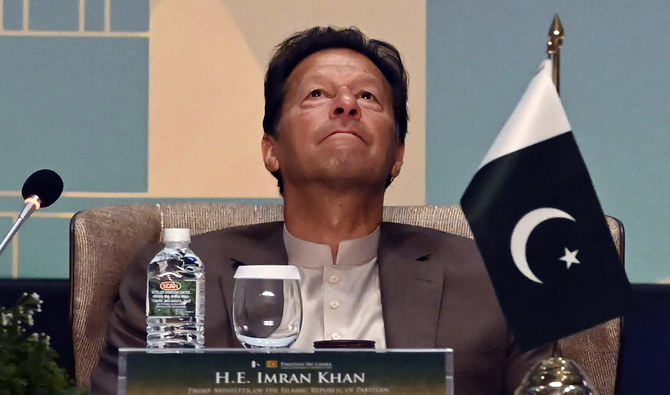

ISLAMABAD: The Election Commission of Pakistan (ECP) on Friday disqualified former prime minister Imran Khan from holding a public office, after he was found guilty of “corrupt practices” in a case related to the declaration of assets he made from the sale of state gifts.
Khan was accused of misusing his position to purchase and sell gifts received during state visits abroad that were worth over Rs140 million ($635,497).
A five-member election tribunal announced the verdict in the Toshakhana case against Khan under Article 63 (1) (p), ruling that the ex-premier had made “false statement and incorrect declaration” in his statement of assets for the year 2020-21.
“The respondent (Khan) had deliberately concealed material facts by not disclosing details of gifts in statement of his assets and liabilities for the year 2018-19,” the ECP said in its order.
“We are of the considered opinion that the respondent has become disqualified under Article 63(1)(p) of the constitution read with section 137, 167 and 173 of the Elections Act, 2017. Consequently, he ceases to be a member of the National Assembly of Pakistan, and his seat has become vacant accordingly.”
The election oversight body said since Khan had made false statements and incorrect declaration, therefore he had also “committed offence of corrupt practices defined under section 167 and 173 of the Elections Act, 2017, punishable under section 174 of the Elections Act, 2017.”
“Office is directed to initiate legal proceedings and to take follow-up action under section 190 (2) of the Elections Act, 2017,” it added.
Article 63 (1) (p) states that a person shall be disqualified from being elected or chosen as, and from being, a member of parliament, if “he is for the time being disqualified from being elected or chosen as a member of the Majlis-e-Shoora (Parliament) or of a Provincial Assembly under any law for the time being inforce.”
The election commission has yet to release a detailed verdict in the case.
Members of Khan’s Pakistan Tehreek-e-Insaf (PTI) party said they were not surprised by the verdict and the party would challenge it in a high court.
"We knew because they will announce a verdict not on the basis of law, but on the basis of politics, so this verdict is not unexpected," PTI’s Asad Umar told reporters outside the ECP office.
"But let me convey it to them and whoever stands by them that your dream of 'minus one' for Imran Khan will never come true."
Legal experts said that unlike former prime ministers Nawaz Sharif and Yousuf Raza Gilani, Khan had not been disqualified by the top court and so he could appeal the judgment in a high court or the Supreme Court of Pakistan.
“It is more like a political decision, and Imran Khan can challenge not only the verdict but also the election commission’s jurisdiction in such matters,” Osama Malik, a legal expert, told Arab News.
Khan has been embroiled in the Toshakhana case since April when PM Shehbaz Sharif said his predecessor had sold state gifts worth $635,497 in Dubai. Toshakhana is a repository for gifts received by a head of state from foreign countries.
Multiple references were filed against Khan accusing him of buying items from the Toshakhana to sell them in the market at higher costs. A major charge was that the former premier failed to declare some of the earnings in his annual statements of assets submitted before the ECP.
Under the law, lawmakers are required to declare their assets with the ECP every year.
Khan’s disqualification by the ECP has also sparked protests by PTI supporters in different cities of Pakistan.