

Palestinian Authority concerned over weapons menace in West Bank

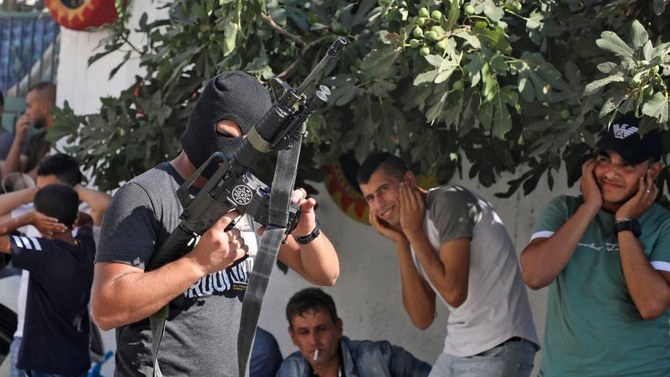
Palestinians cover their ears as a masked man fires a volley during the funeral of Dalia Ahmed Suleiman Samudi, who was killed by Israeli fire, Jenin city, occupied West Bank, Aug. 7, 2020. (AFP)
Short Url
Updated 20 October 2022
Follow

Palestinian Authority concerned over weapons menace in West Bank

  • Proliferation of various light arms via smugglers
  • ‘Israeli dealers fueling conflict among families, groups’

HEBRON: The Palestinian Authority is increasingly concerned about the proliferation of smuggled weapons in the West Bank that is apparently fueling conflict between families and various groupings.

Israel’s arms dealers are seemingly contributing to this menace and the situation is becoming a new challenge to the authority, which is already grappling with a deep financial crisis.

There are fears that some Palestinian groups will use these arms to destabilize the authority and attempt to control the West Bank.

Palestine’s police spokesman Col. Louay Erzeigat has said in a previous press statement that the security forces seize between 600 and 1,000 weapons annually in the West Bank.

Hardly a day passes without weapons being used in various Palestinian cities in the West Bank either in conflicts between various groups, during Israeli raids, and at military checkpoints.

Armed individuals are now increasingly being seen at the funerals of Palestinians killed by Israeli forces, which have become almost a daily occurrence since the beginning of this year, especially in the northern West Bank.

Although Israel has been confiscating weapons during their daily incursions into Palestinian areas, this has not succeeded in stemming the flow of guns.

Palestinians have accused Israeli arms dealers on more than one occasion of fueling conflict between families in areas such as Hebron in the southern West Bank.

The Israeli website “Walla” said in a report that security officials were aware that there were tens of thousands of weapons in Israel that had been stored over the years to be used for various activities.

According to the report, there has also been an increase in arms smuggling to Israel from Lebanon, Syria, Jordan and Egypt, with prices skyrocketing.

For example, the fourth- and fifth-generation Glock pistols are the most advanced on the market and costs about $2,000 each, but in Israeli they are being sold for $15,000.

An M16 rifle usually sells for several thousand dollars but on the Israeli market it can fetch up to $35,000. A Kalashnikov rifle can cost up to $20,000.

Almost every month Israel thwarts an attempt to smuggle handgun and rifle parts from Jordan to the West Bank.

Ismat Mansour, a writer on Israeli affairs, claims that the smuggled weapons mostly go to families for use in internal conflicts, in addition to the armed militias of some sections of the Fatah movement in preparation for the time when Palestine President Mahmoud Abbas finally steps down.

“These weapons are mostly light and the Palestinians do not use them in their attacks against the Israelis as they use locally manufactured weapons such as ‘Carlo’ and ‘M16’ rifles coming from Israel through weapons dealers.”

Since the beginning of the year, the Israeli army has confiscated more than 300 guns from operations conducted at the border with Jordan.

According to the army, it foiled 19 smuggling operations since the beginning of the year, compared to 21 over the past two years.

In early October, it announced that it had seized 60 pistols and one M16 rifle near the town of Zubeidat, close to the Palestine-Jordan border.

The army said in a statement that it had arrested two Palestinians near the town in the largest anti-smuggling operation in the past five years.

In September, it arrested four Palestinians suspected of smuggling weapons from Jordan to the West Bank and confiscated 45 pistols and dozens of rifle parts.

The Israeli army had also arrested a Palestinian while taking a bag loaded with weapons that had been left on the Jordan-Palestine border fence.

The Israeli police, meanwhile, dismantled a network in the West Bank and Palestinian neighborhoods inside Israel, arrested 60 Palestinians and confiscated weapons, ammunition, narcotics and sums of money.

Last April, they thwarted an operation from Lebanon, seizing 100 hand grenades and two weapons suspected to be used for attacks on Israeli targets.

Rafiq Abu Hani, a retired major general and Gaza resident, said there are no heavy weapons in the West Bank, only light arms.

These arms are mostly used by families, various groups and drug dealers, and largely ignored by Israel, said Abu Hani.


Sudan’s RSF committed war crimes, possible crimes against humanity in El-Fasher: UN

Updated 53 min 19 sec ago
Follow

Sudan’s RSF committed war crimes, possible crimes against humanity in El-Fasher: UN

  • Witness describes seeing bodies thrown into the air ‘like a scene out of a horror movie’
  • High commissioner for human rights calls for ‘credible, impartial investigations to establish criminal responsibility’

NEW YORK: Sudan’s Rapid Support Forces unleashed a “wave of intense violence … shocking in its scale and brutality” during their final offensive to capture the besieged city of El-Fasher last October, committing widespread atrocities that amount to war crimes and possible crimes against humanity, the UN Human Rights Office said in a report published on Friday.
The report, based on interviews with more than 140 victims and witnesses from Sudan’s Northern State and eastern Chad in late 2025, documented more than 6,000 killings in the first three days of the RSF assault that followed 18 months of siege.
The report said at least 4,400 people were killed in El-Fasher during those initial days, and more than 1,600 others were killed while they attempted to flee.
The actual death toll during the week-long offensive is likely to be significantly higher, the report added.
In many cases, attacks were directed against innocent civilians based on their ethnicity or perceived affiliation, the report said.
“The wanton violations that were perpetrated by the RSF and allied Arab militia in the final offensive on El-Fasher underscore that persistent impunity fuels continued cycles of violence,” said UN High Commissioner for Human Rights Volker Turk.
“There must be credible and impartial investigations to establish criminal responsibility, including of commanders and other superiors.
“These must lead to meaningful accountability for perpetrators of exceptionally serious crimes, through all available means — whether fair and independent Sudanese courts, use of universal and extraterritorial jurisdiction in third states, before the International Criminal Court or other mechanisms.”
The report said there were reasonable grounds to believe that the RSF and affiliated Arab militia committed war crimes including murder; intentionally directing attacks against civilians and civilian objects; launching indiscriminate attacks; using starvation of as a method of warfare; attacking medical and humanitarian personnel; sexual violence and rape; torture and other cruel treatment; pillaging; and the conscription, enlistment and use of children in hostilities.
The UN said patterns of violations in El-Fasher mirrored those documented in RSF offensives on Zamzam camp in April 2025 and in El-Geneina and Ardamata in 2023.
Taken together, the report said, the incidents demonstrated an organized and sustained course of conduct suggesting a systematic attack against the civilian population in Darfur which, if knowingly committed as part of such an attack, would amount to crimes against humanity.
“The unprecedented scale and brutality of the violence meted out during the offensive deeply compounded the horrific violations the residents of El-Fasher had already been subjected to during the long months of siege, constant hostilities and bombardment,” Turk said.
The report documented multiple incidents of mass killings targeting locations where civilians had gathered, apparently to inflict maximum harm.
On Oct. 26, around 500 people were killed when RSF fighters opened fire with heavy weapons on a crowd of 1,000 sheltering at Al-Rashid dormitory at El-Fasher University.
One witness described seeing bodies thrown into the air “like a scene out of a horror movie,” according to the report.
The RSF also carried out summary executions of civilians accused of collaborating with the Sudanese Armed Forces, often determined on the basis of non-Arab ethnicity such as the Zaghawa community, the report said. Adolescent boys and men under 50 were specifically targeted.
Turk said he had heard direct testimony from survivors during a recent visit to Sudan describing how sexual violence was systematically used as a weapon of war.
Survivors and witnesses recounted patterns of rape and gang rape, abductions for ransom involving sexual violence, and sexual assault during invasive body searches, with women and girls from the Zaghawa and other non-Arab communities particularly at risk.
The report also documented widespread abductions for financial gain as civilians fled.
It identified 10 detention facilities used by the RSF in El-Fasher where severely inadequate conditions led to disease outbreaks and deaths in custody, including the conversion of a children’s hospital into a detention site.
Several thousand people remain missing and unaccounted for, the UN said.
Turk renewed his call on parties to the conflict to end violations by forces under their command, and urged states with influence to act urgently to prevent a repeat of the abuses documented in El-Fasher.
“This includes respecting the arms embargo already in place, and ending the supply, sale or transfer of arms or military material to the parties,” he said, calling on states to support local, regional and international mediation efforts aimed at securing a cessation of hostilities and a pathway toward inclusive civilian governance.
“In a protection crisis of this scale, human rights must remain central to efforts to achieve a durable resolution of the conflict.”