

Top court dismisses government request to stop ex-PM Khan’s anti-government march to Islamabad

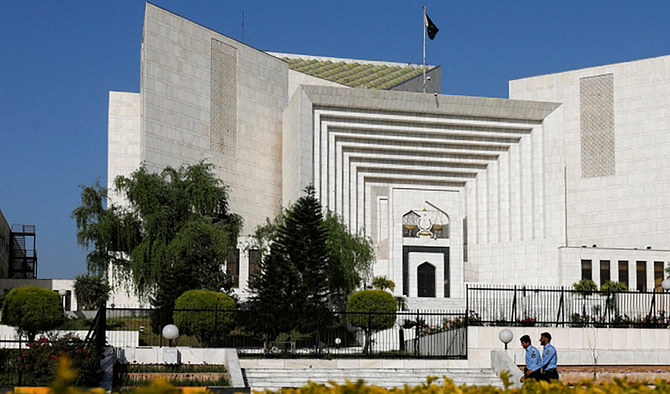
Police officers walk past the Supreme Court of Pakistan building, in Islamabad, Pakistan on April 6, 2022. (REUTERS/File)
Short Url
Updated 20 October 2022
Follow

Top court dismisses government request to stop ex-PM Khan’s anti-government march to Islamabad

  • The government said Khan’s party had flouted the court’s order in May which specified where to hold protest in the city
  • The court said the government could request the court to stop the crowd after people started gathering for the march

ISLAMABAD: Pakistan’s top court on Thursday dismissed the government’s request to stop former prime minister Imran Khan from launching his anti-government “long march” toward the federal capital to force the ruling coalition to announce fresh elections in the country.

Khan, who was ousted from power in a no-confidence vote in April, reiterated his demand for snap polls earlier this week while saying he would not delay his protest march to Islamabad beyond October.

The former prime minister’s Pakistan Tehreek-e-Insaf (PTI) party also brought its workers and followers to the federal capital in May while hoping to bring down the government. However, its top leaders told the party sympathizers to disperse after clashes with police.

The government recalled the previous march carried out by Khan’s party in a contempt petition filed in the Supreme Court, saying the PTI had flouted the court order which specified where the demonstration was going to be held in the city.



Pakistani former prime minister and leader of the opposition party Pakistan Tehreek-e-Insaf (PTI) Imran Khan (front 2R) waves to supporters during a protest rally against the inflation, political destabilisation and continued hikes in fuel prices, in Rawalpindi on July 2, 2022. (AFP/File)

It also demanded that Khan, who was threatening another protest demonstration in his public rallies, be stopped from creating a similar situation at a time when the government was trying to provide relief to flood-affected people in Pakistan.

“You are telling us [the PTI] has planned a march and a sit-in again,” said Chief Justice Umar Ata Bandial was quoted by Dawn newspaper as saying. “You can deal with the situation in accordance with the law. As of now, there are only speeches. You should take steps wherever there are threats in cities.”
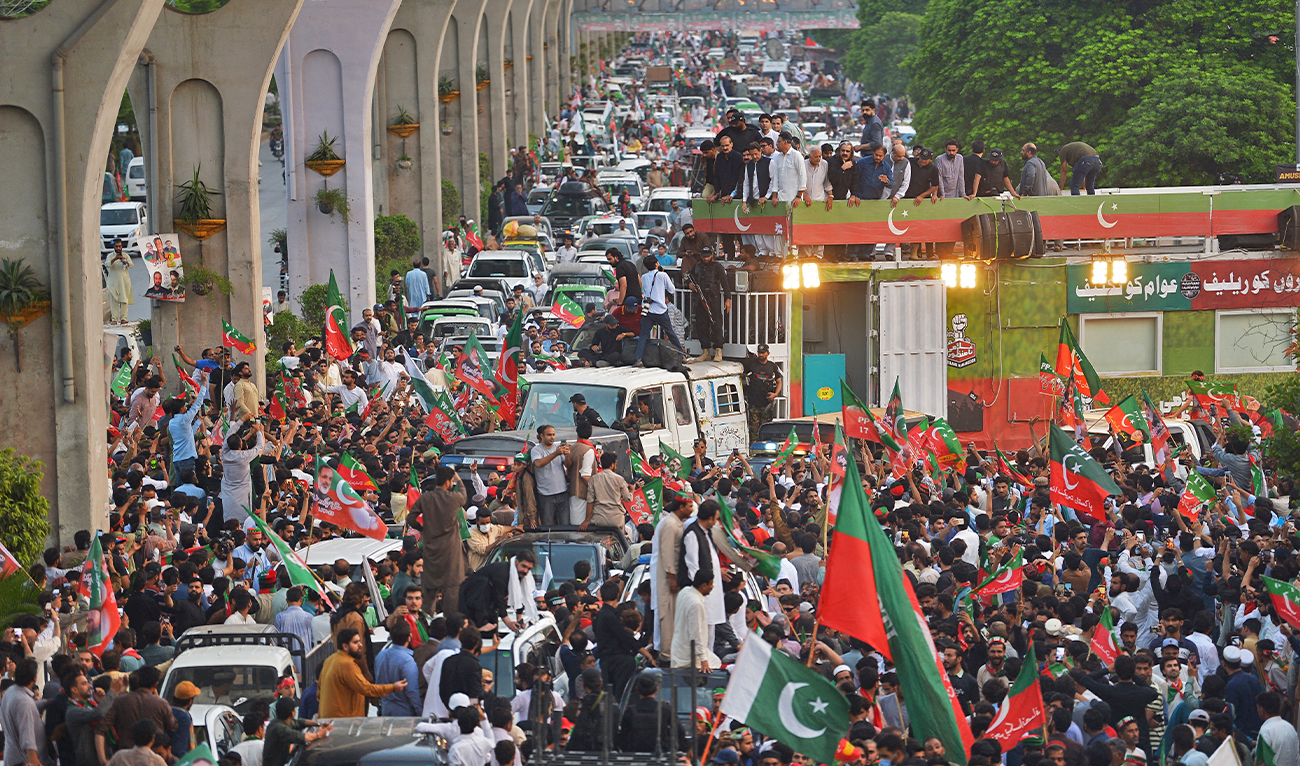


Supporters of the opposition party Pakistan Tehreek-e-Insaf (PTI) march during a protest rally against inflation, political destabilisation and continued hikes in fuel prices, in Rawalpindi on July 2, 2022. (AFP/File)

“You should request [the court] to stop the crowd when people gather,” he continued. “There is no crowd right now.”

Attorney General of Pakistan Ashtar Ausaf told the court during the hearing the PTI’s previous protest march had affected the citizens’ rights in and around Islamabad. He said this was despite the fact that the party had submitted an affidavit wherein it had promised not to create inconvenience for people.

“The court order [also] allocated a specific place but the sit-in was brought to D-Chowk, which resulted in material losses,” he continued. “The court should punish those who violated its orders.”

Later, the hearing was adjourned until October 26.


Pakistan’s Punjab deploys satellites, drones, AI to combat smog

Updated 59 min 15 sec ago
Follow

Pakistan’s Punjab deploys satellites, drones, AI to combat smog

  • Senior minister warns industrial masks may become necessary without a change in public attitudes toward pollution
  • Cities in Punjab face worsening smog each winter, driven by crop burning, vehicle emissions and industrial pollution

ISLAMABAD: Punjab Senior Minister Marriyum Aurangzeb on Wednesday said Pakistan’s most populous province deployed satellites, drones and artificial intelligence to tackle smog, warning that industrial masks may become necessary if public attitudes toward air pollution did not change.

Punjab cities face worsening smog each winter, driven by crop burning, vehicle emissions and industrial pollution that threatens public health and daily life. The smog season typically begins in late October, peaks between November and January and can persist through February.

Smog causes symptoms such as sore throats, eye irritation and respiratory illnesses, while prolonged exposure raises the risk of stroke, heart disease and lung cancer. Children are more vulnerable due to higher breathing rates and weaker immune systems.

“We have the AI machine-learning forecasting system in place, surveillance drones and technology cameras,” Aurangzeb said while addressing an event.

“At present, what is considered one of the world’s best environmental protection forces — with training, equipment, technology and digitally integrated data — is operating in Punjab,” she added.

Aurangzeb said surveillance is now being carried out through drones.

“There is monitoring, technology, cameras,” she continued. “Everything is digital.”

The minister maintained the eastern corridor from India was a major source of smoke which becomes active during the winter season.

She said this was the first time a complete testing system was introduced by the Environmental Protection Agency to measure pollution released by vehicles.

She added the government has loaned 5,000 super seeders to farmers, which are agricultural machines that plant crops directly into fields without removing leftover stubble, reducing crop burning, and helping curb winter smog.

Aurangzeb warned the situation could reach a point where people may have to use industrial masks and carry therm around like a “purse or wallet.”

“This will become a mandatory item if we do not change our attitudes and habits toward air quality, climate and conservation.”

Pakistan’s main urban centers routinely rank among the most polluted cities in the world, with vehicular emissions remaining one of the top contributors to air pollution.

The severe air pollution also undermines economic productivity and diminishes the quality of life for millions of residents.