

Iran accused of civilian deaths in Iraq strikes

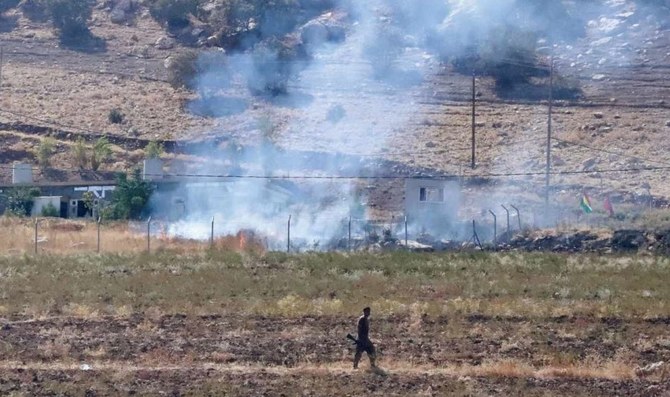
A Kurdish peshmerga fighter walks as smoke billows in the area of Zargwez, outside the Iraqi city of Sulaimaniyah, where several exiled Iranian Kurdish parties maintain offices, Sept. 28, 2022. (AFP)
Short Url
Updated 19 October 2022
Follow

Iran accused of civilian deaths in Iraq strikes

  • At least 16 people killed in strikes on residential areas: Human Rights Watch
  • Iranian attacks in Iraqi Kurdistan ‘part of a long history of lethal attacks on civilians, including during the war in Syria’

LONDON: Attacks by Iran’s Islamic Revolutionary Guard Corps on political organizations in Iraqi Kurdistan last month killed civilians, Human Rights Watch has said.

The strikes came amid mass protests across Iran that began on Sept. 16 following the death of a Kurdish woman, 22-year-old Mahsa Amini, after she was detained and beaten by the country’s morality police for “improperly” wearing a hijab.

Hundreds of people have subsequently been killed, injured and arrested by the authorities in the unrest.

The IRGC claimed responsibility for the attacks in Iraq — which killed at least 16 people — on what it called “terrorist bases” in late September, but HRW said residents claimed strikes were launched on areas with no military value or activity.

The first attack, on Sept. 24, saw the offices of the Kurdistan Democratic Party of Iran shelled in the Iraqi city of Erbil.

On Sept. 28, the offices of the KDPI and the Komala Party of Iranian Kurdistan were shelled in the Koya district of Erbil governorate which, HRW says, resulted in a school being hit, and attacked with drones and missiles in Sulaymaniyah governorate. 

One woman, identified as Reyhane Kanaani — who was 36 weeks pregnant at the time — was killed in Koya, and two children seriously injured, according to UNICEF. Doctors fought to save her and tried to save her baby, but were unable to do so.

Kanaani’s husband Zanyar Rahmani, who works at the KDPI offices that were attacked, told HRW: “Our home is 1.5 km away from the party headquarters. (We live) in a camp for refugees, mostly women and children live there. The area where my wife and I live is not a military place, it is residential for civilians.”

Fuad Khaki Baygi, a member of the KDPI, told HRW: “We are a political party, not a military group. (Iranian authorities) are trying to divert attention from the protests in Iran, so they’ve resorted to indiscriminate shelling in civilian-populated areas in the Kurdistan region of Iraq.”

A police officer stationed near the KDPI offices that were shelled in Koya told HRW: “We have never seen them doing any military activities in the headquarters because it’s located in a residential area. I am aware they have some military activities, but in the mountains, not in the cities.”

The attack in Sulaymaniyah hit a residential complex in Zargwezalla where the Komala Party’s offices were based.

Mohammed Hakemi, a Komala member, told HRW: “We don’t have any military activities. The residents of the complex are all refugees from Iran who escaped.”

Adam Coogle, HRW’s deputy Middle East director, said: “Iran’s Revolutionary Guards forces’ attacks on residential areas in the Kurdistan Region of Iraq is part of a long history of lethal attacks on civilians, including during the war in Syria.

“Countries seeking to hold Iran accountable for its brutal crackdown in recent days should also ensure that those responsible for indiscriminately killing civilians abroad are held accountable as well.”

This is far from the first case of the IRGC targeting organizations based in neighboring Iraq, having killed at least 14 people in a missile attack on Koya in September 2018.

The IRGC was also responsible for the downing of Ukraine International Airlines Flight 752 on Jan. 8, 2020, killing all 176 people on board, following a series of missiles launched at Iraqi territory after the assassination of IRGC chief Qassem Soleimani in Baghdad by a US drone.


Gaza’s Nasser Hospital condemns move by MSF to suspend most services

Updated 16 sec ago
Follow

Gaza’s Nasser Hospital condemns move by MSF to suspend most services

  • On Saturday, MSF said the security breaches, arrests and intimidation put staff and patients at serious risk
  • Nasser Hospital rejects the claims, and says civilian police are inside to protect patients and staff
CAIRO: One of Gaza’s last functioning large hospitals condemned the move by an international organization to pull out of operations over concerns about armed men, claiming on Sunday that the hospital had installed civil police for security. The move comes as at least 10 Palestinians were killed in clashes with the Israeli military in Gaza.
Doctors Without Borders, also known by its acronym MSF, said in a statement Saturday that all its noncritical medical operations at Nasser Hospital were suspended due to security breaches that posed “serious” threats to its teams and patients. MSF said there had been an increase in patients and staff seeing armed men in parts of the compound since the US-brokered October ceasefire was reached.
Nasser Hospital said Sunday that the increase in armed men was due to a civilian police presence aimed at protecting patients and staff and said MSF’s “allegations are factually incorrect, irresponsible, and pose a serious risk to a protected civilian medical facility.”
Nasser Hospital one of few functioning hospitals left in Gaza
Nasser Hospital in Khan Younis is one of the territory’s few functioning hospitals. Hundreds of patients and war-wounded have been treated there daily, and the facility was a hub for Palestinian prisoners released by Israel in exchange for Israeli hostages as part of the current ceasefire deal.
“MSF teams have reported a pattern of unacceptable acts including the presence of armed men, intimidation, arbitrary arrests of patients and a recent situation of suspicion of movement of weapons,” the organization said. The suspension occurred in January but was only recently announced.
Nasser Hospital staff say that in recent months it has been repeatedly attacked by masked, armed men and militias, which is why the presence of an armed civilian police force is crucial. Hamas remains the dominant force in areas not under Israeli control, including in the area where Nasser Hospital is located. But other armed groups have mushroomed across Gaza as a result of the war, including groups backed by Israel’s army in the Israeli-controlled part of the strip.
Throughout the war, which began with the Hamas-led attack on Israel on Oct. 7, 2023, Israel has repeatedly struck hospitals, including Nasser, accusing the militant group of operating in or around them. Hamas security men often have been seen inside hospitals, blocking access to some areas.
Some hostages released from Gaza have said they spent time during captivity in a hospital, including Nasser Hospital.
Ten Palestinians killed in strikes across Gaza
At least 10 Palestinians were killed Sunday by Israeli fire in the Gaza Strip, hospital authorities said.
The dead include five men, all in their 20s, who were killed in an Israeli strike in the eastern part of Khan Younis city, according to the Nasser Hospital, which received the bodies. The strike hit a group of people in an area close to the Yellow Line which separates Israeli-controlled areas from the rest of Gaza, it said.
The Israeli military did not comment on the strike but has said in the past it will attack militants if its troops are threatened, especially near the Yellow Line.
Rami Shaqra said his son, Al-Baraa, was among the militants who were securing the area from potential attacks by the Israeli forces or Israeli-backed armed groups, when they were hit by the Israeli military. He said that they were killed by an airstrike.
Associated Press footage from the morgue showed at least two of the men had headbands denoting membership in the Qassam Brigades, the militant arm of Hamas. In northern Gaza, a drone strike hit a group of people in the Falluja area of Jabaliya refugee camp, killing five people, according to the Shifa Hospital.
The Israeli military said it was striking northern Gaza in response to several ceasefire violations near the Yellow Line, including militants attempting to hide in debris and others who attempted to cross the line while armed.
The Oct. 10 US-brokered ceasefire deal attempted to halt a more than two-year war between Israel and Hamas. While the heaviest fighting has subsided, the ceasefire has seen almost daily Israeli fire.
Israeli forces have carried out repeated airstrikes and frequently fire on Palestinians near military-held zones, killing 601 Palestinians, according to Gaza health officials. The ministry, which is part of the Hamas-led government, maintains detailed casualty records that are seen as generally reliable by UN agencies and independent experts. But it does not give a breakdown of civilians and militants.
Militants have carried out shooting attacks on troops, and Israel says its strikes are in response to that and other violations. Four Israeli soldiers have been killed.