

World Bank estimates floods caused $40B in damages, Pakistan government says

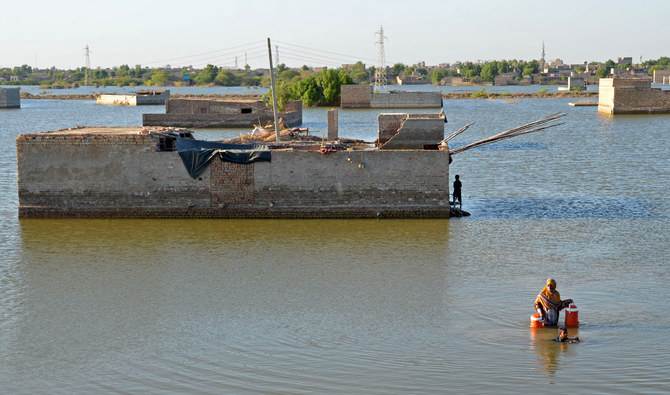
In this file photo taken on October 06, 2022 A flood-affected woman wades through the flood waters to fill drinking water at Dera Allah Yar in Jaffarabad district of Balochistan province. (AFP)
Short Url
Updated 19 October 2022
Follow

World Bank estimates floods caused $40B in damages, Pakistan government says

  • The figure is $10 billion more than an earlier estimate by the government
  • Final report on damages is yet to be finalized with the help of global aid agencies

ISLAMABAD: Pakistan said Wednesday that the World Bank estimates this summer’s record-breaking floods have caused $40 billion in damages in this impoverished South Asian nation.

The figure is $10 billion more than an earlier estimate by the Pakistani government.

Cash-strapped Pakistan was already facing a serious financial crisis before the heavy monsoon rains hit in mid-June. The rains triggered unprecedented floods that at one point left a third of the country’s territory submerged, forcing hundreds of thousands of people to move to safer places.

The new assessment came during a meeting in the capital, Islamabad, between Prime Minister Shahbaz Sharif and experts on climate change. There was no immediate word from the World Bank on the new estimate.

The flooding, which experts say is made worse by climate change, has killed 1,719 people and affected 33 million since mid-June. The waters have damaged or washed away 2 million homes.

Sharif’s government last month offered an estimate of $30 billion from the floods but cautioned that the real figure may be far higher. A final report on the damages is yet to be finalized with the help of international aid agencies and lending institutions, including the World Bank.

The United Nations has revised its appeal for aid for Pakistan five-fold, to $816 million, from the initial $160 million, saying recent assessments about the damages caused by floods pointed to the urgent need for long-term help, lasting into next year.

A government statement following Wednesday’s meeting between the premier and the newly formed Pakistan Climate Change Council quoted an often-repeated statement by Sharif that despite having less than 1 percent share in global carbon emissions, Pakistan is among 10 countries most affected by climate change.

Sharif also said that he hopes the UN climate conference in Egypt next month — for which the Pakistani prime minister was recently nominated as vice-chairman — will offer Pakistan “an opportunity to present its stance on the vulnerability of the developing world with regard to the effects of climate change.”

According to government officials, more than half of the flood victims in Pakistan’s worst-hit Sindh province have returned to their homes over the past three weeks after floodwaters receded there and elsewhere in the country, including Baluchistan, where the UN estimates that floods damaged 43 percent of crops.

The flood-related fatalities have included 345 women and 641 children. The UN says 7 million women and children require immediate access to food.

Pakistan wants the world community to scale up aid for flood survivors, now also threatened by waterborne diseases, malaria and dengue fever. Experts say people in flood-hit areas will face a harsh winter this year and that aid is urgently needed.


Islamic military coalition, Pakistan to deepen cooperation to combat ‘terrorism’ — Pakistani military

Updated 02 February 2026
Follow

Islamic military coalition, Pakistan to deepen cooperation to combat ‘terrorism’ — Pakistani military

  • Islamic Military Counter Terrorism Coalition is a 43-member alliance that includes Pakistan, Saudi Arabia, Egypt, Jordan, UAE and other nations
  • The Pakistani military statement comes after a meeting between IMCTC secretary-general and the chief of Pakistani defense forces in Rawalpindi

ISLAMABAD: Pakistan and the Islamic Military Counter Terrorism Coalition (IMCTC) have reaffirmed their commitment to deepening cooperation, including intelligence sharing and capacity building, to jointly combat “terrorism” and “extremism,” the Pakistani military said on Monday.

The IMCTC is a 43-member military alliance that was formed on Saudi Arabia’s initiative in Dec. 2015 to consolidate Muslim countries’ efforts in countering “terrorism.”

A 17-member IMCTC delegation is visiting Pakistan from Feb. 2-6 to conduct a training at National University of Sciences and Technology on “Re-integration and Rehabilitation of Extremist Elements,” according to the Pakistani military.

On Monday, IMCTC Secretary-General Maj. Gen. Mohammed bin Saeed Al-Moghedi held a meeting with Chief of Pakistani Defense Forces Field Marshal Asim Munir to discuss cooperation among IMCTC member states.

“During the meeting, matters of mutual interest were discussed, with particular emphasis on regional security dynamics and enhanced cooperation in counter-terrorism efforts,” the Inter-Services Public Relations (ISPR), the Pakistani military’s media wing, said in a statement.

“Both sides reaffirmed their shared commitment to combating terrorism and extremism through collaborative strategies, intelligence sharing, and capacity building among member states.”

The IMCTC features Pakistan, Saudi Arabia, Türkiye, Afghanistan, Egypt, Jordan, Qatar, Palestine, UAE, Bangladesh and other nations. In 2017, Pakistan’s former army chief Gen. (retd) Raheel Sharif was appointed as the IMCTC commander-in-chief.

During discussions with Major General Al-Moghedi, Field Marshal Munir appreciated the role of IMCTC in fostering stability and promoting coordinated counterterrorism initiatives across the Islamic world, according to the ISPR.

The IMCTC secretary-general acknowledged Pakistan’s significant contributions and sacrifices in the fight against militancy and lauded the professionalism of Pakistan’s armed forces.

“The meeting underscored the resolve of both sides to further strengthen institutional collaboration for peace, stability, and security in the region,” the ISPR added.

Pakistan enjoys cordial ties with most Muslim countries around the world, particularly Gulf Cooperation Council countries. In Sept. 2025, Pakistan signed a landmark defense pact with Saudi Arabia according to which an act of aggression against one country will be treated as an act of aggression against both.